PUBLISHER: Mordor Intelligence | PRODUCT CODE: 2187285

PUBLISHER: Mordor Intelligence | PRODUCT CODE: 2187285
Philippines Foodservice - Market Share Analysis, Industry Trends & Statistics, Growth Forecasts (2027 - 2032)
According to Mordor Intelligence, the Philippines foodservice market size is projected to expand from USD 21.04 billion in 2026 and USD 24.04 billion in 2027 to USD 46.04 billion by 2032, registering a CAGR of 13.88% between 2027 and 2032.
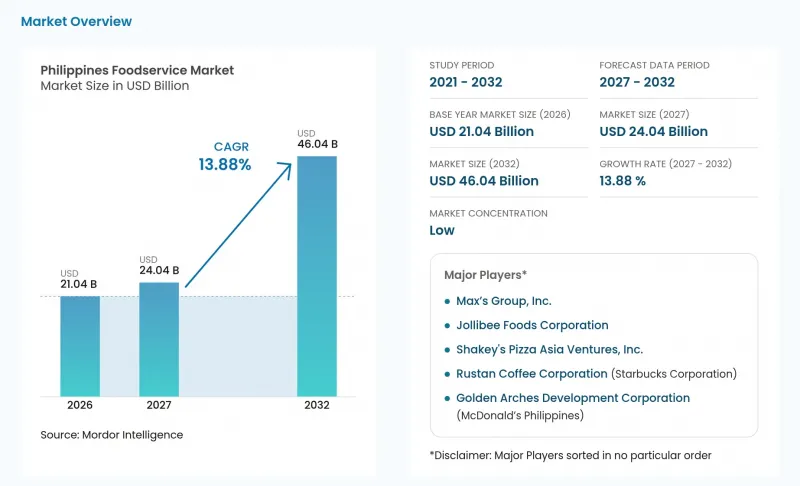
This report is segmented by Foodservice Type (Quick Service Restaurants, Full Service Restaurants, Cafes & Bars, and Cloud Kitchen), Outlet (Independent Outlets and Chained Outlets), Location (Standalone, Retail, Leisure, Lodging, and Travel), and Service Type (Dine-in, Takeaway, and Delivery). The market forecasts are provided in terms of value (USD), based on availability.
Philippines Foodservice Market Trends and Insights
Expansion of cloud and virtual kitchens in major cities
Cloud kitchens can expand foodservice access by separating the place where a meal is prepared from the place where it is consumed. For an operator serving off-premise orders, growth need not require an equivalent addition of dining seats or table service. The relevant commercial capacity is therefore the number of orders a kitchen can prepare and hand over reliably, rather than its seating inventory. This makes the format suited to testing a delivery catchment before committing to a customer-facing dining room. A virtual brand adds a route to demand only if its kitchen can fulfill orders across the intended delivery catchment, linking format expansion to dispatch capacity.
Experiential, social-media-friendly dine-in formats
Experiential dining can generate a restaurant occasion around a shared activity, giving customers another reason to consume food and drinks on site. Dave & Buster's opened its first Philippine location at Opus Mall in Manila in October 2025, combining dining, drinks, arcade games, and sports viewing in partnership with The Bistro Group. Bringing these activities together makes the venue itself part of the proposition, rather than relying entirely on the food order. For operators, that creates an opportunity to attract group occasions that a delivered meal cannot reproduce in full. Repeat visits hinge on the appeal of the games and sports viewing, putting the attraction's renewal needs alongside menu development in the operator's investment choices.
Perishable supply chain gaps and cold-chain limitations
Perishable supply gaps constrain restaurant expansion when a dependable menu requires ingredients that cannot be held safely between harvest and service. In March 2026, the Department of Agriculture said Bicol farmers faced high transport costs and fragmented supply chains, with inadequate cold storage forcing quick low-price sales or exposing harvests to loss. This upstream pressure makes a low farm price an unreliable indicator of economical, consistent restaurant supply. Operators dependent on those perishables face a tradeoff between menu breadth and exposure to interrupted replenishment. The department's ceremonial switching-on of its first completed Cold Storage Expansion Program project in Pili, Camarines Sur, on March 23, 2026, addressed holding capacity. Fragmented distribution and high transport costs can make dependable deliveries costly even where ingredients can be stored safely.
Other drivers and restraints analyzed in the detailed report include:
- Strong cafe culture and modern tea concepts boosting dayparts
- Omnichannel formats and curbside/pick-up infrastructure
- Food safety, traceability, and sustainability compliance overhead
For complete list of drivers and restraints, kindly check the Table Of Contents.
Segment Analysis
Quick service restaurants accounted for a 57.04% share of the Philippines foodservice market size in 2026. Jollibee Foods Corporation had 1,341 Jollibee-brand stores in the Philippines at year-end 2025, including franchised and company-owned outlets. That installed base illustrates the largest segment's ability to make a recognizable meal proposition available through an extensive network, while each outlet provides another point of access to the same brand. For an established national network, an added outlet's value rests on reaching another catchment rather than merely increasing the number of places carrying the brand.
Cloud kitchens are forecast to be the fastest-growing segment, registering a CAGR of 24.2% between 2027 and 2032. Fruitas Holdings Inc.'s wholly owned Fly Kitchen Inc. operated a cloud kitchen serving the group's entire product portfolio in 2025. Serving a portfolio makes the kitchen a common fulfillment point for different products, so its commercial role can develop across several food propositions instead of depending on a single dining concept. Because one kitchen serves the whole portfolio, the group can add reach by loading more products onto shared capacity, and the limit is how many orders that kitchen can fulfill reliably.
Independent outlets represented a 74.24% Philippines foodservice market share in 2026. On December 5, 2025, Elizabeth Mortera, owner of Quezon City's Morning Sun Eatery, reported doubled daily sales after its late-October Michelin Bib Gourmand recognition, having earlier credited the recognition and customers. This example within the largest segment shows how an individual restaurant's identity and outside recognition can provide a route to customer attention without a large branded network. The result belongs to a single carinderia, yet it shows that an independent outlet can draw destination demand from one guide recognition rather than from a chain's repeated storefronts.
Chained outlets are forecast to be the fastest-growing segment, with a CAGR of 14.6% between 2027 and 2032. Figaro Culinary Group, Inc. reported 171 Angel's Pizza stores in the Philippines in October 2026, within the network operated or franchised through Figaro Coffee Systems. A chain of that scale can organize its offer around a repeatable format, giving additional sites an established operating identity while preserving different ownership arrangements. Keeping the same restaurant identity across operated and franchised sites is the chain's scaling task, so the ownership boundary should not become a different customer proposition.
Complete Report Scope:
- By Foodservice Type
- Cafes & Bars
- By Cuisine
- Bars & Pubs
- Cafes
- Juice/Smoothie/Desserts Bars
- Specialist Coffee & Tea Shops
- By Cuisine
- Cloud Kitchen
- Full Service Restaurants
- By Cuisine
- Asian
- European
- Latin American
- Middle Eastern
- North American
- Other FSR Cuisines
- By Cuisine
- Quick Service Restaurants
- By Cuisine
- Bakeries
- Burger
- Ice Cream
- Meat-based Cuisines
- Pizza
- Other QSR Cuisines
- By Cuisine
- Cafes & Bars
- By Outlet
- Chained Outlets
- Independent Outlets
- By Location
- Leisure
- Lodging
- Retail
- Standalone
- Travel
- By Service Type
- Dine-in
- Takeaway
- Delivery
List of Companies Covered in this Report:
- Berjaya Corporation Bhd.
- Bounty Agro Ventures, Inc.
- Three Bears Group (Domino's Pizza)
- Golden Arches Development Corporation (McDonald's Philippines)
- Inspire Brands, Inc.
- Jollibee Foods Corporation
- Mary Grace Foods Inc.
- Max's Group, Inc.
- Restaurant Brands International Inc.
- Seven & I Holdings Co., Ltd.
- Shakey's Pizza Asia Ventures, Inc.
- Rustan Coffee Corporation (Starbucks Corporation)
- Figaro Culinary Group, Inc.
- Eight-8-Ate Holdings, Inc.
- Yum! Brands, Inc.
- Fruitas Holdings Inc.
- Philippine Pizza, Inc.
- One Food Group
- Red Ribbon Bakeshop Inc.
- ArmyNavy Burger Inc.
Additional Benefits:
- The market estimate (ME) sheet in Excel format
- 3 months of analyst support
TABLE OF CONTENTS
1 INTRODUCTION
- 1.1 Study Assumptions and Market Definition
- 1.2 Scope of the Study
2 RESEARCH METHODOLOGY
3 EXECUTIVE SUMMARY
4 MARKET LANDSCAPE
- 4.1 Market Overview
- 4.2 Market Drivers
- 4.2.1 Expansion of cloud and virtual kitchens in major cities
- 4.2.2 Experiential, social-media-friendly dine-in formats
- 4.2.3 Strong cafe culture and modern tea concepts boosting dayparts
- 4.2.4 Omnichannel formats and curbside/pick-up infrastructure
- 4.2.5 Sustainability focus: food-waste reduction and responsible sourcing
- 4.2.6 Personalization and build-your-own formats driving loyalty
- 4.3 Market Restraints
- 4.3.1 Perishable supply chain gaps and cold-chain limitations
- 4.3.2 Food safety, traceability, and sustainability compliance overhead
- 4.3.3 Consumer pushback on ultra-processed items
- 4.3.4 Labor shortages and high staff turnover
- 4.4 Industry Value Chain Analysis
- 4.5 Regulatory Landscape
- 4.6 Technological Outlook
- 4.7 Porter's Five Forces Analysis
- 4.7.1 Threat of New Entrants
- 4.7.2 Bargaining Power of Suppliers
- 4.7.3 Bargaining Power of Buyers
- 4.7.4 Threat of Substitutes
- 4.7.5 Competitive Rivalry
- 4.8 Key Industry Trends
- 4.8.1 Number of Outlets
- 4.8.2 Average Order Value
- 4.8.3 Menu Analysis
5 MARKET SIZE AND GROWTH FORECASTS (VALUE)
- 5.1 By Foodservice Type
- 5.1.1 Cafes & Bars
- 5.1.1.1 By Cuisine
- 5.1.1.1.1 Bars & Pubs
- 5.1.1.1.2 Cafes
- 5.1.1.1.3 Juice/Smoothie/Desserts Bars
- 5.1.1.1.4 Specialist Coffee & Tea Shops
- 5.1.1.1 By Cuisine
- 5.1.2 Cloud Kitchen
- 5.1.3 Full Service Restaurants
- 5.1.3.1 By Cuisine
- 5.1.3.1.1 Asian
- 5.1.3.1.2 European
- 5.1.3.1.3 Latin American
- 5.1.3.1.4 Middle Eastern
- 5.1.3.1.5 North American
- 5.1.3.1.6 Other FSR Cuisines
- 5.1.3.1 By Cuisine
- 5.1.4 Quick Service Restaurants
- 5.1.4.1 By Cuisine
- 5.1.4.1.1 Bakeries
- 5.1.4.1.2 Burger
- 5.1.4.1.3 Ice Cream
- 5.1.4.1.4 Meat-based Cuisines
- 5.1.4.1.5 Pizza
- 5.1.4.1.6 Other QSR Cuisines
- 5.1.4.1 By Cuisine
- 5.1.1 Cafes & Bars
- 5.2 By Outlet
- 5.2.1 Chained Outlets
- 5.2.2 Independent Outlets
- 5.3 By Location
- 5.3.1 Leisure
- 5.3.2 Lodging
- 5.3.3 Retail
- 5.3.4 Standalone
- 5.3.5 Travel
- 5.4 By Service Type
- 5.4.1 Dine-in
- 5.4.2 Takeaway
- 5.4.3 Delivery
6 COMPETITIVE LANDSCAPE
- 6.1 Market Concentration
- 6.2 Strategic Moves
- 6.3 Market Share Analysis
- 6.4 Company Profiles (includes Global level Overview, Market level overview, Core Segments, Financials as available, Strategic Information, Market Rank/Share for key companies, Products and Services, and Recent Developments)
- 6.4.1 Berjaya Corporation Bhd.
- 6.4.2 Bounty Agro Ventures, Inc.
- 6.4.3 Three Bears Group (Domino's Pizza)
- 6.4.4 Golden Arches Development Corporation (McDonald's Philippines)
- 6.4.5 Inspire Brands, Inc.
- 6.4.6 Jollibee Foods Corporation
- 6.4.7 Mary Grace Foods Inc.
- 6.4.8 Max's Group, Inc.
- 6.4.9 Restaurant Brands International Inc.
- 6.4.10 Seven & I Holdings Co., Ltd.
- 6.4.11 Shakey's Pizza Asia Ventures, Inc.
- 6.4.12 Rustan Coffee Corporation (Starbucks Corporation)
- 6.4.13 Figaro Culinary Group, Inc.
- 6.4.14 Eight-8-Ate Holdings, Inc.
- 6.4.15 Yum! Brands, Inc.
- 6.4.16 Fruitas Holdings Inc.
- 6.4.17 Philippine Pizza, Inc.
- 6.4.18 One Food Group
- 6.4.19 Red Ribbon Bakeshop Inc.
- 6.4.20 ArmyNavy Burger Inc.
7 MARKET OPPORTUNITIES AND FUTURE OUTLOOK
- 7.1 White-Space and Unmet-Need Assessment

