PUBLISHER: Mordor Intelligence | PRODUCT CODE: 2187291

PUBLISHER: Mordor Intelligence | PRODUCT CODE: 2187291
Japan Foodservice - Market Share Analysis, Industry Trends & Statistics, Growth Forecasts (2027 - 2032)
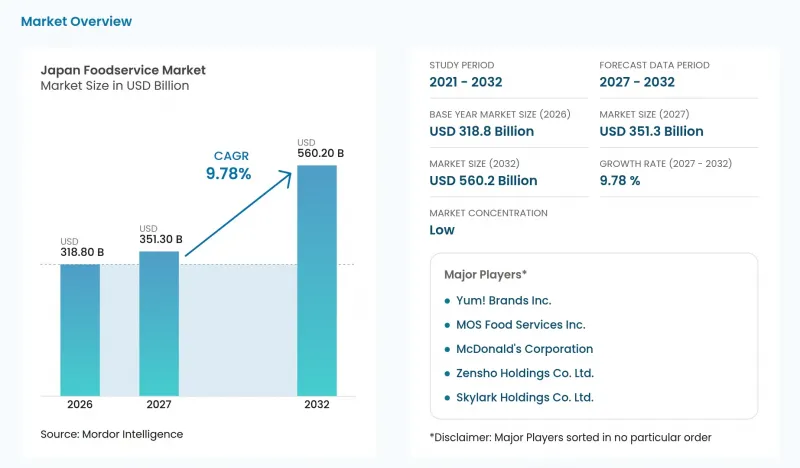
According to Mordor Intelligence, the Japan foodservice market size is expected to increase from USD 318.8 billion in 2026 to USD 351.3 billion in 2027 and reach USD 560.2 billion by 2032, growing at a CAGR of 9.78% over 2027-2032.
This report is segmented by Foodservice Type (Quick Service Restaurants, Full Service Restaurants, and more), Outlet (Independent Outlets and Chained Outlets), Locations (Standalone, Retail, and more), and Service Type (Dine-in, Takeaway, and more). The market forecasts are provided in terms of value (USD), based on availability.
Japan Foodservice Market Trends and Insights
Busy modern life fuels demand for quick convenience
Reducing wait-related friction gives restaurants a way to compete for takeout occasions through the ordering experience. Japan Foodservice Association member companies' fast-food customer count rose 3% in 2025 from 2024 in its all-store survey, including new stores. Recruit's July-August 2026 survey covered adults aged 20-69 in the Tokyo metropolitan, Kansai, and Tokai regions. Among women in their 20s in that survey, 41.9% cited reduced waiting-time stress as a reason to use mobile ordering for restaurant takeout. Alongside the observed increase in member-company customer visits, this preference identifies the ordering experience as a specific attribute operators can address. Convenience can therefore come from a smoother path to an existing meal rather than a more elaborate food offer.
Global tourism boosts authentic dining experiences
Japanese cuisine can make the meal itself part of a visitor's reason to travel, strengthening the case for distinctive restaurant experiences. In 2025, eating Japanese food ranked first among inbound visitors' travel expectations. Second preliminary estimates put eating-and-drinking spending at 21.7% of inbound visitors' travel expenditure in April-June 2026, compared with 21.0% in April-June 2025. This combination links a stated culinary objective with a larger allocation of the travel budget to food and drink. For restaurant operators, recognizable Japanese dishes can connect the visitor's trip objective with a specific dining occasion. Earning a place in the itinerary gives cuisine-focused restaurants a reason to compete on experience alongside convenience.
Increased competition from independent vendors and street-food sellers
Independent vendors and street-food sellers can restrain spending growth when they provide a substitute for a higher-service restaurant meal. If a customer can satisfy the same meal occasion through a simpler service format, the established restaurant faces a ceiling on the premium it can charge. That pressure is especially relevant when a restaurant's offer depends on an attended dining experience rather than the food alone. The operator then has to make the additional service worth paying for instead of assuming that a familiar menu protects its price. The pressure therefore falls first on full service restaurants, whose price rests on attended service that a simpler vendor does not supply.
Other drivers and restraints analyzed in the detailed report include:
- Consumers demand healthier, sustainable, local menus
- Digital apps and in-store robots drive efficiency
- Inconsistencies in food safety measures and adherence to hygiene standards
For complete list of drivers and restraints, kindly check the Table Of Contents.
Segment Analysis
Quick service restaurants accounted for a 46.49% share of the Japan foodservice market size in 2026. McDonald's Company (Japan), Ltd. reported 3,025 Japanese hamburger restaurants at December 2025, including 705 company-operated and 2,320 franchised restaurants. That example places a focused hamburger format across thousands of outlets, illustrating the operating scale available within the largest segment. The installed base lets quick service repeat an established menu across local catchments, so restaurant availability is part of its commercial strength.
Cloud kitchens are the fastest-growing segment, projected to register an 11.5% CAGR during 2027-2032. Wiaas reported that its multi-brand DELISTATION delivery-only ghost-restaurant business had served a cumulative 2.5 million meals from launch through February 2025. On July 16, 2026, Lawson announced expansion of its convenience-store ghost-restaurant service into 4 prefectures, bringing the announced footprint to about 1,600 stores across 45 prefectures. These models connect delivery-focused restaurant brands with preparation capacity, including kitchens inside existing convenience stores. Expansion here means adding delivery brands to existing kitchen capacity rather than building dining seats.
Independent outlets represented a 74.4% Japan foodservice market share in 2026. Chef Junpei Mukai independently opened Ristorante YOLHA in Shinjuku, Tokyo, on April 9, 2026. Mukai had worked as a chef at Cassolo, a restaurant operated by Chef's value, a Creek & River subsidiary, before opening YOLHA as an independent. For this independent opening, commercial reach centers on establishing YOLHA's identity at its Shinjuku site, making the individual restaurant rather than a wider branded network the unit of expansion.
Chained outlets are the fastest-growing segment, with a projected CAGR of 10.7% during 2027-2032. Curry House CoCo Ichibanya had 1,205 Japanese outlets at February 2026, comprising 118 directly operated and 1,087 franchise outlets. That operating mix makes franchise participation central to how this chain reaches domestic diners. Brand expansion can draw on local franchise operation as well as a directly operated estate, giving the group more than one route to restaurant coverage. The strategic priority becomes supporting a coherent offer across separately operated locations, because the brand's footprint extends well beyond the restaurants it directly runs.
Complete Report Scope:
- By Foodservice Type
- Cafe and Bars
- By Cuisine
- Bars & Pubs
- Cafe
- Juice/Smoothie/Desserts Bars
- Specialist Coffee & Tea Shops
- By Cuisine
- Cloud Kitchen
- Full Service Restaurants
- By Cuisine
- Asian
- European
- Latin American
- Middle Eastern
- North American
- Other FSR Cuisines
- By Cuisine
- Quick Service Restaurants
- By Cuisine
- Bakeries
- Burger
- Ice Cream
- Meat-based Cuisines
- Pizza
- Other QSR Cuisines
- By Cuisine
- Cafe and Bars
- By Outlet
- Chained Outlets
- Independent Outlets
- By Locations
- Leisure
- Lodging
- Retail
- Standalone
- Travel
- By Service Type
- Dine-in
- Takeaway
- Delivery
List of Companies Covered in this Report:
- CKE Restaurants Holdings, Inc.
- Zensho Holdings Co. Ltd.
- Skylark Holdings Co. Ltd.
- Food & Life Companies Ltd.
- Colowide Co. Ltd.
- Toridoll Holdings Corp.
- Starbucks Corporation
- MOS Food Services Inc.
- Komeda Holdings Co. Ltd.
- Kura Sushi Inc.
- Plenus Co. Ltd.
- Domino's Pizza Enterprises Ltd.
- Yoshinoya Holdings Co. Ltd.
- Yum! Brands Inc.
- Saizeriya Co. Ltd.
- Hotland Holdings Co. Ltd.
- Ringer Hut Co. Ltd.
- McDonald's Corporation
- Papa John's International, Inc.
- Wendy's International, LLC
Additional Benefits:
- The market estimate (ME) sheet in Excel format
- 3 months of analyst support
TABLE OF CONTENTS
1 INTRODUCTION
- 1.1 Study Assumptions and Market Definition
- 1.2 Scope of the Study
2 RESEARCH METHODOLOGY
3 EXECUTIVE SUMMARY
4 MARKET LANDSCAPE
- 4.1 Market Overview
- 4.2 Market Drivers
- 4.2.1 Busy modern life fuels demand for quick convenience
- 4.2.2 Global tourism boosts authentic dining experiences
- 4.2.3 Consumers demand healthier, sustainable, local menus
- 4.2.4 Digital apps and in-store robots drive efficiency
- 4.2.5 Growing interest in diverse international cuisines
- 4.2.6 High-quality pre-prepared meals gain acceptance
- 4.3 Market Restraints
- 4.3.1 Increased competition from independent vendors and street-food sellers
- 4.3.2 Inconsistencies in food safety measures and adherence to hygiene standards
- 4.3.3 Severe labor shortages strain service capacity
- 4.3.4 Reliance on imports creates supply chain fragility
- 4.4 Industry Value Chain Analysis
- 4.5 Regulatory Landscape
- 4.6 Technological Outlook
- 4.7 Porter's Five Forces Analysis
- 4.7.1 Threat of New Entrants
- 4.7.2 Bargaining Power of Suppliers
- 4.7.3 Bargaining Power of Buyers
- 4.7.4 Threat of Substitutes
- 4.7.5 Competitive Rivalry
- 4.8 KEY INDUSTRY TRENDS
- 4.8.1 Number of Outlets
- 4.8.2 Average Order Value
5 MARKET SIZE AND GROWTH FORECASTS (VALUE)
- 5.1 By Foodservice Type
- 5.1.1 Cafe and Bars
- 5.1.1.1 By Cuisine
- 5.1.1.1.1 Bars & Pubs
- 5.1.1.1.2 Cafe
- 5.1.1.1.3 Juice/Smoothie/Desserts Bars
- 5.1.1.1.4 Specialist Coffee & Tea Shops
- 5.1.1.1 By Cuisine
- 5.1.2 Cloud Kitchen
- 5.1.3 Full Service Restaurants
- 5.1.3.1 By Cuisine
- 5.1.3.1.1 Asian
- 5.1.3.1.2 European
- 5.1.3.1.3 Latin American
- 5.1.3.1.4 Middle Eastern
- 5.1.3.1.5 North American
- 5.1.3.1.6 Other FSR Cuisines
- 5.1.3.1 By Cuisine
- 5.1.4 Quick Service Restaurants
- 5.1.4.1 By Cuisine
- 5.1.4.1.1 Bakeries
- 5.1.4.1.2 Burger
- 5.1.4.1.3 Ice Cream
- 5.1.4.1.4 Meat-based Cuisines
- 5.1.4.1.5 Pizza
- 5.1.4.1.6 Other QSR Cuisines
- 5.1.4.1 By Cuisine
- 5.1.1 Cafe and Bars
- 5.2 By Outlet
- 5.2.1 Chained Outlets
- 5.2.2 Independent Outlets
- 5.3 By Locations
- 5.3.1 Leisure
- 5.3.2 Lodging
- 5.3.3 Retail
- 5.3.4 Standalone
- 5.3.5 Travel
- 5.4 By Service Type
- 5.4.1 Dine-in
- 5.4.2 Takeaway
- 5.4.3 Delivery
6 COMPETITIVE LANDSCAPE
- 6.1 Market Concentration
- 6.2 Strategic Moves
- 6.3 Market Share Analysis
- 6.4 Company Profiles (includes Global level Overview, Market level overview, Core Segments, Financials as available, Strategic Information, Market Rank/Share for key companies, Products and Services, and Recent Developments)
- 6.4.1 CKE Restaurants Holdings, Inc.
- 6.4.2 Zensho Holdings Co. Ltd.
- 6.4.3 Skylark Holdings Co. Ltd.
- 6.4.4 Food & Life Companies Ltd.
- 6.4.5 Colowide Co. Ltd.
- 6.4.6 Toridoll Holdings Corp.
- 6.4.7 Starbucks Corporation
- 6.4.8 MOS Food Services Inc.
- 6.4.9 Komeda Holdings Co. Ltd.
- 6.4.10 Kura Sushi Inc.
- 6.4.11 Plenus Co. Ltd.
- 6.4.12 Domino's Pizza Enterprises Ltd.
- 6.4.13 Yoshinoya Holdings Co. Ltd.
- 6.4.14 Yum! Brands Inc.
- 6.4.15 Saizeriya Co. Ltd.
- 6.4.16 Hotland Holdings Co. Ltd.
- 6.4.17 Ringer Hut Co. Ltd.
- 6.4.18 McDonald's Corporation
- 6.4.19 Papa John's International, Inc.
- 6.4.20 Wendy's International, LLC
7 MARKET OPPORTUNITIES AND FUTURE OUTLOOK
- 7.1 White-Space and Unmet-Need Assessment

