PUBLISHER: Mordor Intelligence | PRODUCT CODE: 2187751

PUBLISHER: Mordor Intelligence | PRODUCT CODE: 2187751
Malaysia Foodservice - Market Share Analysis, Industry Trends & Statistics, Growth Forecasts (2027 - 2032)
According to Mordor Intelligence, the Malaysia foodservice market size is projected to expand from USD 16.67 billion in 2026 and USD 18.85 billion in 2027 to USD 34.24 billion by 2032, registering a CAGR of 12.68% between 2027 and 2032.
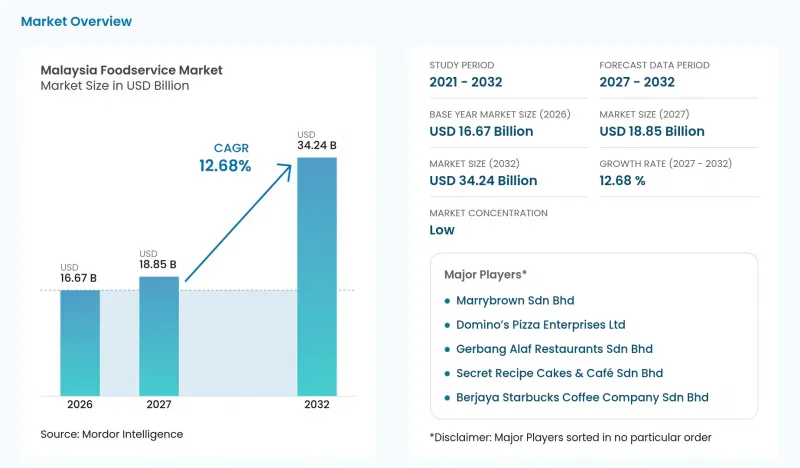
This report is segmented by Foodservice Type (Full Service Restaurants, Cafe and Bars, and more), Outlet (Independent Outlets and Chained Outlets), Locations (Standalone, Retail, and more), and Service Type (Dine-in, Takeaway, and more). The market forecasts are provided in terms of value (USD), based on availability.
Malaysia Foodservice Market Trends and Insights
Expansion and modernization of urban infrastructure
On July 21, 2026, Transport Minister Anthony Loke reported that the Seremban Sentral station project was about 35% complete. The project was expected to integrate the existing KTM Seremban station with a modern terminal and commercial spaces by March 2027, providing capacity for around 30,000 passengers daily upon completion. For foodservice operators, combining passenger access with commercial premises can create opportunities to serve meals within a transport journey. Integration with an existing rail station anchors this opportunity to established transport infrastructure rather than requiring a wholly new destination. With completion targeted for March 2027, the near-term opportunity concerns foodservice site planning, while meal sales depend on the terminal becoming operational.
Rapid digitization and mobile app adoption for ordering
Mobile ordering can bring local prepared-food sellers into a wider commercial network without requiring them to build their own ordering platform. In September 2025, Grab Malaysia and the Federal Agricultural Marketing Authority (FAMA) extended their partnership to a new Putrajaya market, with food and beverage merchants available on GrabFood. By that announcement, the partnership had digitalized nearly 300 merchants across more than 30 markets since 2023, including fresh-produce businesses. For small food businesses, the relevant demand opportunity is access beyond customers who physically visit their trading location, while the platform supplies the ordering channel. Each food and beverage merchant added to GrabFood gives customers another prepared-meal option to order without visiting the market, so the channel's reach grows with the number of onboarded vendors that sell prepared food.
Supply chain fragility and ingredient sourcing challenges
Ingredient availability can limit menu breadth even when a foodservice outlet has the capacity to serve more customers. In June 2026, Ground FLAW cafe in Kuala Lumpur reported temporarily pausing its miso-soup side dish after its usual paste had been unavailable for several months. The cafe had been unable to find another brand with the same taste profile. Separately, the Department of Statistics Malaysia (DOSM) reported that extreme weather and monsoon-driven flooding caused vegetable shortages and price increases in several Malaysian states toward the end of 2025. Kuala Lumpur cafe KLCG switched the pasta used in one dish after local suppliers could no longer provide it, according to the June 2026 report. Ground FLAW's lack of a taste-compatible substitute therefore turned a missing input into a product withdrawal, leaving restoration of that menu item dependent on supply recovery or an acceptable replacement.
Other drivers and restraints analyzed in the detailed report include:
- Rise of cloud kitchens and virtual-only brands
- Increasing consumer preference for convenience and ready-to-eat food
- Pressure from multinational and domestic chains on smaller operators
For complete list of drivers and restraints, kindly check the Table Of Contents.
Segment Analysis
Full-service restaurants accounted for a 33.84% share of the Malaysia foodservice market size in 2026. Berjaya Roasters (M) Sdn Bhd, Berjaya Food's wholly owned subsidiary and Kenny Rogers Roasters master franchisee, operated 48 Malaysian restaurants, including sub-franchisee outlets, as of June 30, 2025. Berjaya Food subsequently reported lower Malaysian Kenny Rogers Roasters revenue for the quarter ended June 30, 2026, following rationalization and closure of non-performing stores. Substantial capacity and selective closures can therefore coexist within the largest segment, making the productivity of individual full-service restaurants central to how operators allocate their footprint.
Cloud kitchens are the fastest-growing segment, with a projected CAGR of 15.4% between 2027 and 2032. By mid-2026, Hakshan operated 13 kitchens across the Klang Valley and Ipoh, comprising 10 outlets and 3 cloud kitchens. The combination illustrates how a foodservice operator can maintain customer-facing premises while using production-only locations to extend its meal offer. With 3 of its 13 kitchens operating as cloud kitchens, Hakshan had most of its kitchen locations in customer-facing outlets, showing how production-only sites can supplement an outlet network rather than require its replacement.
Independent outlets represented a 73.49% Malaysia foodservice market share in 2026. A worker at a Kuantan coffee roastery supplying local businesses, cited by The Straits Times, estimated that Kuala Lumpur had nearly 800 independent cafes in June 2026. This city-level cafe base illustrates how independent foodservice can comprise many individual propositions within a single urban setting. Single-outlet differentiation therefore has commercial importance within such an urban base, allowing a business in the largest segment to compete through a recognizable menu and a clearly defined local dining occasion.
Chained outlets are the fastest-growing segment, with a projected CAGR of 12.8% between 2027 and 2032. Envictus reported that Texas Chicken's Malaysian store count grew from 101 to 107 during FY2026 through June 30, 2026. For the quarter ended June 30, 2026, Envictus also described a competitive environment for Texas Chicken as consumers remained selective in their spending. The resulting commercial task is to expand access while winning choices from selective consumers, making the relevance of the meal offer at each additional store central to converting new capacity into spending.
Complete Report Scope:
- By Foodservice Type
- Cafe and Bars
- By Cuisine
- Bars & Pubs
- Cafe
- Juice/Smoothie/Desserts Bars
- Specialist Coffee and Tea Shops
- By Cuisine
- Cloud Kitchen
- Full Service Restaurants
- By Cuisine
- Asian
- European
- Latin American
- Middle Eastern
- North American
- Other FSR Cuisines
- By Cuisine
- Quick Service Restaurants
- By Cuisine
- Bakeries
- Burger
- Ice Cream
- Meat-based Cuisines
- Pizza
- Other QSR Cuisines
- By Cuisine
- Cafe and Bars
- By Outlet
- Chained Outlets
- Independent Outlets
- By Locations
- Leisure
- Lodging
- Retail
- Standalone
- Travel
- By Service Type
- Dine-in
- Takeaway
- Delivery
List of Companies Covered in this Report:
- Gerbang Alaf Restaurants Sdn Bhd
- Berjaya Starbucks Coffee Company Sdn Bhd
- Domino's Pizza Enterprises Ltd
- Marrybrown Sdn Bhd
- Secret Recipe Cakes & Cafe Sdn Bhd
- A&W (Malaysia) Sdn Bhd
- Revenue Valley Sdn Bhd
- Nando's Chickenland Malaysia Sdn Bhd
- OldTown Bhd
- San Francisco Coffee Sdn Bhd
- Texchem Resources Bhd
- Craveat International Sdn Bhd
- Loob Holding Sdn Bhd (Tealive)
- KyoChon Sdn Bhd
- Big Apple Donuts & Coffee
- Sushi King Sdn Bhd
- The Chicken Rice Shop Sdn Bhd
- Papparich Group International Sdn Bhd
- Kenny Rogers Roasters
- Baskin Robbins Malaysia Sdn Bhd
Additional Benefits:
- The market estimate (ME) sheet in Excel format
- 3 months of analyst support
TABLE OF CONTENTS
1 INTRODUCTION
- 1.1 Study Assumptions and Market Definition
- 1.2 Scope of the Study
2 RESEARCH METHODOLOGY
3 EXECUTIVE SUMMARY
4 MARKET LANDSCAPE
- 4.1 Market Overview
- 4.2 Market Drivers
- 4.2.1 Expansion and modernization of urban infrastructure
- 4.2.2 Rapid digitization and mobile app adoption for ordering
- 4.2.3 Rise of cloud kitchens and virtual-only brands
- 4.2.4 Increasing consumer preference for convenience and ready-to-eat food
- 4.2.5 Strong coffee and cafe culture
- 4.2.6 Expansion of quick-service and fast-casual restaurant chains
- 4.3 Market Restraints
- 4.3.1 Supply chain fragility and ingredient sourcing challenges
- 4.3.2 Pressure from multinational and domestic chains on smaller operators
- 4.3.3 Quality consistency issues and lack of standardized operating procedures among independents
- 4.3.4 Frequent policy/tax changes on food and beverage products
- 4.4 Industry Value Chain Analysis
- 4.5 Regulatory Landscape
- 4.6 Technological Outlook
- 4.7 Porter's Five Forces Analysis
- 4.7.1 Threat of New Entrants
- 4.7.2 Bargaining Power of Suppliers
- 4.7.3 Bargaining Power of Buyers
- 4.7.4 Threat of Substitutes
- 4.7.5 Competitive Rivalry
- 4.8 KEY INDUSTRY TRENDS
- 4.8.1 Number of Outlets
- 4.8.2 Average Order Value
5 MARKET SIZE AND GROWTH FORECASTS (VALUE)
- 5.1 By Foodservice Type
- 5.1.1 Cafe and Bars
- 5.1.1.1 By Cuisine
- 5.1.1.1.1 Bars & Pubs
- 5.1.1.1.2 Cafe
- 5.1.1.1.3 Juice/Smoothie/Desserts Bars
- 5.1.1.1.4 Specialist Coffee and Tea Shops
- 5.1.1.1 By Cuisine
- 5.1.2 Cloud Kitchen
- 5.1.3 Full Service Restaurants
- 5.1.3.1 By Cuisine
- 5.1.3.1.1 Asian
- 5.1.3.1.2 European
- 5.1.3.1.3 Latin American
- 5.1.3.1.4 Middle Eastern
- 5.1.3.1.5 North American
- 5.1.3.1.6 Other FSR Cuisines
- 5.1.3.1 By Cuisine
- 5.1.4 Quick Service Restaurants
- 5.1.4.1 By Cuisine
- 5.1.4.1.1 Bakeries
- 5.1.4.1.2 Burger
- 5.1.4.1.3 Ice Cream
- 5.1.4.1.4 Meat-based Cuisines
- 5.1.4.1.5 Pizza
- 5.1.4.1.6 Other QSR Cuisines
- 5.1.4.1 By Cuisine
- 5.1.1 Cafe and Bars
- 5.2 By Outlet
- 5.2.1 Chained Outlets
- 5.2.2 Independent Outlets
- 5.3 By Locations
- 5.3.1 Leisure
- 5.3.2 Lodging
- 5.3.3 Retail
- 5.3.4 Standalone
- 5.3.5 Travel
- 5.4 By Service Type
- 5.4.1 Dine-in
- 5.4.2 Takeaway
- 5.4.3 Delivery
6 COMPETITIVE LANDSCAPE
- 6.1 Market Concentration
- 6.2 Strategic Moves
- 6.3 Market Share Analysis
- 6.4 Company Profiles (includes Global level Overview, Market level overview, Core Segments, Financials as available, Strategic Information, Market Rank/Share for key companies, Products and Services, and Recent Developments)
- 6.4.1 Gerbang Alaf Restaurants Sdn Bhd
- 6.4.2 Berjaya Starbucks Coffee Company Sdn Bhd
- 6.4.3 Domino's Pizza Enterprises Ltd
- 6.4.4 Marrybrown Sdn Bhd
- 6.4.5 Secret Recipe Cakes & Cafe Sdn Bhd
- 6.4.6 A&W (Malaysia) Sdn Bhd
- 6.4.7 Revenue Valley Sdn Bhd
- 6.4.8 Nando's Chickenland Malaysia Sdn Bhd
- 6.4.9 OldTown Bhd
- 6.4.10 San Francisco Coffee Sdn Bhd
- 6.4.11 Texchem Resources Bhd
- 6.4.12 Craveat International Sdn Bhd
- 6.4.13 Loob Holding Sdn Bhd (Tealive)
- 6.4.14 KyoChon Sdn Bhd
- 6.4.15 Big Apple Donuts & Coffee
- 6.4.16 Sushi King Sdn Bhd
- 6.4.17 The Chicken Rice Shop Sdn Bhd
- 6.4.18 Papparich Group International Sdn Bhd
- 6.4.19 Kenny Rogers Roasters
- 6.4.20 Baskin Robbins Malaysia Sdn Bhd
7 MARKET OPPORTUNITIES AND FUTURE OUTLOOK
- 7.1 White-Space and Unmet-Need Assessment

