PUBLISHER: Mordor Intelligence | PRODUCT CODE: 2187325

PUBLISHER: Mordor Intelligence | PRODUCT CODE: 2187325
Indonesia Construction - Market Share Analysis, Industry Trends & Statistics, Growth Forecasts (2027 - 2032)
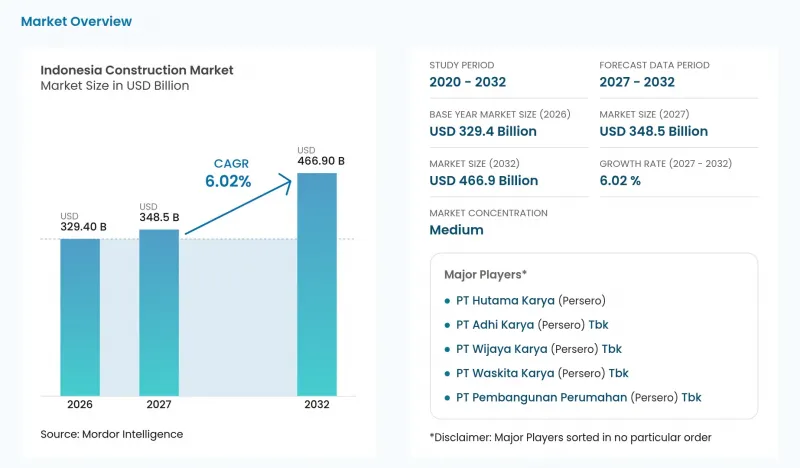
According to Mordor Intelligence, the Indonesia construction market size is expected to increase from USD 329.4 billion in 2026 to USD 348.5 billion in 2027 and reach USD 466.9 billion by 2032, growing at a CAGR of 6.02% over 2027-2032.
This report is segmented by Sector (Infrastructure, Residential, and Commercial), Construction Type (New Construction and Renovation), Construction Method (Conventional On-Site and Modern Methods of Construction), Investment Source (Public and Private), and Geography (Java, Sumatra, Kalimantan, Sulawesi, and Others). The market forecasts are provided in terms of value (USD), based on availability.
Indonesia Construction Market Trends and Insights
Government infrastructure megaproject pipeline (IKN, toll roads)
Nusantara's institutional construction program creates demand across multiple contracted packages with a common delivery purpose. By December 6, 2025, the Nusantara Capital City Authority had signed 20 phase-two packages for 2025-2029, including physical works for the legislative and judicial complexes. That structure gives institutional builders a role in coordinating separately packaged work into facilities that can function together. In August 2026, the authority proposed using part of its 2027 budget to continue construction of those facilities. Signed phase-two packages give builders committed work, while the proposed 2027 continuation creates a separate opportunity that depends on budget approval.
Residential housing backlog & mortgage stimulus
Housing finance connects Indonesia's substantial ownership gap to buyers who can support residential development. BPS data reported by the Ministry of Housing put the 2026 home-ownership backlog at about 9.29 million households, down about 350,000 from 2025. The smaller gap reduces unmet ownership need, but its remaining scale gives developers a substantial potential customer base. BP Tapera, which administers the FLPP subsidized-mortgage program, reported 177,161 mortgages disbursed by October 9, 2026, against a calendar-year target of 350,000. For residential contractors, this financing channel matters because an ownership need becomes commercially actionable when a household can fund a purchase. At 177,161 of 350,000 mortgages, about half of the 2026 FLPP target remained to be disbursed after October 9, leaving potential financed purchases beyond those already recorded.
SOE debt overhang & funding tightness
Debt-service pressure can constrain a contractor's ability to turn awarded work into funded site activity. PT Wijaya Karya (Persero) Tbk deferred a March 25, 2026 bond-interest and sukuk profit-sharing payment after reporting limited unrestricted cash. This liquidity problem matters to construction because mobilizing a project requires financial headroom alongside the technical ability to deliver it. For an owner considering a financially stretched contractor, a signed contract therefore offers less assurance of timely execution unless the project also has dependable funding arrangements. Debt obligations competing with mobilization cash can consequently add financing costs and delay the start of otherwise deliverable construction work.
Other drivers and restraints analyzed in the detailed report include:
- Foreign capital & PPP inflows for industrial estates
- Mining-based downstream investments (nickel, EV metals)
- Land-acquisition bureaucracy & permitting delays
For complete list of drivers and restraints, kindly check the Table Of Contents.
Segment Analysis
Infrastructure accounted for a 55.54% share of the Indonesia construction market size in 2026. The Ministry of Public Works built 113 kilometers of new roads, upgraded capacity and preserved 720 kilometers of roads, and built 2.5 kilometers of bridges in 2025. Its water-resource program also built irrigation networks covering 13,000 hectares and rehabilitated networks covering 123,000 hectares that year. These outputs connect the largest segment to both asset expansion and work on existing networks, giving civil contractors different forms of physical delivery demand. The ministry's irrigation-rehabilitation footprint exceeded its new-network footprint, giving water-network renewal a substantial role alongside transport expansion.
Commercial construction is the fastest-growing segment, with a forecast 6.68% CAGR over 2027-2032. In Q2 2026, the commercial-property rental demand index grew 1.32% year over year, driven by hotel demand in nearly all surveyed cities and convention-hall demand in Jakarta. Stronger demand for using space can improve the development case for operators considering additional or upgraded facilities. Venue builders have a city-specific lead in Jakarta, while hotel contractors face a geographically broader rental-demand signal.
New construction represented a 79.02% Indonesia construction market share in 2026. On October 1, 2026, the housing ministry reported that Himperra had realized more than 22,000 subsidized homes against its 47,000-home target under the FLPP subsidized-mortgage program. Himperra's FLPP target gives the largest segment a defined delivery base, with progress measured through individual homes. For residential builders, the scale of that undertaking creates demand for organizing many separate building jobs within an identifiable program. Himperra's target identifies a specific developer group for builders seeking subsidized-home work, narrowing the prospective customer base to participating developers.
Renovation is the fastest-growing segment, with a forecast 6.55% CAGR over 2027-2032. Yayasan Buddha Tzu Chi's Bebenah Kampung program had completed 441 of 500 home renovations in Johar Baru, Jakarta, by April 23, 2026. The foundation's program began in April 2025 and organized improvements within a defined neighborhood. Completing most of its target within roughly a year shows how neighborhood renewal can accumulate through separate home-level jobs.
Complete Report Scope:
- By Sector
- Residential
- Apartments/Condominiums
- Villas/Landed Houses
- Commercial
- Office
- Retail
- Industrial and Logistics
- Others
- Infrastructure
- Transportation Infrastructure (Roadways, Railways, Airways, others)
- Energy & Utilities
- Others
- Residential
- By Construction Type
- New Construction
- Renovation
- By Construction Method
- Conventional On-Site
- Modern Methods of Construction (Prefabricated, Modular, etc)
- By Investment Source
- Public
- Private
- By Geography
- Java
- Sumatra
- Kalimantan
- Sulawesi
- Others
List of Companies Covered in this Report:
- PT Hutama Karya (Persero)
- PT Wijaya Karya (Persero) Tbk
- PT Pembangunan Perumahan (Persero) Tbk
- PT Adhi Karya (Persero) Tbk
- PT Waskita Karya (Persero) Tbk
- PT Nindya Karya (Persero)
- PT Brantas Abipraya (Persero)
- PT Jaya Konstruksi Manggala Pratama Tbk
- PT Total Bangun Persada Tbk
- PT Acset Indonusa Tbk
- PT PP Presisi Tbk
- PT Wijaya Karya Beton Tbk
- PT Wijaya Karya Bangunan Gedung Tbk
- PT Nusantara Infrastructure Tbk
- PT Jasa Marga (Persero) Tbk
- PT Indonesia Pondasi Raya Tbk (Indopora)
- PT Rekayasa Industri
- PT JGC Indonesia
- PT China Harbour Indonesia
- PT Ciputra Development Tbk
Additional Benefits:
- The market estimate (ME) sheet in Excel format
- 3 months of analyst support
TABLE OF CONTENTS
1 INTRODUCTION
- 1.1 Study Assumptions and Market Definition
- 1.2 Scope of the Study
2 RESEARCH METHODOLOGY
3 EXECUTIVE SUMMARY
4 MARKET LANDSCAPE
- 4.1 Market Overview
- 4.2 Market Drivers
- 4.2.1 Government infrastructure megaproject pipeline (IKN, toll roads)
- 4.2.2 Residential housing backlog & mortgage stimulus
- 4.2.3 Foreign capital & PPP inflows for industrial estates
- 4.2.4 Mining-based downstream investments (nickel, EV metals)
- 4.2.5 Data-center & hyperscale cloud build-outs
- 4.2.6 Green-building incentives & building energy-efficiency requirements
- 4.3 Market Restraints
- 4.3.1 SOE debt overhang & funding tightness
- 4.3.2 Land-acquisition bureaucracy & permitting delays
- 4.3.3 Skill-certification gap across construction labor force
- 4.3.4 Volatile cement & specialty-material supply chains
- 4.4 Industry Value Chain Analysis
- 4.5 Regulatory Landscape
- 4.6 Technological Outlook
- 4.7 Porter's Five Forces Analysis
- 4.7.1 Threat of New Entrants
- 4.7.2 Bargaining Power of Suppliers
- 4.7.3 Bargaining Power of Buyers
- 4.7.4 Threat of Substitutes
- 4.7.5 Competitive Rivalry
- 4.8 Government Initiatives & Vision
- 4.9 Pricing (Construction Materials) and Construction Cost (Materials, Labour, Equipment) Analysis
- 4.10 Comparison of Key Industry Metrics of the Indonesia with Other Countries
- 4.11 Key Upcoming/Ongoing Projects (with a focus on Mega Projects)
5 MARKET SIZE AND GROWTH FORECASTS (VALUE)
- 5.1 By Sector
- 5.1.1 Residential
- 5.1.1.1 Apartments/Condominiums
- 5.1.1.2 Villas/Landed Houses
- 5.1.2 Commercial
- 5.1.2.1 Office
- 5.1.2.2 Retail
- 5.1.2.3 Industrial and Logistics
- 5.1.2.4 Others
- 5.1.3 Infrastructure
- 5.1.3.1 Transportation Infrastructure (Roadways, Railways, Airways, others)
- 5.1.3.2 Energy & Utilities
- 5.1.3.3 Others
- 5.1.1 Residential
- 5.2 By Construction Type
- 5.2.1 New Construction
- 5.2.2 Renovation
- 5.3 By Construction Method
- 5.3.1 Conventional On-Site
- 5.3.2 Modern Methods of Construction (Prefabricated, Modular, etc)
- 5.4 By Investment Source
- 5.4.1 Public
- 5.4.2 Private
- 5.5 By Geography
- 5.5.1 Java
- 5.5.2 Sumatra
- 5.5.3 Kalimantan
- 5.5.4 Sulawesi
- 5.5.5 Others
6 COMPETITIVE LANDSCAPE
- 6.1 Market Concentration
- 6.2 Strategic Moves
- 6.3 Market Share Analysis
- 6.4 Company Profiles (includes Global level Overview, Market level overview, Core Segments, Financials as available, Strategic Information, Market Rank/Share for key companies, Products and Services, and Recent Developments)
- 6.4.1 PT Hutama Karya (Persero)
- 6.4.2 PT Wijaya Karya (Persero) Tbk
- 6.4.3 PT Pembangunan Perumahan (Persero) Tbk
- 6.4.4 PT Adhi Karya (Persero) Tbk
- 6.4.5 PT Waskita Karya (Persero) Tbk
- 6.4.6 PT Nindya Karya (Persero)
- 6.4.7 PT Brantas Abipraya (Persero)
- 6.4.8 PT Jaya Konstruksi Manggala Pratama Tbk
- 6.4.9 PT Total Bangun Persada Tbk
- 6.4.10 PT Acset Indonusa Tbk
- 6.4.11 PT PP Presisi Tbk
- 6.4.12 PT Wijaya Karya Beton Tbk
- 6.4.13 PT Wijaya Karya Bangunan Gedung Tbk
- 6.4.14 PT Nusantara Infrastructure Tbk
- 6.4.15 PT Jasa Marga (Persero) Tbk
- 6.4.16 PT Indonesia Pondasi Raya Tbk (Indopora)
- 6.4.17 PT Rekayasa Industri
- 6.4.18 PT JGC Indonesia
- 6.4.19 PT China Harbour Indonesia
- 6.4.20 PT Ciputra Development Tbk
7 MARKET OPPORTUNITIES AND FUTURE OUTLOOK
- 7.1 White-Space and Unmet-Need Assessment

