PUBLISHER: Mordor Intelligence | PRODUCT CODE: 2187373

PUBLISHER: Mordor Intelligence | PRODUCT CODE: 2187373
UK Construction - Market Share Analysis, Industry Trends & Statistics, Growth Forecasts (2027 - 2032)
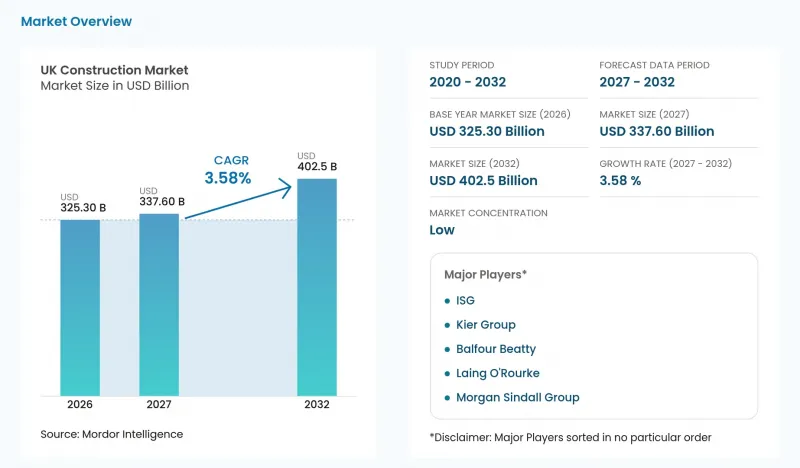
According to Mordor Intelligence, the UK construction market size was valued at USD 325.3 billion in 2026 and estimated to grow from USD 337.6 billion in 2027 to reach USD 402.5 billion by 2032, at a CAGR of 3.58% during the forecast period (2027-2032).
UK Construction Market Trends and Insights
Government mega-projects (HS2, RIS3) boosting civil-engineering backlog
Civil-engineering demand depends on the work still to be delivered and the timing of subsequent public programs. By February 2026, HS2 had completed over 108 million cubic meters of earthworks across its civil construction, around 70% of the planned quantity. That left roughly 30% of planned earthworks to complete at that date. The Department for Transport's RIS3 sets an investment plan for operating, maintaining, renewing, and enhancing England's strategic road network from April 2026 to March 2031. Civil contractors active on both programs can balance the remaining railway earthworks against road renewal packages during the April 2026 to March 2031 RIS3 period.
Chronic housing shortfall pushing residential starts
Unmet housing need creates construction demand when it can be converted into deliverable residential schemes. Seasonally adjusted new-build dwelling starts in England were estimated at 35,910 in the second quarter of 2026, up 20% year over year but 47% below the second-quarter 2023 peak. The building-control series covered an estimated 80% of England's housebuilding, and the recent increase partly reflected Building Safety Regulator reporting. England's planning framework deems unmet housing need to exist for policy S5(1)(j) when an authority's delivery falls below 75% of its requirement over the previous 3 years. That deemed unmet need applies in addition to the separate action-plan and 20% land-supply buffer requirements. For housebuilders, an authority's delivery shortfall can therefore matter commercially as a location-specific basis for developing housing proposals.
Skilled-labor shortage & aging workforce
Skilled-labor shortages constrain how much work smaller contractors can turn into completed projects. In July to December 2025, 72% of 493 small and medium-sized UK construction businesses surveyed by the Federation of Master Builders and Chartered Institute of Building reported a skilled-trades shortage. Shortages caused job delays for 49%, job cancellations for 22%, and paused expansion plans for 30% of respondents. The expansion response was newly introduced in that survey wave. The October 2026 Construction Jobs Plan separately identified recruitment that was failing to replace workers nearing retirement quickly enough or at the required skill level. Without sufficient skilled capacity, additional orders risk adding delivery commitments that a smaller contractor cannot fulfill on time.
Other drivers and restraints analyzed in the detailed report include:
- Net-Zero 2050 targets stimulating green retrofit demand
- Off-site & modular building uptake post-Building Safety Act
- Material-price volatility & supply-chain disruption
For complete list of drivers and restraints, kindly check the Table Of Contents.
Segment Analysis
Residential accounted for a 37.63% share of the UK construction market size in 2026, making it the largest segment. England's provisional dwelling-stock estimate was 25.8 million on March 31, 2025, an increase of 208,600 dwellings from a year earlier. That installed base gives residential contractors a demand context extending beyond the homes added during an individual year, with work on existing dwellings included within construction activity. Builders and suppliers can consequently address different contract packages across housing additions and interventions in the existing residential stock.
Infrastructure is the fastest-growing segment in the United Kingdom construction market, with a forecast CAGR of 7.3% during 2027-2032. The Office for National Statistics' infrastructure statistics in development recorded 3.2% current-price growth in Great Britain's new-work infrastructure construction in 2025 compared with 2024. Within that series, water, sewerage, and electricity spending rose 17.8%, 74.8%, and 15.3%, respectively, over the same period. Commercial construction faced a different order signal, as private commercial new work contributed to the 11.8% quarter-over-quarter fall in Great Britain's total construction new orders in the second quarter of 2026. That contrast makes utility-work capability a distinct commercial option for contractors seeking demand beyond commercial building awards.
New construction represented a 53.62% UK construction market share in 2026 and was the largest segment. Seasonally adjusted chained-volume construction output in Great Britain in 2025 was GBP 128.5 billion (USD 169.4 billion) for all new work. In February 2026, the Department for Education planned to rebuild over 750 schools and sixth-form colleges across England through 2034-35. The program prioritizes the worst-condition buildings where places are needed now and in the future. For education contractors, that planned sequence makes replacement-building delivery capacity relevant across successive school projects, extending the opportunity beyond a single site.
Renovation is the fastest-growing segment in the United Kingdom construction market, with a forecast CAGR of 6.9% during 2027-2032. Repair and maintenance construction output in Great Britain increased 0.4% month over month in August 2026. ODS completed the refurbishment of The Leys Children and Family Centre for Oxfordshire County Council in Oxford in January 2025. Jointly funded by the Education and Skills Funding Agency, the work extended and reconfigured the existing building for the Family Solutions Service and the Oxfordshire Hospital School. That combination makes the connection between added space and the retained building central to the contractor's scope for this public-service refurbishment.
Complete Report Scope:
- By Sector
- Residential
- Apartments/Condominiums
- Villas/Landed Houses
- Commercial
- Office
- Retail
- Industrial and Logistics
- Others
- Infrastructure
- Transportation Infrastructure (Roadways, Railways, Airways, others)
- Energy & Utilities
- Others
- Residential
- By Construction Type
- New Construction
- Renovation
- By Construction Method
- Conventional On-Site
- Modern Methods of Construction (Prefabricated, Modular, etc)
- By Investment Source
- Public
- Private
- By Geography
- England
- Scotland
- Wales
- Northern Ireland
List of Companies Covered in this Report:
- Balfour Beatty
- Kier Group
- Morgan Sindall Group
- Laing O'Rourke
- ISG
- Skanska UK
- BAM Construct & Ventures UK
- Bouygues UK
- Willmott Dixon
- Wates Group
- Galliford Try
- Sir Robert McAlpine
- Mace Group
- Multiplex
- Costain Group
- VINCI Construction UK (incl. Taylor Woodrow)
- Ferrovial Construction UK
- Lendlease Europe (UK)
- John Sisk & Son (UK)
- Barratt Redrow
- Persimmon
- Taylor Wimpey
- Vistry Group
- Berkeley Group
Additional Benefits:
- The market estimate (ME) sheet in Excel format
- 3 months of analyst support
TABLE OF CONTENTS
1 INTRODUCTION
- 1.1 Study Assumptions and Market Definition
- 1.2 Scope of the Study
2 RESEARCH METHODOLOGY
3 EXECUTIVE SUMMARY
4 MARKET LANDSCAPE
- 4.1 Market Overview
- 4.2 Market Drivers
- 4.2.1 Government mega-projects (HS2, RIS3) boosting civil-engineering backlog
- 4.2.2 Chronic housing shortfall pushing residential starts
- 4.2.3 Net-Zero 2050 targets stimulating green retrofit demand
- 4.2.4 Off-site & modular building uptake post-Building Safety Act
- 4.2.5 Infrastructure secondary-market M&A by global PE & pension funds
- 4.2.6 Digital-twin adoption improving project delivery efficiency
- 4.3 Market Restraints
- 4.3.1 Skilled-labor shortage & aging workforce
- 4.3.2 Material-price volatility & supply-chain disruption
- 4.3.3 Lengthy planning & permitting timelines
- 4.3.4 Cyber-security risks in BIM-centric projects
- 4.4 Industry Value Chain Analysis
- 4.5 Regulatory Landscape
- 4.6 Technological Outlook
- 4.7 Porter's Five Forces Analysis
- 4.7.1 Threat of New Entrants
- 4.7.2 Bargaining Power of Suppliers
- 4.7.3 Bargaining Power of Buyers
- 4.7.4 Threat of Substitutes
- 4.7.5 Competitive Rivalry
- 4.8 Government Initiatives & Vision
- 4.9 Pricing (Construction Materials) and Construction Cost (Materials, Labour, Equipment) Analysis
- 4.10 Comparison of Key Industry Metrics of the United Kingdom with Other Countries
- 4.11 Key Upcoming/Ongoing Projects (with a focus on Mega Projects)
5 MARKET SIZE AND GROWTH FORECASTS (VALUE)
- 5.1 By Sector
- 5.1.1 Residential
- 5.1.1.1 Apartments/Condominiums
- 5.1.1.2 Villas/Landed Houses
- 5.1.2 Commercial
- 5.1.2.1 Office
- 5.1.2.2 Retail
- 5.1.2.3 Industrial and Logistics
- 5.1.2.4 Others
- 5.1.3 Infrastructure
- 5.1.3.1 Transportation Infrastructure (Roadways, Railways, Airways, others)
- 5.1.3.2 Energy & Utilities
- 5.1.3.3 Others
- 5.1.1 Residential
- 5.2 By Construction Type
- 5.2.1 New Construction
- 5.2.2 Renovation
- 5.3 By Construction Method
- 5.3.1 Conventional On-Site
- 5.3.2 Modern Methods of Construction (Prefabricated, Modular, etc)
- 5.4 By Investment Source
- 5.4.1 Public
- 5.4.2 Private
- 5.5 By Geography
- 5.5.1 England
- 5.5.2 Scotland
- 5.5.3 Wales
- 5.5.4 Northern Ireland
6 COMPETITIVE LANDSCAPE
- 6.1 Market Concentration
- 6.2 Strategic Moves
- 6.3 Market Share Analysis
- 6.4 Company Profiles (includes Global level Overview, Market level overview, Core Segments, Financials as available, Strategic Information, Market Rank/Share for key companies, Products and Services, and Recent Developments)
- 6.4.1 Balfour Beatty
- 6.4.2 Kier Group
- 6.4.3 Morgan Sindall Group
- 6.4.4 Laing O'Rourke
- 6.4.5 ISG
- 6.4.6 Skanska UK
- 6.4.7 BAM Construct & Ventures UK
- 6.4.8 Bouygues UK
- 6.4.9 Willmott Dixon
- 6.4.10 Wates Group
- 6.4.11 Galliford Try
- 6.4.12 Sir Robert McAlpine
- 6.4.13 Mace Group
- 6.4.14 Multiplex
- 6.4.15 Costain Group
- 6.4.16 VINCI Construction UK (incl. Taylor Woodrow)
- 6.4.17 Ferrovial Construction UK
- 6.4.18 Lendlease Europe (UK)
- 6.4.19 John Sisk & Son (UK)
- 6.4.20 Barratt Redrow
- 6.4.21 Persimmon
- 6.4.22 Taylor Wimpey
- 6.4.23 Vistry Group
- 6.4.24 Berkeley Group
7 MARKET OPPORTUNITIES AND FUTURE OUTLOOK
- 7.1 White-Space and Unmet-Need Assessment

