PUBLISHER: Mordor Intelligence | PRODUCT CODE: 2187778

PUBLISHER: Mordor Intelligence | PRODUCT CODE: 2187778
Semaglutide - Market Share Analysis, Industry Trends & Statistics, Growth Forecasts (2027 - 2032)
According to Mordor Intelligence, the semaglutide market size was valued at USD 31.97 billion in 2026 and estimated to grow from USD 36.1 billion in 2027 to reach USD 64.51 billion by 2032, at a CAGR of 12.31% during the forecast period (2027-2032).
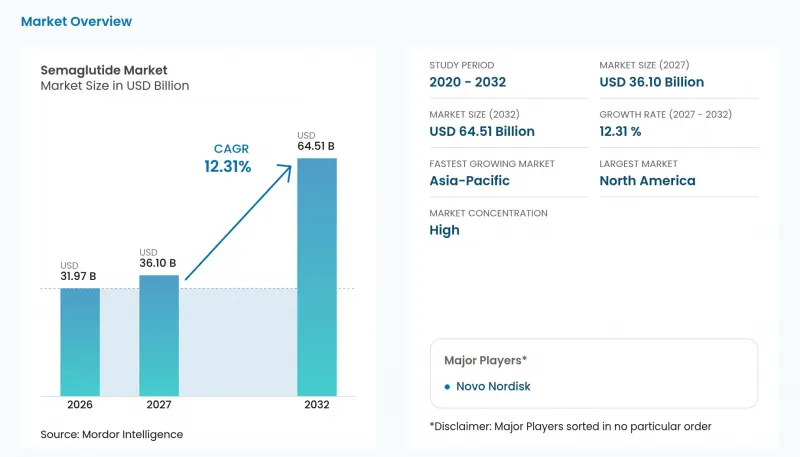
This report is segmented by Brand (Ozempic, Wegovy, and more), Formulation (Injectable and Oral), Indication (Type-2 Diabetes, Chronic Weight Management, and more), Distribution Channel (Hospital Pharmacies, Retail Pharmacies, and more), and Geography (North America, Asia-Pacific, and more). The market forecasts are provided in terms of value (USD), based on availability.
Global Semaglutide Market Trends and Insights
Rising Prevalence of Obesity & Type-2 Diabetes
The scale of obesity and diabetes creates a substantial treatment opportunity for semaglutide suppliers. The International Diabetes Federation estimated that 589 million adults aged 20-79 were living with diabetes worldwide in 2024, including diagnosed and undiagnosed cases. The World Obesity Federation projected that 1.1 billion adults aged 20 and older would have obesity globally in 2030, defined as BMI of 30 kg/m2 or higher. For diabetes-care providers, the undiagnosed component makes patient identification part of the pathway toward appropriate medicine use. The diabetes estimate anchors treatment potential in an existing disease burden, while the obesity projection points to a longer-term prescribing opportunity through 2030.
Superior Weight-Loss Efficacy Versus Other GLP-1 RAs
Weight-loss differentiation can favor semaglutide when clinicians compare it with older single-receptor GLP-1 medicines. A retrospective US adult obesity cohort analyzed 12-month outcomes following treatment starts from January 1, 2006, through September 30, 2023. The study, published in 2026, associated semaglutide with 1.84 percentage points greater adjusted weight loss than liraglutide. Where treatment objectives center on body-weight reduction, this difference can strengthen the clinical rationale for selecting semaglutide within that comparison. For obesity-focused suppliers, the commercial advantage is a specific outcome-based distinction against older mono-agonists, with product positioning anchored to the studied population and observational result.
High Therapy Cost & Limited Reimbursement
Coverage decisions can prevent clinical eligibility from becoming funded treatment for patients seeking obesity care. In its FY 2025-2026 survey, KFF reported that high costs were a key consideration in state Medicaid obesity-drug coverage decisions and that budget challenges were weakening interest in expansion. States may choose whether to cover weight-loss drugs, while coverage is required for certain other medically accepted indications. For manufacturers, the indication determines whether a state must cover treatment or may decline weight-loss coverage despite medicine availability. Broader obesity eligibility therefore cannot translate directly into equivalent publicly funded demand. The remaining barrier is the cost of securing sustained treatment where optional coverage competes with constrained state budgets.
Other drivers and restraints analyzed in the detailed report include:
- Expanded Regulatory Approvals for CVD Risk Reduction
- Growing Adoption of Self-Injectable Pens & Oral Tablets
- Risk of Supply Interruptions Linked to Pen-Fill & Cartridge Capacity
For complete list of drivers and restraints, kindly check the Table Of Contents.
Segment Analysis
Ozempic accounted for a 64.98% share of the semaglutide market size in 2026. Novo Nordisk reported global Ozempic sales of DKK 127.1 billion (USD 19.2 billion) in 2025. Novo Nordisk attributed sales growth to both US Operations and International Operations. The company's US sales were positively affected by gross-to-net sales adjustments that year. For Novo Nordisk, this adjustment means prescription counts alone cannot explain the brand's reported revenue, making net revenue per prescription relevant to sustaining the largest segment by brand.
Wegovy is forecast to be the fastest-growing segment by brand, with a CAGR of 14.52% during 2027-2032. Novo Nordisk reported more than 5 million cumulative US Wegovy pill prescriptions 30 weeks after launch, using prescription data through July 17, 2026. This cumulative prescribing base makes oral launch execution relevant to the brand's growth potential, giving expansion a commercial foundation in completed prescriptions. Sustaining that expansion will depend on converting prescribing scale into recurring medicine sales over the forecast period, with the pill contributing to the development of the broader Wegovy franchise.
Injectable formulations represented a 58.31% semaglutide market share in 2026. Novo Nordisk made its Wegovy 7.2 mg single-dose injection pen available in the United Kingdom on June 1, 2026. Availability was for appropriate adult patients under the licensed indication and local prescribing arrangements. For the supplier, this expands the largest segment through a defined dose and device combination within a specific national prescribing system. The formulation's commercial role therefore includes development within injectable therapy itself, with licensed patient selection governing the reach of the additional presentation and the treatment demand it can serve.
Oral formulations are projected to be the fastest-growing segment, at a 16.25% CAGR during 2027-2032. Novo Nordisk launched its oral Wegovy semaglutide pill in the United Kingdom in July 2026. Its addition to the Wegovy offering makes route of administration a lever for expanding the same branded franchise. For the manufacturer, country expansion can combine an established product identity with a new delivery choice. The opportunity is to broaden that franchise's treatment reach while developing an oral prescribing base in each newly served country, linking formulation development with the commercial work of a national launch.
Complete Report Scope:
- By Brand
- Wegovy
- Ozempic
- Rybelsus
- By Formulation
- Injectable
- Oral
- By Indication
- Type-2 Diabetes
- Chronic Weight Management
- Cardiovascular Risk Reduction
- Others
- By Distribution Channel
- Hospital Pharmacies
- Retail Pharmacies
- Online Pharmacies
- By Geography
- North America
- United States
- Canada
- Mexico
- Europe
- Germany
- United Kingdom
- France
- Italy
- Spain
- Rest of Europe
- Asia-Pacific
- China
- Japan
- India
- Australia
- South Korea
- Rest of Asia-Pacific
- Middle East & Africa
- GCC
- South Africa
- Rest of Middle East & Africa
- South America
- Brazil
- Argentina
- Rest of South America
- North America
Geography Analysis
North America held a 45.64% semaglutide market share in 2026, making it the largest region. Novo Nordisk reported more than 265,000 total weekly Wegovy pill prescriptions in the United States for the week ending July 17, 2026. The scale of this single oral product makes tablet execution a meaningful part of the region's commercial opportunity, with product availability already translated into prescriptions. Suppliers serving North America can build on that operating base through continuing branded treatment, with the oral franchise providing a specific route for expanding semaglutide's contribution to regional finished-medicine revenue.
Asia-Pacific is forecast to be the fastest-growing region, with a CAGR of 16.4% during 2027-2032. In March 2026, Novo Nordisk cut Indian prices for Ozempic and Wegovy by up to 36% and 48%, respectively. The company made the paired reductions amid competition from lower-priced local generics. For branded semaglutide suppliers, this provides a way to broaden affordability in India while exposing the business to a trade-off between access development and price protection. The regional growth opportunity therefore includes competitive pricing as well as treatment expansion, with wider use needing to support the value retained from affected medicine presentations.
Europe, Middle East & Africa, and South America show how format authorization, product registration, and public coverage can shape different commercial pathways. The European Union authorizes Wegovy as a prescription-only semaglutide medicine supplied as injectable pens and oral tablets, including in Germany. South Africa registered 5 Wegovy injection strengths, from 0.25 mg to 2.4 mg per dose, under Novo Nordisk (Pty) Ltd. on February 11, 2025. In September 2025, Brazil declined semaglutide coverage under its public health system (SUS) for patients aged 45 and older with grade II or III obesity, no diabetes, and established cardiovascular disease. For suppliers, EU format authorization defines the available treatment offering, South African registration establishes product eligibility, and Brazil's scoped coverage decision limits a public-funding route.
- Novo Nordisk
Additional Benefits:
- The market estimate (ME) sheet in Excel format
- 3 months of analyst support
TABLE OF CONTENTS
1 INTRODUCTION
- 1.1 Study Assumptions and Market Definition
- 1.2 Scope of the Study
2 RESEARCH METHODOLOGY
3 EXECUTIVE SUMMARY
4 MARKET LANDSCAPE
- 4.1 Market Overview
- 4.2 Market Drivers
- 4.2.1 Rising Prevalence of Obesity & Type-2 Diabetes
- 4.2.2 Superior Weight-Loss Efficacy Versus Other GLP-1 RAs
- 4.2.3 Expanded Regulatory Approvals for CVD Risk Reduction
- 4.2.4 Growing Adoption of Self-Injectable Pens & Oral Tablets
- 4.2.5 Employer-Sponsored Obesity-Management Programs
- 4.2.6 API Supply-Chain Localization Incentives in Asia
- 4.3 Market Restraints
- 4.3.1 High Therapy Cost & Limited Reimbursement
- 4.3.2 Risk of Supply Interruptions Linked to Pen-Fill & Cartridge Capacity
- 4.3.3 GI Side-Effects Driving Real-World Discontinuations
- 4.3.4 Regulatory Scrutiny of Off-Label Cosmetic Use
- 4.4 Industry Value Chain Analysis
- 4.5 Regulatory Landscape
- 4.6 Technological Outlook
- 4.7 Porter's Five Forces Analysis
- 4.7.1 Threat of New Entrants
- 4.7.2 Bargaining Power of Suppliers
- 4.7.3 Bargaining Power of Buyers
- 4.7.4 Threat of Substitutes
- 4.7.5 Competitive Rivalry
5 MARKET SIZE AND GROWTH FORECASTS (VALUE)
- 5.1 By Brand
- 5.1.1 Wegovy
- 5.1.2 Ozempic
- 5.1.3 Rybelsus
- 5.2 By Formulation
- 5.2.1 Injectable
- 5.2.2 Oral
- 5.3 By Indication
- 5.3.1 Type-2 Diabetes
- 5.3.2 Chronic Weight Management
- 5.3.3 Cardiovascular Risk Reduction
- 5.3.4 Others
- 5.4 By Distribution Channel
- 5.4.1 Hospital Pharmacies
- 5.4.2 Retail Pharmacies
- 5.4.3 Online Pharmacies
- 5.5 By Geography
- 5.5.1 North America
- 5.5.1.1 United States
- 5.5.1.2 Canada
- 5.5.1.3 Mexico
- 5.5.2 Europe
- 5.5.2.1 Germany
- 5.5.2.2 United Kingdom
- 5.5.2.3 France
- 5.5.2.4 Italy
- 5.5.2.5 Spain
- 5.5.2.6 Rest of Europe
- 5.5.3 Asia-Pacific
- 5.5.3.1 China
- 5.5.3.2 Japan
- 5.5.3.3 India
- 5.5.3.4 Australia
- 5.5.3.5 South Korea
- 5.5.3.6 Rest of Asia-Pacific
- 5.5.4 Middle East & Africa
- 5.5.4.1 GCC
- 5.5.4.2 South Africa
- 5.5.4.3 Rest of Middle East & Africa
- 5.5.5 South America
- 5.5.5.1 Brazil
- 5.5.5.2 Argentina
- 5.5.5.3 Rest of South America
- 5.5.1 North America
6 COMPETITIVE LANDSCAPE
- 6.1 Market Concentration
- 6.2 Strategic Moves
- 6.3 Market Share Analysis
- 6.4 Company Profiles (includes Global level Overview, Market level overview, Core Segments, Financials as available, Strategic Information, Market Rank/Share for key companies, Products and Services, and Recent Developments)
- 6.4.1 Novo Nordisk A/S
7 MARKET OPPORTUNITIES AND FUTURE OUTLOOK
- 7.1 White-Space and Unmet-Need Assessment

