PUBLISHER: Mordor Intelligence | PRODUCT CODE: 2154942

PUBLISHER: Mordor Intelligence | PRODUCT CODE: 2154942
South America Residential Construction - Market Share Analysis, Industry Trends & Statistics, Growth Forecasts (2026 - 2031)
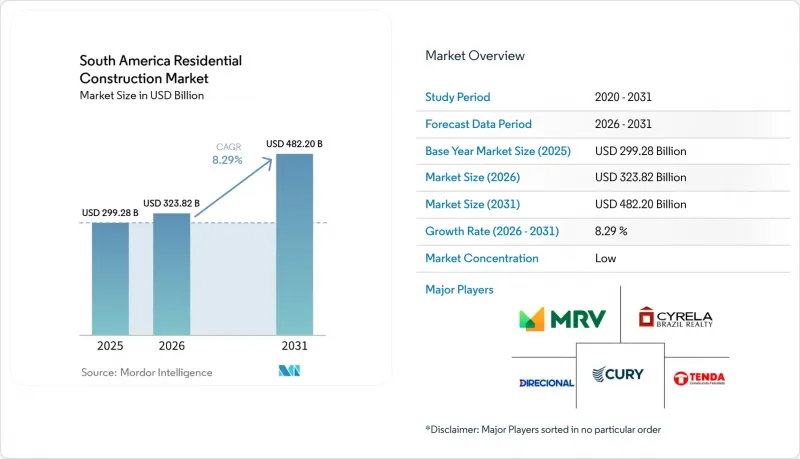
According to Mordor Intelligence, the South America residential construction market size is projected to be USD 299.28 billion in 2025, USD 323.82 billion in 2026, and reach USD 482.20 billion by 2031, growing at a CAGR of 8.29% from 2026 to 2031.
South America Residential Construction Market Trends and Insights
Affordable Housing Program Funding Supports Residential Construction
Public funding gives developers a more stable base of housing demand when private credit is limited. Brazil's Minha Casa, Minha Vida program, known as MCMV, has contracted 2.4 million homes since 2023 and targets 3 million homes by the end of 2026. Its annual allocation reached USD 27.3 billion, compared with USD 22.7 billion in 2025. Brazil also allocated USD 1.9 billion to 85,000 MCMV homes through the New PAC program in June 2026. These commitments support new project pipelines across income groups and regions.
Urban Housing Deficits Drive New Residential Development
Housing shortages keep demand for formal homebuilding in place across the region. Brazil's quantitative housing deficit stood at 5.77 million units in 2024, while Colombia reported a deficit of 4.81 million homes in 2025. Chile's Ministry of Housing and Urban Development estimated a shortage of 491,804 homes using the 2024 census. These deficits support long-term demand even when high interest rates delay private purchases. Builders with approved land and access to public programs can address demand as financing conditions improve.
High Mortgage Rates and Credit Selectivity Limit Buyer Demand
High interest rates reduce the number of buyers who can qualify for conventional mortgages. Brazil's Selic policy rate reached 15% in 2026, increasing pressure on regulated mortgage products. Colombia also saw a gap between new-home sales and construction starts in 2025. Argentina's mortgage-backed purchases fell by more than 37% in the first 5 months of 2026 from the same period in 2025. Program-linked developers are therefore better placed than builders who rely on market-rate mortgage demand.
Other drivers and restraints analyzed in the detailed report include:
- Social Rental and Subsidized Mortgage Programs Expand Housing Demand
- Urban Density Increases Demand for Vertical Housing
- Construction Cost and Skilled Labor Volatility Pressure Project Viability
For complete list of drivers and restraints, kindly check the Table Of Contents.
Segment Analysis
Apartments/condominiums held 55.00% of the South America residential construction market size in 2025. Their position reflects long-standing urban concentration in Brazil, Colombia, and Chile, where infrastructure and employment are concentrated in major cities. Multi-family projects make more intensive use of costly urban land and can serve both affordable and middle-income buyers. In Sao Paulo, vertical projects linked to Minha Casa, Minha Vida represented a substantial share of residential launches and sales in 2025. Developers also use apartment projects in premium segments, which broadens the format beyond social housing. Cyrela launched Heritage Riviera in Porto Feliz in 2026, a multi-phase development with potential sales of USD 536 million to USD 714 million. This shows that denser project formats can also be used in higher-value residential communities.
Villas/landed houses are forecast to expand at an 8.70% CAGR through 2031. The format benefits from demand outside expensive urban cores, especially in secondary Colombian cities. Amarilo S.A.S. expanded its geographic presence into Pereira and Cucuta and planned a 3,385-unit social housing project near Armenia. These moves indicate that land availability and affordability can support horizontal development where major-city prices rise. Chile's DS 1 subsidy also supports construction on owned sites for middle-income households. This creates a distributed source of single-family development that is not limited to large developer-led projects. The South America residential construction market includes both urban towers and outward residential growth, with each responding to a different housing need.
New construction accounted for 78.00% of the South America residential construction market size in 2025. Government programs continue to emphasize fresh-unit delivery, and household formation remains an important source of demand in Brazil and other countries. New projects also absorb migration into growing cities and provide the physical supply needed to reduce quantitative housing shortages. Program funding can support new construction even when conventional credit conditions are restrictive. Large housing allocations in Brazil, Peru, and Paraguay, therefore, have a direct effect on development pipelines. New Construction remains important to listed developers because it supports repeatable project models and access to formal housing finance. Its scale also supports demand for building materials, contractors, and utility connections.
Renovation is forecast to grow at a 9.40% CAGR through 2031, the fastest pace within the construction type. This growth follows the large number of existing homes that require repairs or improvements to meet habitability needs. Brazil's Housing Improvement stream and Colombia's Decree 413 of 2025 direct public support toward this part of the housing shortage. Renovation projects generally have lower ticket values and avoid the land costs that affect new developments. Their shorter project cycles can help contractors deploy capital more frequently during periods of high financing costs. Colombia's seismic construction rules apply to structural interventions, including renovations, which increases the importance of qualified contractors. The South America residential construction industry can therefore gain from repair work as well as from large new residential developments.
Complete Report Scope:
- By Type
- Apartments/Condominiums
- Villas/Landed Houses
- By Construction Type
- New Construction
- Renovation
- By Construction Method
- Conventional On-Site
- Modern Methods of Construction (Prefabricated, Modular, etc)
- By Investment Source
- Public
- Private
- By Country
- Brazil
- Argentina
- Colombia
- Chile
- Rest of South America
List of Companies Covered in this Report:
- MRV Engenharia e Participacoes S.A.
- Cyrela Brazil Realty S.A.
- Direcional Engenharia S.A.
- Cury Construtora e Incorporadora S.A.
- Construtora Tenda S.A.
- EZTEC Empreendimentos e Participacoes S.A.
- Even Construtora e Incorporadora S.A.
- Gafisa S.A.
- Plano&Plano Desenvolvimento Imobiliario S.A.
- Trisul S.A.
- Tecnisa S.A.
- Moura Dubeux Engenharia S.A.
- Melnick Desenvolvimento Imobiliario S.A.
- Pacaembu Construtora S.A.
- Socovesa S.A.
- Besalco S.A.
- SalfaCorp S.A.
- Constructora Bolivar S.A.
- Amarilo S.A.S.
- Constructora Conconcreto S.A.
Additional Benefits:
- The market estimate (ME) sheet in Excel format
- 3 months of analyst support
TABLE OF CONTENTS
1 Introduction
- 1.1 Study Assumptions & Market Definition
- 1.2 Scope of the Study
2 Research Methodology
3 Executive Summary
4 Market Insights and Dynamics
- 4.1 Market Overview
- 4.2 Market Drivers
- 4.2.1 Affordable Housing Program Funding Supports Residential Construction
- 4.2.2 Urban Housing Deficits Drive New Residential Development
- 4.2.3 Social Rental and Subsidized Mortgage Programs Expand Housing Demand
- 4.2.4 Urban Density Increases Demand for Vertical Housing
- 4.2.5 Industrialized Housing Accelerates Residential Project Delivery
- 4.2.6 BIM-Enabled Design Improves Construction and Procurement Efficiency
- 4.3 Market Restraints
- 4.3.1 High Mortgage Rates and Credit Selectivity Limit Buyer Demand
- 4.3.2 Construction Cost and Skilled Labor Volatility Pressures Project Viability
- 4.3.3 Land, Permitting, and Utility Bottlenecks Delay Project Delivery
- 4.3.4 Fragmented Industrialized Housing Standards Increase Compliance Complexity
- 4.4 Government Initiatives & Vision
- 4.5 Regulatory Outlook
- 4.6 Technological Outlook
- 4.7 Industry Attractiveness - Porter's Five Forces Analysis
- 4.7.1 Bargaining Power of Suppliers
- 4.7.2 Bargaining Power of Consumers
- 4.7.3 Threat of New Entrants
- 4.7.4 Threat of Substitutes
- 4.7.5 Intensity of Competitive Rivalry
- 4.8 Pricing (Construction Materials) and Construction Cost (Materials, Labor, Equipment) Analysis
- 4.9 Comparison of Key Industry Metrics of South America with Other Countries
- 4.10 Key Upcoming/Ongoing Projects
5 South America Residential Construction Market, Market Size & Growth Forecasts (Value, USD)
- 5.1 By Type
- 5.1.1 Apartments/Condominiums
- 5.1.2 Villas/Landed Houses
- 5.2 By Construction Type
- 5.2.1 New Construction
- 5.2.2 Renovation
- 5.3 By Construction Method
- 5.3.1 Conventional On-Site
- 5.3.2 Modern Methods of Construction (Prefabricated, Modular, etc)
- 5.4 By Investment Source
- 5.4.1 Public
- 5.4.2 Private
- 5.5 By Country
- 5.5.1 Brazil
- 5.5.2 Argentina
- 5.5.3 Colombia
- 5.5.4 Chile
- 5.5.5 Rest of South America
6 Competitive Landscape
- 6.1 Market Concentration
- 6.2 Strategic Moves
- 6.3 Market Share Analysis
- 6.4 Company Profiles (Includes Global Level Overview, Market Level Overview, Core Segments, Financials as Available, Strategic Information, Products & Services, and Recent Developments)
- 6.4.1 MRV Engenharia e Participacoes S.A.
- 6.4.2 Cyrela Brazil Realty S.A.
- 6.4.3 Direcional Engenharia S.A.
- 6.4.4 Cury Construtora e Incorporadora S.A.
- 6.4.5 Construtora Tenda S.A.
- 6.4.6 EZTEC Empreendimentos e Participacoes S.A.
- 6.4.7 Even Construtora e Incorporadora S.A.
- 6.4.8 Gafisa S.A.
- 6.4.9 Plano&Plano Desenvolvimento Imobiliario S.A.
- 6.4.10 Trisul S.A.
- 6.4.11 Tecnisa S.A.
- 6.4.12 Moura Dubeux Engenharia S.A.
- 6.4.13 Melnick Desenvolvimento Imobiliario S.A.
- 6.4.14 Pacaembu Construtora S.A.
- 6.4.15 Socovesa S.A.
- 6.4.16 Besalco S.A.
- 6.4.17 SalfaCorp S.A.
- 6.4.18 Constructora Bolivar S.A.
- 6.4.19 Amarilo S.A.S.
- 6.4.20 Constructora Conconcreto S.A.
7 Market Opportunities & Future Outlook
- 7.1 White-space & Unmet-Need Assessment

