PUBLISHER: Mordor Intelligence | PRODUCT CODE: 2154907

PUBLISHER: Mordor Intelligence | PRODUCT CODE: 2154907
South America Condominiums and Apartment - Market Share Analysis, Industry Trends & Statistics, Growth Forecasts (2026 - 2031)
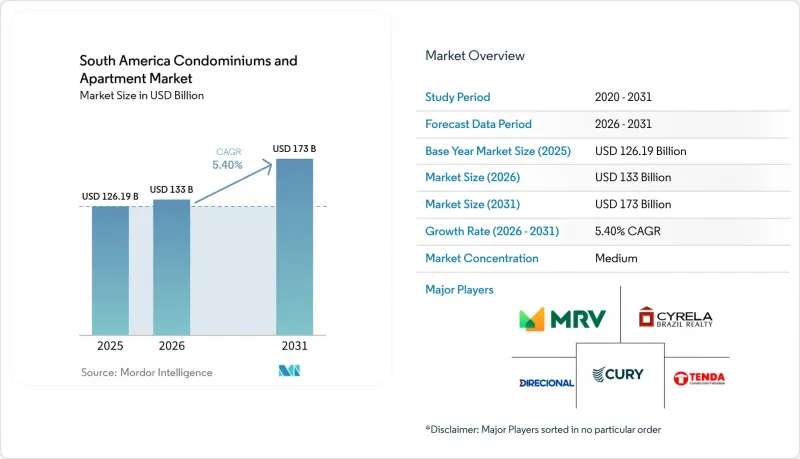
According to Mordor Intelligence, the South America condominiums and apartment market size was valued at USD 126.19 billion in 2025 and is estimated to grow from USD 133 billion in 2026 to reach USD 173 billion by 2031, at a CAGR of 5.40% during the forecast period (2026-2031).
South America Condominiums and Apartment Market Trends and Insights
Persistent Housing Deficits and Household Formation Drive Apartment Demand
The South America condominiums and apartment market is supported by a large unmet need for adequate homes. The Inter-American Development Bank reported a housing deficit of more than 45 million homes across Latin America and the Caribbean. Brazil recorded a deficit of 5.77 million dwellings at the end of 2024, even after a second consecutive decline in the total. Smaller households and more single-parent and female-headed households are increasing the number of homes required beyond population growth alone. This pattern favors compact, accessible apartments in locations close to employment, services, and public transport. Developers that align unit layouts, payment schedules, building locations, and pricing with these households can address a durable demand base, particularly where smaller homes offer lower entry costs without separating residents from jobs, schools, health services, and public transport.
Urbanization and Vertical Development Increase High-Density Housing Demand
Cities remain central to the South America condominiums and apartment market because urban residents account for a large share of the region's population. The Economic Commission for Latin America and the Caribbean reported that 82% of Latin America's population lived in urban areas. Land constraints in established districts are encouraging higher-density projects in both major metropolitan areas and nearby secondary cities. The Royal Institution of Chartered Surveyors noted that many mid-sized cities in the region are growing faster than megacities. Security, shared amenities, and proximity to daily services are also supporting demand for condominiums. Vertical development, therefore, remains relevant beyond the largest capital cities, as municipal governments, landowners, and developers respond to scarce central land with projects that use existing infrastructure more efficiently and meet residents' preferences for locations that reduce commuting time.
High Mortgage Rates and Bank Spreads Limit Buyer Purchasing Power
High mortgage costs remain a near-term constraint on the South America condominiums and apartment market. Mortgage costs in Brazil remained elevated during 2026, keeping monthly repayments difficult for many households and limiting the immediate benefit of early policy-rate reductions. The country's housing finance system caps certain mortgage rates, which can reduce lenders' willingness to originate loans when their funding costs are high. The gap between buyer income and monthly payments can delay primary-home purchases. Some households are consequently choosing rental accommodation rather than ownership. This transfer of demand supports multifamily rental projects. Still, it limits sales activity in the short term, as developers face slower unit absorption, households defer purchases, and lenders remain selective even after benchmark policy rates begin to decline.
Other drivers and restraints analyzed in the detailed report include:
- Affordable Housing Programs Support Apartment Construction
- Mortgage Recovery and Lower Interest Rates Expand Buyer Demand
- Urban Land Scarcity and Zoning Constraints Restrict New Supply
For complete list of drivers and restraints, kindly check the Table Of Contents.
Segment Analysis
Sales held 72% of the South America condominiums and apartment market in 2025, supported by owner-occupier demand and public programs that facilitate home purchases. Rental is forecast to grow at a 6.30% CAGR through 2031, making it the fastest-growing business model. Colombia recorded 7.3 million renting households and 7.1 million owner households in 2025, marking a change in the country's housing tenure profile. This shift supports professionally managed rental housing, particularly in large employment centers. Sales will remain important because many households continue to prefer ownership when financing is available.
Rental operators are scaling supply to capture this demand. Greystar operates multifamily and student housing in Sao Paulo and is expanding its regional operating platform. Rental projects benefit when construction schedules are predictable because earlier completion brings earlier rental income. A study of a Rio de Janeiro multifamily case found that building information modeling and off-site construction reduced project duration by up to 40% and costs by 6%. These methods may improve project economics for rental developers. More rental supply could also intensify competition for new-build sales in selected districts.
Complete Report Scope:
- By Business Model
- Sales
- Rental
List of Companies Covered in this Report:
- MRV Engenharia e Participacoes S.A.
- Cyrela Brazil Realty S.A.
- Direcional Engenharia S.A.
- Cury Construtora e Incorporadora S.A.
- Construtora Tenda S.A.
- Plano&Plano Desenvolvimento Imobiliario S.A.
- EZTEC Empreendimentos e Participacoes S.A.
- Even Construtora e Incorporadora S.A.
- Moura Dubeux Engenharia S.A.
- Mitre Realty Empreendimentos e Participacoes S.A.
- Tegra Incorporadora
- Amarilo S.A.S.
- Marval S.A.
- Constructora Bolivar S.A.
- Constructora Capital
- Greystar Real Estate Partners, LLC
- Paz Corp S.A.
- Socovesa S.A.
- Grupo ECIPSA
- EDISUR S.A.
Additional Benefits:
- The market estimate (ME) sheet in Excel format
- 3 months of analyst support
TABLE OF CONTENTS
1 Introduction
- 1.1 Study Assumptions & Market Definition
- 1.2 Scope of the Study
2 Research Methodology
3 Executive Summary
4 Market Insights and Dynamics
- 4.1 Market Overview
- 4.2 Market Drivers
- 4.2.1 Persistent Housing Deficits and Household Formation Drive Apartment Demand
- 4.2.2 Urbanization and Vertical Development Increase High-Density Housing Demand
- 4.2.3 Affordable Housing Programs Support Apartment Construction
- 4.2.4 Mortgage Recovery and Lower Interest Rates Expand Buyer Demand
- 4.2.5 Alternative Credit and Digital Finance Improve Mortgage Access
- 4.2.6 Modular Construction and BIM Adoption Accelerate Apartment Delivery
- 4.3 Market Restraints
- 4.3.1 High Mortgage Rates and Bank Spreads Limit Buyer Purchasing Power
- 4.3.2 Urban Land Scarcity and Zoning Constraints Restrict New Supply
- 4.3.3 Informal Employment Limits Access to Conventional Mortgages
- 4.3.4 Climate Risks Increase Project Design and Financing Costs
- 4.4 Value / Supply-Chain Analysis
- 4.5 Regulatory Landscape
- 4.6 Technological Outlook
- 4.7 Industry Attractiveness - Porter's Five Forces Analysis
- 4.7.1 Bargaining Power of Suppliers
- 4.7.2 Bargaining Power of Consumers
- 4.7.3 Threat of New Entrants
- 4.7.4 Threat of Substitutes
- 4.7.5 Intensity of Competitive Rivalry
5 Condominiums and Apartments Market Size & Growth Forecasts (Value USD)
- 5.1 By Business Model
- 5.1.1 Sales
- 5.1.2 Rental
6 Condominiums and Apartments Market (Sales Model) Size & Growth Forecasts (Value USD)
- 6.1 By Price Band
- 6.1.1 Affordable
- 6.1.2 Mid-Market
- 6.1.3 Luxury
- 6.2 By Mode of Sale
- 6.2.1 Primary (New-Build)
- 6.2.2 Secondary (Existing-Home Resale)
- 6.3 By Country
- 6.3.1 Brazil
- 6.3.2 Argentina
- 6.3.3 Colombia
- 6.3.4 Chile
- 6.3.5 Rest of South America
7 Competitive Landscape
- 7.1 Market Concentration
- 7.2 Strategic Moves
- 7.3 Market Share Analysis
- 7.4 Company Profiles (Includes Global Level Overview, Market Level Overview, Core Segments, Financials as Available, Strategic Information, Products & Services, and Recent Developments)
- 7.4.1 MRV Engenharia e Participacoes S.A.
- 7.4.2 Cyrela Brazil Realty S.A.
- 7.4.3 Direcional Engenharia S.A.
- 7.4.4 Cury Construtora e Incorporadora S.A.
- 7.4.5 Construtora Tenda S.A.
- 7.4.6 Plano&Plano Desenvolvimento Imobiliario S.A.
- 7.4.7 EZTEC Empreendimentos e Participacoes S.A.
- 7.4.8 Even Construtora e Incorporadora S.A.
- 7.4.9 Moura Dubeux Engenharia S.A.
- 7.4.10 Mitre Realty Empreendimentos e Participacoes S.A.
- 7.4.11 Tegra Incorporadora
- 7.4.12 Amarilo S.A.S.
- 7.4.13 Marval S.A.
- 7.4.14 Constructora Bolivar S.A.
- 7.4.15 Constructora Capital
- 7.4.16 Greystar Real Estate Partners, LLC
- 7.4.17 Paz Corp S.A.
- 7.4.18 Socovesa S.A.
- 7.4.19 Grupo ECIPSA
- 7.4.20 EDISUR S.A.
8 Market Opportunities & Future Outlook
- 8.1 White-Space & Unmet-Need Assessment

