
PUBLISHER: Mordor Intelligence | PRODUCT CODE: 1939660

PUBLISHER: Mordor Intelligence | PRODUCT CODE: 1939660
Asia-Pacific Dairy - Market Share Analysis, Industry Trends & Statistics, Growth Forecasts (2026 - 2031)
The Asia-Pacific dairy market was valued at USD 202.81 billion in 2025 and estimated to grow from USD 212.5 billion in 2026 to reach USD 268.37 billion by 2031, at a CAGR of 4.78% during the forecast period (2026-2031).
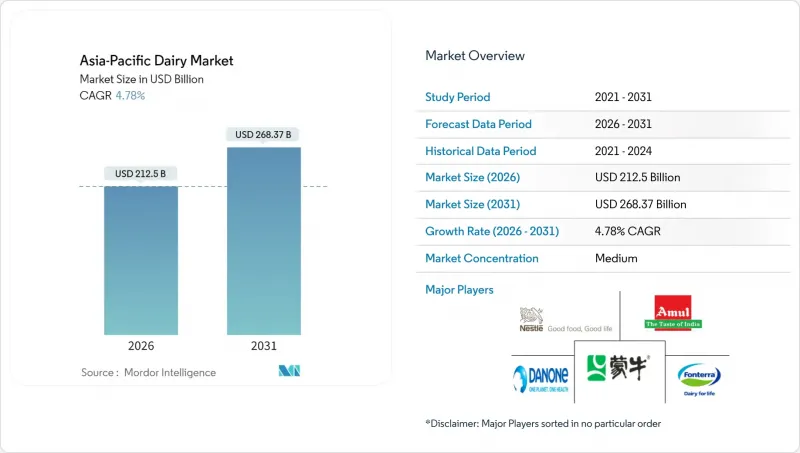
This trajectory reflects structural shifts rather than simple volume accumulation, urbanization in China pushed per capita dairy consumption from 36.1 kg in 2019 to 42.3 kg by 2024, while India's production base swelled to 230 million tonnes in 2024, cementing its position as the world's largest milk producer. The region's growth diverges sharply from mature Western markets, where incremental gains hinge on premiumization; here, first-time adoption and category expansion drive the bulk of revenue. Category migration from plain milk to value-added offerings such as drinkable yogurt, lactose-free UHT milk, and high-protein whey concentrates improves average selling prices and cushions producers against input-cost volatility. Meanwhile, omnichannel distribution, particularly e-commerce with temperature-controlled last-mile delivery, converts previously latent demand into repeat purchases. Competitive intensity remains balanced, allowing both cooperatives and multinationals to invest in premium SKUs without triggering destructive price wars.
Asia-Pacific Dairy Market Trends and Insights
Processing Innovation Expands Sector into High-Value Categories
Aseptic packaging and enzyme engineering have unlocked categories once deemed impractical for tropical climates. Tetra Pak's 2024 mascarpone technology extends shelf life to 8 months without refrigeration, enabling Italian-style desserts to reach Indonesian and Philippine markets where cold chains remain patchy. China's Yili introduced lactose-free UHT milk using microbial lactase in 2024, capturing consumers who previously avoided dairy altogether. Membrane filtration now concentrates whey protein to 80% purity at scale, feeding the sports-nutrition boom in Japan and South Korea. These advances do more than preserve product, they redefine what counts as "dairy" in regions where traditional fermentation and fresh consumption dominated for centuries.
Organized Promotions Drive Nutritional Awareness and Sales
Government-backed campaigns and corporate nutrition initiatives are reshaping consumption norms. India's National Dairy Development Board launched school milk programs reaching 12 million children in 2024, embedding dairy as a daily staple rather than a luxury. Nestle India's "Nestle a+ Nourish" campaign tied fortified milk to cognitive development, leveraging pediatrician endorsements to shift middle-class purchasing. In Vietnam, Vinamilk's partnerships with maternal health clinics positioned yogurt as essential prenatal nutrition, lifting sales in provinces where dairy was historically absent. These efforts work because they address skepticism head-on, many Asian consumers still associate milk with childhood or illness recovery, not adult wellness.
Lactose Intolerance Restricts Inherent Market Penetration
Genetic prevalence of lactase non-persistence caps addressable populations, 90% of East Asians, 70% of South Asians, and 60% of Southeast Asians experience discomfort from unmodified dairy . While enzyme-treated milk and plant-dairy blends offer workarounds, they fragment the market and dilute brand equity; a consumer who switches to oat milk exits the dairy value chain entirely. Japan's aging demographic exacerbates the issue, as lactase production declines further with age, pushing seniors toward calcium-fortified alternatives. Companies must invest in reformulation pipelines and consumer education, costs that erode margins without guaranteeing conversion. The constraint is biological, not behavioral, making it harder to overcome through marketing alone.
Other drivers and restraints analyzed in the detailed report include:
- Dairy Acceptance Achieves Widespread Staple Food Status
- Modern Retail Enhances Product Accessibility and Choice
- Varying Regulatory Measures Generate Substantial Trade Friction
For complete list of drivers and restraints, kindly check the Table Of Contents.
Segment Analysis
Milk captured 55.02% of product-type value in 2025, anchored by India's vast liquid consumption and China's UHT dominance, yet yogurt's 5.62% CAGR through 2031 signals a premiumization wave. Probiotic strains like Lactobacillus casei and Bifidobacterium lactis have transformed yogurt from a niche health food into a functional beverage, with drinkable formats accounting significant share of China's yogurt sales in 2024. Cheese remains underpenetrated, processed variants hold a significant share of retail cheese sales, reflecting limited culinary integration outside pizza and sandwiches, but foodservice demand is surging, with the majority of China's cheese consumption now occurring in restaurants and quick-service outlets, according to the China Dairy Industry Association. Butter and cream categories grow steadily as bakery chains proliferate, though import dependence persists due to insufficient domestic butterfat supply.
Dairy desserts, led by ice cream, benefit from year-round consumption in tropical climates, with premium single-serve formats gaining traction in convenience stores. Sour milk drinks, traditional in Central Asia, are being repositioned as gut-health beverages in urban China, leveraging kefir and kumis heritage. Condensed and powdered milk serve as pantry staples in rural areas lacking refrigeration, though fresh and UHT variants are gradually displacing them as cold chains extend. Emerging innovations blur category boundaries, Mengniu's 2024 launch of a yogurt-cheese hybrid targets consumers seeking protein density without cooking effort, while flavored milk now includes turmeric and matcha variants tailored to local palates. The shift from commodity milk to value-added formats is irreversible; companies that cling to plain white milk will cede margin to those engineering functional, convenient, and culturally resonant products. Regulatory oversight by FSSAI in India and CFDA in China ensures product safety but also raises entry barriers, as compliance costs favor scale players with in-house testing labs.
The Asia-Pacific Dairy Market is Segmented by Product Type (Butter, Cheese, Cream, Dairy Desserts, Milk, Sour Milk Drinks, Yogurt), Distribution Channel (Off-Trade and On-Trade) and Geography (Australia, China, India, Japan, and Rest of Asia-Pacific). The Market Forecasts are Provided in Terms of Value (USD) and Volume (Tons).
List of Companies Covered in this Report:
- Gujarat Cooperative Milk Marketing Federation Ltd.
- Vietnam Dairy Products Joint Stock Company
- Fonterra Co-operative Group Limited
- Inner Mongolia Mengniu Dairy (Group) Co., Ltd. (Mengniu)
- Royal FrieslandCampina N.V.
- Dutch Mill Co., Ltd.
- Nestle S.A.
- Danone S.A.
- Meiji Holdings Co., Ltd.
- The Coca-Cola Company
- Blue Diamond Growers
- Califia Farms LLC
- Oatly Group AB
- PT Greenfields Indonesia
- Godrej Tyson Foods Ltd
- Arla Foods amba
- The Hershey Company
- Tata Consumer Products Limited
- Life Health Foods (India) Pvt. Ltd.
- Groupe Lactalis S.A.
Additional Benefits:
- The market estimate (ME) sheet in Excel format
- 3 months of analyst support
TABLE OF CONTENTS
1 INTRODUCTION
- 1.1 Study Assumptions and Market Definition
- 1.2 Scope of the Study
2 RESEARCH METHODOLOGY
3 EXECUTIVE SUMMARY
4 Key Industry Trends
- 4.1 Per Capita Consumption
- 4.2 Raw Material/Commodity Production
5 MARKET LANDSCAPE
- 5.1 Market Overview
- 5.2 Market Drivers
- 5.2.1 Processing Innovation Expands Sector into High-Value Categories
- 5.2.2 Organized Promotions Drive Nutritional Awareness and Sales
- 5.2.3 Dairy Acceptance Achieves Widespread Staple Food Status
- 5.2.4 Modern Retail Enhances Product Accessibility and Choice
- 5.2.5 Urbanization Facilitates Lifestyle Westernization Trends
- 5.2.6 Reduced Trade Barriers Enable Foreign Market Entry
- 5.3 Market Restraints
- 5.3.1 Lactose Intolerance Restricts Inherent Market Penetration
- 5.3.2 Varying Regulatory Measures Generate Substantial Trade Friction
- 5.3.3 Supply Chain Maturity Challenged by Rapid Demand Pace
- 5.3.4 Underdeveloped Cold Chain Hinders Product Quality Maintenance
- 5.4 Value Chain Analysis
- 5.5 Regulatory Framework
- 5.6 Porter's Five Forces
- 5.6.1 Threat of New Entrants
- 5.6.2 Bargaining Power of Buyers
- 5.6.3 Bargaining Power of Suppliers
- 5.6.4 Threat of Substitutes
- 5.6.5 Competitive Rivalry
6 MARKET SIZE AND GROWTH FORECASTS (VALUE and VOLUME )
- 6.1 Product Type
- 6.1.1 Butter
- 6.1.1.1 Salted Butter
- 6.1.1.2 Unsalted Butter
- 6.1.2 Cheese
- 6.1.2.1 Natural Cheese
- 6.1.2.1.1 Cheddar
- 6.1.2.1.2 Cottage
- 6.1.2.1.3 Ricotta
- 6.1.2.1.4 Parmesan
- 6.1.2.1.5 Others
- 6.1.2.2 Processed Cheese
- 6.1.2.1 Natural Cheese
- 6.1.3 Cream
- 6.1.3.1 Fresh Cream
- 6.1.3.2 Cooking Cream
- 6.1.3.3 Whippng Cream
- 6.1.3.4 Others
- 6.1.4 Dairy Desserts
- 6.1.4.1 Ice Cream
- 6.1.4.2 Cheesecakes
- 6.1.4.3 Frozen Desserts
- 6.1.4.4 Others
- 6.1.5 Milk
- 6.1.5.1 Condensed milk
- 6.1.5.2 Flavored Milk
- 6.1.5.3 Fresh Milk
- 6.1.5.4 UHT Milk
- 6.1.5.5 Powdered Milk
- 6.1.6 Yogurt
- 6.1.6.1 Drinkable
- 6.1.6.2 Spoonable
- 6.1.7 Sour Milk Drinks
- 6.1.1 Butter
- 6.2 Distribution Channel
- 6.2.1 On-trade
- 6.2.2 Off-trade
- 6.2.2.1 Convenience Stores
- 6.2.2.2 Specialist Retailers
- 6.2.2.3 Supermarkets and Hypermarkets
- 6.2.2.4 On-line Retail
- 6.2.2.5 Others
- 6.3 By Geography
- 6.3.1 India
- 6.3.2 China
- 6.3.3 Japan
- 6.3.4 Australia
- 6.3.5 Rest of Asia-Pacific
7 COMPETITIVE LANDSCAPE
- 7.1 Market Concentration
- 7.2 Strategic Moves
- 7.3 Market Share Analysis
- 7.4 Company Profiles (includes Global level Overview, Market level overview, Core Segments, Financials as available, Strategic Information, Market Rank/Share for key companies, Products and Services, and Recent Developments)
- 7.4.1 Gujarat Cooperative Milk Marketing Federation Ltd.
- 7.4.2 Vietnam Dairy Products Joint Stock Company
- 7.4.3 Fonterra Co-operative Group Limited
- 7.4.4 Inner Mongolia Mengniu Dairy (Group) Co., Ltd. (Mengniu)
- 7.4.5 Royal FrieslandCampina N.V.
- 7.4.6 Dutch Mill Co., Ltd.
- 7.4.7 Nestle S.A.
- 7.4.8 Danone S.A.
- 7.4.9 Meiji Holdings Co., Ltd.
- 7.4.10 The Coca-Cola Company
- 7.4.11 Blue Diamond Growers
- 7.4.12 Califia Farms LLC
- 7.4.13 Oatly Group AB
- 7.4.14 PT Greenfields Indonesia
- 7.4.15 Godrej Tyson Foods Ltd
- 7.4.16 Arla Foods amba
- 7.4.17 The Hershey Company
- 7.4.18 Tata Consumer Products Limited
- 7.4.19 Life Health Foods (India) Pvt. Ltd.
- 7.4.20 Groupe Lactalis S.A.
8 MARKET OPPORTUNITIES AND FUTURE OUTLOOK

