PUBLISHER: Mordor Intelligence | PRODUCT CODE: 2063964

PUBLISHER: Mordor Intelligence | PRODUCT CODE: 2063964
Asia-Pacific High-Power LED Package - Market Share Analysis, Industry Trends & Statistics, Growth Forecasts (2026 - 2031)
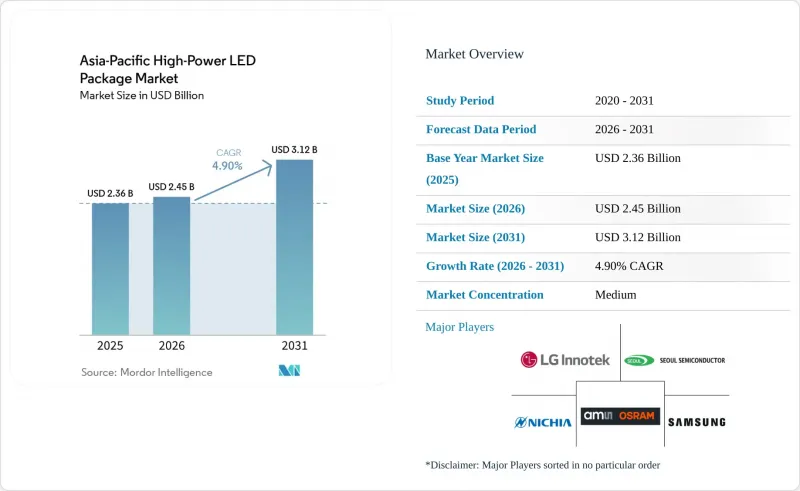
According to Mordor Intelligence, the asia-Pacific high-Power lED package market size was valued at USD 2.45 billion in 2026 and is projected to expand from USD 2.36 billion in 2025 to reach USD 3.12 billion by 2031, registering a 4.90% CAGR over 2026-2031.
This report is Segmented by Power Range (1W-3W, 3W-10W, Above 10W), Architecture (Single-Die Packages (SMD / Discrete), Multi-Die Packages (SMD), and More), Application (General Lighting, Automotive Lighting, Display and Backlighting, Specialty / Niche), and Country (China, Japan, India, Southeast Asia, Rest of Asia-Pacific). The Market Forecasts are Provided in Terms of Value (USD).
Asia-Pacific High-Power LED Package Market Trends and Insights
Surge in Mini-LED Backlight Adoption in Premium Consumer Devices
Premium televisions and tablets are shifting from edge-lit designs to mini-LED direct backlighting to raise contrast ratios and local dimming precision, a move that directly lifts demand for high-power packages capable of handling elevated current densities without color-shift drift. Samsung's 2026 Neo QLED lineup and MediaTek's showcase of micro-LED display engines confirm technology migration beyond consumer screens. TrendForce estimates show that mini-LED backlight unit shipments will grow 17% annually from 2024 through 2029, with tablet penetration reaching 15% by 2027. Packages in the 3 W-10 W bracket benefit most because they combine high luminous efficacy with manageable thermal footprints. Suppliers able to maintain sub-5 nm wavelength tolerance, still concentrated in Japan and South Korea, secure margin expansion as OEMs tighten binning specifications.
Accelerated Smart-Factory LED Retrofits Across East Asia
Manufacturing plants in China and Japan are swapping legacy discharge lamps for high-power LED arrays to meet energy-efficiency mandates and improve machine-vision accuracy. Dagu Chemical's 2025 program integrated smart lighting controls with enterprise resource planning systems to optimize lux levels, achieving operational payback within 2 years. Packages above 5 W reduce luminaire counts, thereby cutting installation labor and maintenance cycles over a 10-year life. In 2024, China's Ministry of Industry and Information Technology issued guidance classifying LED retrofits as a qualified carbon-reduction measure. Demand is also rising for tunable white-spectrum products that shift color temperature for night-shift ergonomics.
Supply Tightness of Sapphire Substrates Post-2025
As semiconductor fabs reallocated epitaxy lines toward radio-frequency filters for 5G infrastructure, sapphire wafer supply tightened, and spot prices rose by 20% quarter over quarter. Chinese and Taiwanese packagers without long-term offtake contracts must bid in volatile spot markets, eroding gross margins. Vertically integrated players such as Sanan Optoelectronics, which runs captive sapphire-growth furnaces, maintain cost stability and underprice rivals, driving consolidation. Relief is likely after 2027 when new Malaysian and Vietnamese capacity becomes operational, yet near-term tightness is expected to restrict smaller firms from committing to multi-year automotive contracts.
Other drivers and restraints analyzed in the detailed report include:
- Government-Backed Automotive LED Mandates in China and India
- Thermal-Management Breakthroughs Enabling Above 5 W Single-Package Output
- IP Litigation Risks in Flip-Chip Package Designs
For complete list of drivers and restraints, kindly check the Table Of Contents.
Segment Analysis
In 2025, the 1 W-3 W bracket captured 45.51% of the High-Power LED Package market, a position rooted in cost-sensitive general lighting. The Above 10 W group is forecast to grow 5.39% annually through 2031, propelled by automotive headlamps, industrial high bays, and stadium floodlights that benefit from luminaires built around fewer yet brighter modules. This structural pivot is possible because diamond substrates and sub-0.5 K W-1 junction-to-case resistance allow packages to exceed earlier thermal ceilings. Automotive original equipment manufacturers value tighter beam control and reduced driver complexity, aligning with Above 10 W adoption with China's GB 4599-2024 and India's Draft AIS-199 standards. Suppliers lacking advanced material science risk ceding this high-margin turf to vertically integrated Chinese and Japanese rivals.
The prospects for the 3 W-10 W middle tier remain favorable, driven by its ability to effectively balance lumen output with capital budget constraints, particularly in applications such as municipal street lighting and horticulture lamps. These segments continue to rely on this power range due to its cost-effectiveness and suitability for their specific requirements. However, the declining cost per lumen at higher power ratings poses a potential challenge to the long-term relevance of this tier. This trend could become more pronounced if advancements in smart-factory retrofits and mini-LED backlights persist, as these technologies increasingly emphasize premium efficacy and tighter binning standards, which may shift market preferences toward higher-performing alternatives.
List of Companies Covered in this Report:
- Nichia Corporation
- Samsung Electronics Co., Ltd.
- Cree LED, a SMART Global Holdings Inc. company
- OSRAM Opto Semiconductors GmbH
- Seoul Semiconductor Co., Ltd.
- Lumileds Holding B.V.
- LG Innotek Co., Ltd.
- Everlight Electronics Co., Ltd.
- Epistar Corporation
- Toyoda Gosei Co., Ltd.
- Seoul Viosys Co., Ltd.
- Lite-On Technology Corporation
- Honglitronic Co., Ltd.
- Lextar Electronics Corporation
- Foshan NationStar Optoelectronics Co., Ltd.
- Sanan Optoelectronics Co., Ltd.
- Genesis Photonics Inc.
- Edison Opto Corporation
- Dominant Opto Technologies Sdn. Bhd.
- ProLight Opto Technology Corporation
Additional Benefits:
- The market estimate (ME) sheet in Excel format
- 3 months of analyst support
TABLE OF CONTENTS
1 INTRODUCTION
- 1.1 Study Assumptions and Market Definition
- 1.2 Scope of the Study
2 RESEARCH METHODOLOGY
3 EXECUTIVE SUMMARY
4 MARKET LANDSCAPE
- 4.1 Market Overview
- 4.2 Market Drivers
- 4.2.1 Surge in Mini-LED Backlight Adoption in Premium Consumer Devices
- 4.2.2 Accelerated Smart-Factory LED Retrofits Across East Asia
- 4.2.3 Government-Backed Automotive LED Mandates in China and India
- 4.2.4 Thermal-Management Breakthroughs Enabling Above 5 W Single-Package Output
- 4.2.5 Rise of Vertical-Integration Models Among Chinese Packaging Houses
- 4.2.6 Advanced Driver-Assistance Systems Demanding High-Intensity Headlamps
- 4.3 Market Restraints
- 4.3.1 Supply Tightness of Sapphire Substrates Post-2025
- 4.3.2 IP Litigation Risks in Flip-Chip Package Designs
- 4.3.3 Persistent Cost Gap Versus Mid-Power Alternatives in General Lighting
- 4.3.4 Regulatory Scrutiny on Blue-Light Hazard in Public Illumination
- 4.4 Industry Value Chain Analysis
- 4.5 Technology Analysis
- 4.6 Regulatory Landscape
- 4.7 Impact of Macroeconomic Factors
- 4.8 Porter's Five Forces Analysis
- 4.8.1 Bargaining Power of Suppliers
- 4.8.2 Bargaining Power of Buyers
- 4.8.3 Threat of New Entrants
- 4.8.4 Threat of Substitutes
- 4.8.5 Intensity of Competitive Rivalry
5 MARKET SIZE AND GROWTH FORECASTS (VALUE)
- 5.1 By Power Range
- 5.1.1 1 W - 3 W
- 5.1.2 3 W - 10 W
- 5.1.3 Above 10 W
- 5.2 By Architecture
- 5.2.1 Single-Die Packages (SMD / Discrete)
- 5.2.2 Multi-Die Packages (SMD)
- 5.2.3 COB (Chip-on-Board)
- 5.2.4 Other Architectures (CSP, Flip-Chip, Hybrid Modules)
- 5.3 By Application
- 5.3.1 General Lighting
- 5.3.2 Automotive Lighting
- 5.3.3 Display and Backlighting
- 5.3.4 Specialty / Niche
- 5.4 By Country
- 5.4.1 China
- 5.4.2 Japan
- 5.4.3 India
- 5.4.4 Southeast Asia
- 5.4.5 Rest of Asia-Pacific
6 COMPETITIVE LANDSCAPE
- 6.1 Market Concentration
- 6.2 Strategic Moves
- 6.3 Market Share Analysis
- 6.4 Company Profiles (includes Global Level Overview, Market Level Overview, Core Segments, Financials as available, Strategic Information, Market Rank/Share, Products and Services, Recent Developments)
- 6.4.1 Nichia Corporation
- 6.4.2 Samsung Electronics Co., Ltd.
- 6.4.3 Cree LED, a SMART Global Holdings Inc. company
- 6.4.4 OSRAM Opto Semiconductors GmbH
- 6.4.5 Seoul Semiconductor Co., Ltd.
- 6.4.6 Lumileds Holding B.V.
- 6.4.7 LG Innotek Co., Ltd.
- 6.4.8 Everlight Electronics Co., Ltd.
- 6.4.9 Epistar Corporation
- 6.4.10 Toyoda Gosei Co., Ltd.
- 6.4.11 Seoul Viosys Co., Ltd.
- 6.4.12 Lite-On Technology Corporation
- 6.4.13 Honglitronic Co., Ltd.
- 6.4.14 Lextar Electronics Corporation
- 6.4.15 Foshan NationStar Optoelectronics Co., Ltd.
- 6.4.16 Sanan Optoelectronics Co., Ltd.
- 6.4.17 Genesis Photonics Inc.
- 6.4.18 Edison Opto Corporation
- 6.4.19 Dominant Opto Technologies Sdn. Bhd.
- 6.4.20 ProLight Opto Technology Corporation
7 MARKET OPPORTUNITIES AND FUTURE OUTLOOK
- 7.1 White-Space and Unmet-Need Assessment

