
PUBLISHER: Mordor Intelligence | PRODUCT CODE: 2064372

PUBLISHER: Mordor Intelligence | PRODUCT CODE: 2064372
Singapore Integrated Facility Management - Market Share Analysis, Industry Trends & Statistics, Growth Forecasts (2026 - 2031)
According to Mordor Intelligence, the singapore integrated facility management market size is projected to expand from USD 811.26 million in 2025 and USD 831.60 million in 2026 to USD 930.11 million by 2031, registering a CAGR of 2.26% between 2026 to 2031.
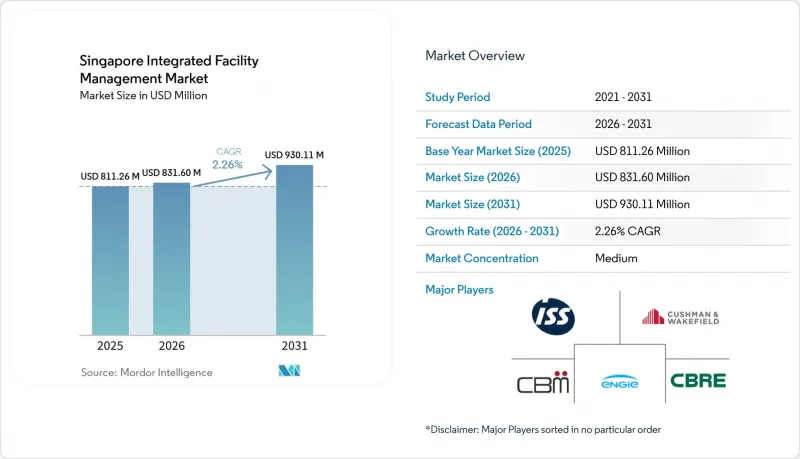
This report is Segmented by Service Type (Hard Facility Management [Asset Management, MEP and HVAC Services, and More], and Soft Facility Management [Office Support and Security, Cleaning Services, Catering Services, and More]), and End User (Commercial, Hospitality, Healthcare, Industrial and Process Sector, and More). The Market Forecasts are Provided in Terms of Value (USD).
Singapore Integrated Facility Management Market Trends and Insights
Growing Government Push for Smart Green Buildings
The Singapore integrated facility management market is benefiting from the government's direct push to improve the energy performance of existing buildings. Singapore's building sector accounted for more than 20% of national carbon emissions, which keeps energy efficiency high on the policy agenda and supports long-term demand for technical service providers that can deliver measurable outcomes. The Building Control (Environmental Sustainability Measures for Existing Buildings) (Amendment) Regulations 2025 took effect on September 30, 2025, and imposed Energy Use Intensity thresholds of 200 kWh/m2/year for offices, 495 kWh/m2/year for retail, and 360 kWh/m2/year for hospitals. Buildings that exceed those thresholds must appoint a qualified energy auditor, submit an Energy Efficiency Improvement Plan, and deliver a 10% reduction within 3 years, which expands the technical scope of FM contracts and supports recurring specialist work. The Green Mark Incentive Scheme for Existing Buildings 2.0 also lowers the financial barrier for retrofit activity by co-funding up to 50% of retrofit capital expenditure, which makes performance-linked FM contracts easier for owners to adopt. Singapore had greened 61% of its building stock by May 2026, and the remaining gap to the 80% target by 2030 leaves a clear near-term pipeline for retrofit-linked service mandates in the Singapore integrated facility management (IFM) market.
Mandatory Preventive Maintenance Requirements and HSE Regulations
The Singapore IFM market also benefits from a stringent regulatory environment that makes preventive maintenance difficult to defer. Building owners must manage overlapping obligations covering workplace safety, fire safety certification, lift servicing, escalator servicing, and cooling system maintenance, which increases the appeal of a single integrated provider that can coordinate those routines under one operating model. The BCA FM01 work head framework narrows the eligible pool for public sector maintenance contracts because M1-grade applicants must hold SGD 2 million (USD 1.5 million) in paid-up capital and at least SGD 40 million (USD 30 million) in a verified IFM project track record. That screening effect supports margin discipline for larger accredited operators in the Singapore integrated facility management market, especially where clients value reliability over lowest-cost bidding. Government tender requirements also reinforce that pattern because operators that cannot meet recognized safety standards are less likely to qualify for high-value preventive maintenance work. In practice, this turns compliance calendars into a recurring revenue base for established firms that can handle multiple regulators, technical trades, and reporting obligations without disruption.
Shortage Of Qualified FM Workforce Limiting Service Scalability
Labor remains the clearest structural limit on how fast the Singapore integrated facility management (IFM) market can scale. Singapore's labour market recorded a vacancy-to-unemployed ratio of 1.58 in December 2025, and 24.3% of employers reported skills gaps that increased workloads and affected service quality. In facility management, the pressure is sharper because labour accounts for 40% to 50% of operating costs, and many hard FM contracts require certified technicians, mechanical engineers, and energy auditors who are not easy to replace. The aging domestic technical workforce and weaker entry of younger workers into trade roles are adding to the problem, while foreign worker limits make large-scale staffing responses difficult. That combination restrains how much new business providers can absorb, even when demand is present, because contract mobilization depends on qualified people rather than only sales capacity. BCA Academy's specialist training programs support the medium-term pipeline, but they do not fully relieve the near-term staffing constraint facing the Singapore integrated facility management market.
Other drivers and restraints analyzed in the detailed report include:
- Corporate ESG Push Driving Outsourcing of Facility Services
- AI And IoT Integration for Predictive Maintenance
- Data Privacy and Cybersecurity Risks in Smart Building Systems
For complete list of drivers and restraints, kindly check the Table Of Contents.
Segment Analysis
Hard Facility Management (FM) is the fastest-growing service line in the Singapore integrated facility management (IFM) market, with the Singapore IFM market size for this segment set to rise at a 2.88% CAGR from 2026 to 2031. That pace is tied to the September 2025 MEI regime, which turns energy performance from a discretionary upgrade topic into a timed compliance requirement for large buildings above 5,000 m2 gross floor area. Once buildings cross prescribed energy intensity thresholds, owners must engage qualified specialists and document improvement actions, which gives hard FM providers a recurring role in audits, mechanical optimization, system tuning, and follow-up reporting. KONE's connected elevator services in Singapore, which improved proactive fault identification by 70% and reduced callouts by 40% in the first 2 years of deployment, show how technical operators are moving from scheduled visits toward continuous monitoring contracts that increase revenue per asset. The Singapore integrated facility management industry also benefits from local operating conditions because high humidity and long annual cooling hours make HVAC upkeep difficult to defer without affecting comfort, efficiency, and building compliance.
Soft FM remained the volume leader and held 61.75% of the Singapore IFM market share in 2025. Its lead reflects the breadth of work covered across cleaning, security, landscaping, pest control, concierge, and related site services that appear in almost every asset class. In the Singapore integrated facility management industry, this service group remains deeply embedded in commercial buildings, public spaces, logistics facilities, and hygiene-sensitive environments that require steady execution every day. The cost profile is changing, however, because wage regulation in cleaning and security is pushing operators to defend margins through robotics, process redesign, and outcome-based pricing rather than through higher labour deployment alone. OCS Singapore's November 2024 arrangement with SoftBank Robotics and the Environmental Services Industry Transformation Map 2025 both point in that direction, with productivity, automation, and labour efficiency shaping the next phase of competition in soft FM.
List of Companies Covered in this Report:
- C&W Services
- ISS A/S
- CBM Pte Ltd
- CBRE Group, Inc.
- Jones Lang LaSalle Incorporated
- ENGIE Services Singapore Pte Ltd.
- Atalian Global Services
- Knight Frank Pte Ltd.
- Keppel Infrastructure Holdings Pte Ltd.
- SMM Pte Ltd
- Colliers International Group Inc.
- Sodexo SA
- DTZ Facilities & Engineering (S) Limited
- Certis Group
- AETOS Holdings Pte Ltd.
- Surbana Jurong Pte Ltd.
- UEMS Solutions Pte Ltd.
- Mapletree Facilities Services Pte Ltd.
- OCS Group International Ltd.
- BMS Engineering and Trading Pte Ltd.
Additional Benefits:
- The market estimate (ME) sheet in Excel format
- 3 months of analyst support
TABLE OF CONTENTS
1 INTRODUCTION
- 1.1 Study Assumptions and Market Definition
- 1.2 Scope of the Study
2 RESEARCH METHODOLOGY
3 EXECUTIVE SUMMARY
4 MARKET LANDSCAPE
- 4.1 Market Overview
- 4.2 Market Drivers
- 4.2.1 Growing Government Push for Smart, Green Buildings
- 4.2.2 Mandatory Preventive Maintenance Norms Under BCA Regulations
- 4.2.3 Corporate ESG Targets Driving Outsourcing of Facility Operations
- 4.2.4 5G-Enabled IoT Adoption for Predictive Maintenance
- 4.2.5 Expansion of Integrated Resorts and Mixed-Use Mega Projects
- 4.2.6 Shift Toward Outcome-Based FM Contracts in Public Sector
- 4.3 Market Restraints
- 4.3.1 Shortage of Skilled Technicians for High-Tech Building Systems
- 4.3.2 Squeezed Margins Due to Rising Manpower Costs
- 4.3.3 Data-Security Concerns in Cloud-Based FM Platforms
- 4.3.4 Volatility in Commercial Real-Estate Demand Post-Pandemic
- 4.4 Industry Value Chain Analysis
- 4.5 Regulatory Landscape
- 4.6 Technological Outlook
- 4.7 Impact of Macroeconomic Factors on the Market
- 4.8 Porter's Five Forces Analysis
- 4.8.1 Threat of New Entrants
- 4.8.2 Bargaining Power of Buyers
- 4.8.3 Bargaining Power of Suppliers
- 4.8.4 Threat of Substitutes
- 4.8.5 Competitive Rivalry
5 MARKET SIZE AND GROWTH FORECASTS (VALUE)
- 5.1 By Service Type
- 5.1.1 Hard Facility Management
- 5.1.1.1 Asset Management
- 5.1.1.2 MEP and HVAC Services
- 5.1.1.3 Fire Systems and Safety
- 5.1.1.4 Other Hard Facility Management Services
- 5.1.2 Soft Facility Management
- 5.1.2.1 Office Support and Security
- 5.1.2.2 Cleaning Services
- 5.1.2.3 Catering Services
- 5.1.2.4 Other Soft Facility Management Services
- 5.1.1 Hard Facility Management
- 5.2 By End User Industry
- 5.2.1 Commercial
- 5.2.2 Hospitality
- 5.2.3 Institutional and Public Infrastructure
- 5.2.4 Healthcare
- 5.2.5 Industrial and Process Sector
- 5.2.6 Other End-User Industries
6 COMPETITIVE LANDSCAPE
- 6.1 Market Concentration
- 6.2 Strategic Moves
- 6.3 Market Share Analysis
- 6.4 Company Profiles (includes Global Level Overview, Market Level Overview, Core Segments, Financials as available, Strategic Information, Market Rank/Share, Products and Services, Recent Developments)
- 6.4.1 C&W Services
- 6.4.2 ISS A/S
- 6.4.3 CBM Pte Ltd
- 6.4.4 CBRE Group, Inc.
- 6.4.5 Jones Lang LaSalle Incorporated
- 6.4.6 ENGIE Services Singapore Pte Ltd.
- 6.4.7 Atalian Global Services
- 6.4.8 Knight Frank Pte Ltd.
- 6.4.9 Keppel Infrastructure Holdings Pte Ltd.
- 6.4.10 SMM Pte Ltd
- 6.4.11 Colliers International Group Inc.
- 6.4.12 Sodexo SA
- 6.4.13 DTZ Facilities & Engineering (S) Limited
- 6.4.14 Certis Group
- 6.4.15 AETOS Holdings Pte Ltd.
- 6.4.16 Surbana Jurong Pte Ltd.
- 6.4.17 UEMS Solutions Pte Ltd.
- 6.4.18 Mapletree Facilities Services Pte Ltd.
- 6.4.19 OCS Group International Ltd.
- 6.4.20 BMS Engineering and Trading Pte Ltd.
7 MARKET OPPORTUNITIES AND FUTURE OUTLOOK
- 7.1 White-Space and Unmet-Need Assessment

