
PUBLISHER: Mordor Intelligence | PRODUCT CODE: 2064415

PUBLISHER: Mordor Intelligence | PRODUCT CODE: 2064415
Indonesia Integrated Facility Management - Market Share Analysis, Industry Trends & Statistics, Growth Forecasts (2026 - 2031)
According to Mordor Intelligence, the indonesia integrated facility management market size is expected to grow from USD 2.84 billion in 2025 to USD 2.99 billion in 2026 and is forecast to reach USD 3.65 billion by 2031 at 4.07% CAGR over 2026-2031.
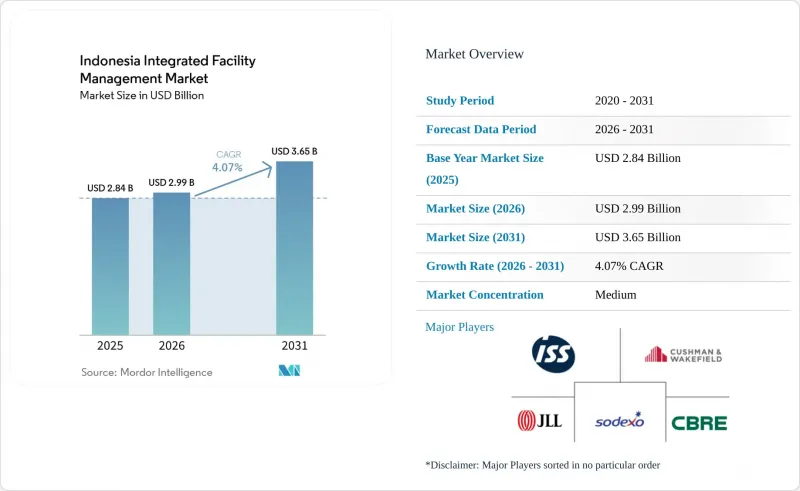
This report is Segmented by Service Type (Hard Facility Management [Asset Management, MEP and HVAC Services, and More], and Soft Facility Management [Office Support and Security, Cleaning Services, Catering Services, and More]), and End User (Commercial, Hospitality, Institutional and Public Infrastructure, and More). The Market Forecasts are Provided in Terms of Value (USD).
Indonesia Integrated Facility Management Market Trends and Insights
Rapid Expansion of Commercial Real Estate in Urban Hubs
The Indonesia integrated facility management market is benefiting from tighter office supply in premium urban districts, where Jakarta's CBD Grade A occupancy stayed above 75% in Q4 2024, and no new Grade A buildings were completed during the prior two years. That setting is pushing landlords to compete more on building performance, tenant service quality, and operating reliability than on the simple expansion of floor space. The same pattern is visible in newer asset categories, since INA and DayOne established a Batam data center platform with 72.4 MW capacity that was fully contracted by a global hyperscaler for ten years, which points to steady demand for power, cooling, safety, and security management. In near-term office supply, only two new Grade A towers, Two Sudirman and Indonesia One, are scheduled for completion in 2027 and 2028, which supports continued demand for strong service standards in existing stock. This keeps the Indonesia integrated facility management (IFM) market closely tied to asset-quality competition in major urban hubs rather than to growth in building count alone.
Growing Outsourcing Trend to Focus on Core Competencies
The Indonesia integrated facility management market is seeing stronger outsourcing demand from institutions that previously kept building operations in-house, especially in transport, healthcare, and event infrastructure. ISS Indonesia's reappointment at the Jakarta International Convention Center and its appointment across TransJakarta's 231 km BRT network show that large public-facing assets are now using structured service contracts at an operating scale. That demand matters because the TransJakarta network serves more than one million passenger trips a day, so cleaning, maintenance, and support services must be delivered with repeatable processes and clear service control. JLL's appointment at Bali International Hospital adds another example, since a high-complexity healthcare asset moved into an internationally managed building operations model soon after inauguration. As outsourcing broadens from private commercial buildings to public and quasi-public assets, the Indonesia IFM market gains a larger base of multi-site and longer-duration contracts.
Shortage of Skilled Technicians for Advanced Systems
The Indonesia integrated facility management market still faces a skill bottleneck in building automation, HVAC optimization, fire systems, and other advanced technical services that are becoming more important under newer building rules. The gap is visible in digital operations because the 2025 ITB work on HVAC digital twins assumed technicians who could manage IoT sensors, live data flows, and system tuning. That skill profile is limited outside the main Java corridor, which makes high-standard service deployment uneven across the country. Indonesia's island geography makes the constraint harder to solve because moving specialist teams to outer-island industrial and energy sites adds travel, housing, and response-time pressure. UEM Edgenta's FY2025 emphasis on multi-skilling, competency-based training, and cross-deployment shows that workforce development is a sector-wide operating need rather than a short-term staffing issue.
Other drivers and restraints analyzed in the detailed report include:
- Government Incentives for Green and Smart Buildings
- Rising ESG-Linked Asset Management Mandates by Sovereign Funds
- Fragmented Supplier Base Inflating Procurement Costs
For complete list of drivers and restraints, kindly check the Table Of Contents.
Segment Analysis
Soft facility management (FM) retained 61.6% of the Indonesia integrated facility management (IFM) market size in 2025, which reflected the country's labor-intensive operating model across cleaning, security, office support, catering, and related workplace services. The Indonesia integrated facility management market has long favored soft services because many owners first outsourced visible day-to-day operations before moving into deeper technical outsourcing. That pattern still holds in many facilities where cleaning quality, manpower reliability, and front-line support shape user experience more directly than advanced engineering systems. Soft-service demand is also being strengthened by stricter hygiene expectations in healthcare and hospitality, where operators want more formal compliance controls and service tracking. In security, the market is moving toward more integrated delivery, as OCS Indonesia's May 2025 partnership with Baharkam Polri showed that institutional clients are looking for scalable models that combine governance and operational oversight.
Hard FM is the faster-moving part of the Indonesia IFM industry, and it is forecast to rise at a 5.1% CAGR through 2031 as automation, HVAC performance, fire safety, and MEP reliability become compliance requirements that are harder to postpone. The smart building rules and tighter AC efficiency standards are moving owners toward retrofit, commissioning, and performance-monitoring work across existing high-rise stock. Johnson Controls' completed work at Thamrin Nine gave the Indonesia IFM market a visible benchmark because the project paired advanced chiller plant design with building automation and delivered a 30% energy reduction. Catering remains more fragmented than cleaning or security, yet remote industrial and energy projects are increasingly favouring integrated camp management contracts where supply continuity and workforce servicing must be maintained across difficult locations. This keeps Soft FM dominant by current revenue, while Hard FM gains ground as compliance and energy performance become more central to asset operations.
List of Companies Covered in this Report:
- PT CBRE Indonesia
- PT Jones Lang LaSalle Indonesia
- Cushman & Wakefield plc
- Sodexo S.A.
- PT Shield-On Service Tbk.
- PT Samudera Indonesia Properti Manajemen
- Colliers International Group Inc.
- PT Global Facility Management
- PT ISS Ciptamitra Facility Services
- PT Angkasa Pura Solusi
- PT PP Properti Tbk.
- PT Wijaya Karya Realty
- PT Telkom Property Indonesia
Additional Benefits:
- The market estimate (ME) sheet in Excel format
- 3 months of analyst support
TABLE OF CONTENTS
1 INTRODUCTION
- 1.1 Study Assumptions and Market Definition
- 1.2 Scope of the Study
2 RESEARCH METHODOLOGY
3 EXECUTIVE SUMMARY
4 MARKET LANDSCAPE
- 4.1 Market Overview
- 4.2 Market Drivers
- 4.2.1 Rapid Expansion of Commercial Real Estate in Urban Hubs
- 4.2.2 Growing Outsourcing Trend to Focus on Core Competencies
- 4.2.3 Government Incentives for Green and Smart Buildings
- 4.2.4 Rising ESG-Linked Asset Management Mandates by Sovereign Funds
- 4.2.5 Digital Twin Adoption for Predictive Maintenance
- 4.2.6 Facility Consolidation in Decommissioned Oil and Gas Sites
- 4.3 Market Restraints
- 4.3.1 Shortage of Skilled Technicians for Advanced Systems
- 4.3.2 Fragmented Supplier Base Inflating Procurement Costs
- 4.3.3 Low Technology Adoption Among Small Facility Owners
- 4.3.4 Labour Law Uncertainties and Contractual Rigidities
- 4.4 Industry Value Chain Analysis
- 4.5 Regulatory Landscape
- 4.6 Technological Outlook
- 4.7 Porter's Five Forces Analysis
- 4.7.1 Threat of New Entrants
- 4.7.2 Bargaining Power of Suppliers
- 4.7.3 Bargaining Power of Buyers
- 4.7.4 Threat of Substitutes
- 4.7.5 Competitive Rivalry
- 4.8 Impact of Macroeconomic Factors on the Market
5 MARKET SIZE AND GROWTH FORECASTS (VALUE)
- 5.1 By Service Type
- 5.1.1 Hard Facility Management
- 5.1.1.1 Asset Management
- 5.1.1.2 MEP and HVAC Services
- 5.1.1.3 Fire Systems and Safety
- 5.1.1.4 Other Hard FM Services
- 5.1.2 Soft Facility Management
- 5.1.2.1 Office Support and Security
- 5.1.2.2 Cleaning Services
- 5.1.2.3 Catering Services
- 5.1.2.4 Other Soft FM Services
- 5.1.1 Hard Facility Management
- 5.2 By End User Industry
- 5.2.1 Commercial
- 5.2.2 Hospitality
- 5.2.3 Institutional and Public Infrastructure
- 5.2.4 Healthcare
- 5.2.5 Industrial and Process Sector
- 5.2.6 Other End-User Industries
6 COMPETITIVE LANDSCAPE
- 6.1 Market Concentration
- 6.2 Strategic Moves
- 6.3 Market Share Analysis
- 6.4 Company Profiles (includes Global Level Overview, Market Level Overview, Core Segments, Financials as available, Strategic Information, Market Rank/Share, Products and Services, Recent Developments)
- 6.4.1 PT CBRE Indonesia
- 6.4.2 PT Jones Lang LaSalle Indonesia
- 6.4.3 Cushman & Wakefield plc
- 6.4.4 Sodexo S.A.
- 6.4.5 PT Shield-On Service Tbk.
- 6.4.6 PT Samudera Indonesia Properti Manajemen
- 6.4.7 Colliers International Group Inc.
- 6.4.8 PT Global Facility Management
- 6.4.9 PT ISS Ciptamitra Facility Services
- 6.4.10 PT Angkasa Pura Solusi
- 6.4.11 PT PP Properti Tbk.
- 6.4.12 PT Wijaya Karya Realty
- 6.4.13 PT Telkom Property Indonesia
7 MARKET OPPORTUNITIES AND FUTURE OUTLOOK
- 7.1 White-Space and Unmet-Need Assessment

