PUBLISHER: Mordor Intelligence | PRODUCT CODE: 2072917

PUBLISHER: Mordor Intelligence | PRODUCT CODE: 2072917
India Cross-Border E-Commerce Logistics - Market Share Analysis, Industry Trends & Statistics, Growth Forecasts (2026 - 2031)
According to Mordor Intelligence, the india cross-border e-commerce logistics market size is expected to increase from USD 641.73 million in 2025 to USD 686.80 million in 2026 and reach USD 949.51 million by 2031, growing at a CAGR of 6.69% over 2026-2031.
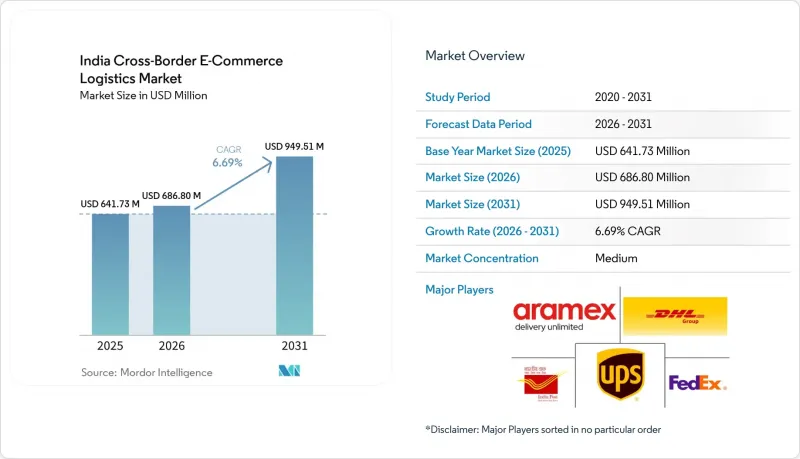
The India cross-border e-commerce logistics market is supported by a broader export enablement push that now combines e-commerce export hubs, Dak Ghar Niryat Kendras, courier facilitation, and direct marketplace onboarding for MSMEs, steadily broadening the seller base beyond the largest metros. This report is Segmented by Product Category (Foods, Personal Care, Fashion, Furniture, Electronics, Others), by Logistics Function (Transportation, VAS, and More), by Business Model (B2C, and More), by Delivery Speed (Express, Standard), and by Flow Direction (Outbound [North America, Europe, and More], Inbound [North America, Europe, and More]). The Market Forecasts are in Value (USD).
India Cross-Border E-Commerce Logistics Market Trends and Insights
E-Commerce Export Hubs, DNKs, and Export-Incentive Support
India's export enablement architecture is becoming more practical for small sellers because it now combines physical access points with digital processing support. The government had established 1,013 Dak Ghar Niryat Kendras across the country, which give exporters in remote and secondary clusters a formal export access node rather than an informal workaround. The same official framework also states that e-commerce export hubs are being built to reduce logistics costs and time, streamline regulation, and simplify re-imports, with integrated support around customs clearance, packaging, quality certification, and warehousing. In practice, this matters for the India cross-border e-commerce logistics market because parcel exports depend on repeatable process quality, not only on seller demand. It also means the India cross-border e-commerce logistics market can pull new volume from places that previously had product supply but lacked a viable export channel.
Global Demand for Indian Fashion, Decor, Beauty, and Heritage Products
Demand conditions remain favorable for categories where India already has a visible online export identity. Amazon Global Selling stated in October 2025 that Indian sellers had crossed USD 20 billion in cumulative e-commerce exports, with the United States, United Kingdom, Germany, Canada, UAE, France, Italy, Spain, and Saudi Arabia among key export markets in 2024. The same release showed that health and personal care and beauty were among the fastest-growing categories over the last 10 years, and non-electronics categories are becoming more important in export parcel flows. For the India cross-border e-commerce logistics market, that matters because categories with stronger brand pull and higher perceived value can absorb premium freight, DDP handling, and returns processing more easily than low-value commodity parcels. That is one reason the India cross-border e-commerce logistics market is seeing stronger long-run support from fashion, decor, beauty, and culturally differentiated products than from categories that compete mainly on price.
Customs, Documentation, and Payment Reconciliation Complexity
The customs and payment layer is still difficult for small exporters to handle consistently. RBI's PA-CB framework brought entities facilitating cross-border online payment transactions for import and export under direct regulation, with clear rules around merchant onboarding, transaction handling, settlement accounts, due diligence, and reporting. That is a positive step for long-term system quality, but it also confirms that cross-border commerce is no longer a light-compliance activity for intermediaries or sellers. The India cross-border e-commerce logistics market still faces operating friction when exporters must align platform workflows, payment timelines, customs declarations, and delivery commitments across several parties. For smaller sellers, the real challenge is not just access to demand. It is the ability to complete every documentation and settlement step without delays, exceptions, or reconciliation gaps.
Other drivers and restraints analyzed in the detailed report include:
- Marketplace and Aggregator-Led MSME Export Onboarding
- Faster Cross-Border Fulfillment Through Courier Digitization and Visibility Tools
- US De Minimis Withdrawal Disrupting Low-Ticket Parcel Economics
For complete list of drivers and restraints, kindly check the Table Of Contents.
Segment Analysis
Fashion and lifestyle held 30.76% of the India cross-border e-commerce logistics market share in 2025, making it the largest category in the market. Its position reflects steady demand for accessories, apparel, and footwear, where India combines manufacturing depth with a recognizable export identity. These products also align well with parcel-led trade because they ship in manageable sizes and fit marketplace-led selling models. That keeps fashion and lifestyle central to volume formation across the India cross-border e-commerce logistics market.
Health and beauty / personal care is projected to expand at a 7.68% CAGR over 2026-2031, making it the fastest-growing product segment. Amazon's October 2025 update showed that health and personal care and beauty were among the fastest-growing categories for Indian sellers over the last decade, supporting the momentum already visible in the India cross-border e-commerce logistics market. Beauty is also structurally favorable because average order values tend to be stronger than in many low-ticket apparel lines, which improves the economics of premium shipping and DDP handling. Consumer electronics, household appliances, and furniture remain smaller contributors, but they create more complex packaging, customs valuation, and damage-control requirements. Foods and beverages is still smaller in absolute terms, yet it adds corridor depth in ethnic and specialty categories where repeat diaspora demand supports steady parcel traffic. Handicrafts remained an important growth lever inside Fashion and Lifestyle, which shows that culturally differentiated products continue to matter for export mix quality.
Transportation accounted for 71.42% of the India cross-border e-commerce logistics market size in 2025, which confirms that line-haul movement still absorbs most value in the operating stack. Air freight remains especially important in this segment because cross-border parcel trade depends on time-definite delivery, particularly for fashion, health-linked categories, and premium consumer orders. The dominance of transportation also reflects the long-standing need to move shipments across multiple borders and service zones before the last-mile handoff occurs. As a result, transport still anchors revenue generation in the India cross-border e-commerce logistics market.
The value-added services and others segment is forecast to grow at a 11.87% CAGR over 2026-2031, making it the fastest-growing segment. This reflects stronger demand for customs-as-a-service, DDP management, returns support, relabeling, and destination-specific compliance processing. Kuehne+Nagel's 100,000 m2 capacity addition across five Indian cities shows that fulfillment infrastructure is being expanded through automation rather than just square footage, which supports these higher service layers. Sea transport and inland waterway activity are becoming more relevant for organized B2B flows, especially after Maersk launched its FI2 Far East Asia to India service as a second direct lane alongside FI3. Rail remains smaller, but Maersk's weekly reefer rail link from Hyderabad to Nhava Sheva shows that specialized multimodal options are expanding for specific export sectors. The India cross-border e-commerce logistics industry is therefore shifting toward a margin structure where service layering matters more than basic freight movement alone. Over time, the India cross-border e-commerce logistics market should see more value captured by operators that convert warehousing, compliance, and returns processing into a bundled offering.
Complete Report Scope:
- By Product Category
- Foods and Beverages
- Personal and Household Care
- Fashion and Lifestyle (Accessories, Apparel, Footwear)
- Furniture
- Consumer Electronics and Household Appliances
- Other Products
- By Logistics Function
- Transportation
- Road
- Air
- Sea and Inland Waterways
- Rail
- Warehousing, Distribution and Inventory Management
- Value-added Services and Others
- Transportation
- By Business Model
- B2C
- B2B
- C2C
- By Delivery Speed
- Express
- Standard
- By Flow Direction
- Outbound (Exports)
- North America
- Europe
- Asia-Pacific
- Middle East and Africa
- South America
- Inbound (Imports)
- North America
- Europe
- Asia-Pacific
- Middle East and Africa
- South America
- Outbound (Exports)
List of Companies Covered in this Report:
- DHL Group
- FedEx
- United Parcel Service of America, Inc. (UPS)
- Aramex
- India Post
- Delhivery, Ltd.
- Shiprocket X
- Blue Dart Express Pvt. Ltd.
- DTDC Express Pvt. Ltd.
- XpressBees
- Allcargo Gati Logistics Pvt. Ltd.
- SEKO Logistics
- Kuehne+Nagel
- A.P. Moller - Maersk
- NimbusPost
- Ekart Logistics
- Amazon, Inc.
- ShipGlobal.in
- IThink Logistics
- Shadowfax
- Easyship
- Shipyaari
Additional Benefits:
- The market estimate (ME) sheet in Excel format
- 3 months of analyst support
TABLE OF CONTENTS
1 Introduction
- 1.1 Study Assumptions and Market Definition
- 1.2 Scope of the Study
2 Research Methodology
3 Executive Summary
4 Market Landscape
- 4.1 Market Overview and Role of Cross-border E-commerce Logistics in E-commerce Market
- 4.2 Trends in E-Commerce Industry
- 4.3 Consumer Behavior and Demand-Supply Analysis
- 4.4 Regulatory Framework
- 4.5 Value Chain and Distribution Channel Analysis
- 4.6 Market Drivers
- 4.6.1 E-Commerce Export Hubs, DNKs, and Export-Incentive Support
- 4.6.2 Global Demand for Indian Fashion, Decor, Beauty, and Heritage Products
- 4.6.3 Marketplace and Aggregator-Led MSME Export Onboarding
- 4.6.4 Faster Cross-Border Fulfillment Through Courier Digitization and Visibility Tools
- 4.6.5 Postal-Route Incentive Parity Improving Low-AOV Parcel Economics
- 4.6.6 RBI-Regulated Cross-Border Payment Rails and UPI-Linked Settlement Innovation
- 4.7 Market Restraints
- 4.7.1 Customs, Documentation, and Payment Reconciliation Complexity
- 4.7.2 High Landed Cost, DDP Burden, and Reverse-Logistics Losses
- 4.7.3 US De Minimis Withdrawal Disrupting Low-Ticket Parcel Economics
- 4.7.4 EU ICS2 And VAT Data-Compliance Tightening for SME Exporters
- 4.8 Technology Innovations Outlook
- 4.9 Porter's Five Forces Analysis
- 4.9.1 Threat of New Entrants
- 4.9.2 Bargaining Power of Suppliers
- 4.9.3 Bargaining Power of Buyers
- 4.9.4 Threat of Substitutes
- 4.9.5 Rivalry Among Competitors
- 4.10 Evolution of Cross-border E-commerce Logistics Requirements
- 4.11 Impact of Geo-Political Events on Supply Chain Shifts
5 Market Size and Growth Forecasts
- 5.1 By Product Category
- 5.1.1 Foods and Beverages
- 5.1.2 Personal and Household Care
- 5.1.3 Fashion and Lifestyle (Accessories, Apparel, Footwear)
- 5.1.4 Furniture
- 5.1.5 Consumer Electronics and Household Appliances
- 5.1.6 Other Products
- 5.2 By Logistics Function
- 5.2.1 Transportation
- 5.2.1.1 Road
- 5.2.1.2 Air
- 5.2.1.3 Sea and Inland Waterways
- 5.2.1.4 Rail
- 5.2.2 Warehousing, Distribution and Inventory Management
- 5.2.3 Value-added Services and Others
- 5.2.1 Transportation
- 5.3 By Business Model
- 5.3.1 B2C
- 5.3.2 B2B
- 5.3.3 C2C
- 5.4 By Delivery Speed
- 5.4.1 Express
- 5.4.2 Standard
- 5.5 By Flow Direction
- 5.5.1 Outbound (Exports)
- 5.5.1.1 North America
- 5.5.1.2 Europe
- 5.5.1.3 Asia-Pacific
- 5.5.1.4 Middle East and Africa
- 5.5.1.5 South America
- 5.5.2 Inbound (Imports)
- 5.5.2.1 North America
- 5.5.2.2 Europe
- 5.5.2.3 Asia-Pacific
- 5.5.2.4 Middle East and Africa
- 5.5.2.5 South America
- 5.5.1 Outbound (Exports)
6 Competitive Landscape
- 6.1 Market Concentration
- 6.2 Key Strategic Moves
- 6.3 Market Share Analysis
- 6.4 Company Profiles (Includes Global Level Overview, Market Level Overview, Core Segments, Financials as Available, Strategic Information, Market Rank/Share for Key Companies, Products and Services, and Recent Developments)
- 6.4.1 DHL Group
- 6.4.2 FedEx
- 6.4.3 United Parcel Service of America, Inc. (UPS)
- 6.4.4 Aramex
- 6.4.5 India Post
- 6.4.6 Delhivery, Ltd.
- 6.4.7 Shiprocket X
- 6.4.8 Blue Dart Express Pvt. Ltd.
- 6.4.9 DTDC Express Pvt. Ltd.
- 6.4.10 XpressBees
- 6.4.11 Allcargo Gati Logistics Pvt. Ltd.
- 6.4.12 SEKO Logistics
- 6.4.13 Kuehne+Nagel
- 6.4.14 A.P. Moller - Maersk
- 6.4.15 NimbusPost
- 6.4.16 Ekart Logistics
- 6.4.17 Amazon, Inc.
- 6.4.18 ShipGlobal.in
- 6.4.19 iThink Logistics
- 6.4.20 Shadowfax
- 6.4.21 Easyship
- 6.4.22 Shipyaari
7 Market Opportunities and Future Outlook
- 7.1 White-space and Unmet-Need Assessment

