PUBLISHER: Mordor Intelligence | PRODUCT CODE: 2073188

PUBLISHER: Mordor Intelligence | PRODUCT CODE: 2073188
Vietnam Cross-Border B2C E-Commerce Logistics - Market Share Analysis, Industry Trends & Statistics, Growth Forecasts (2026 - 2031)
According to Mordor Intelligence, the vietnam cross-border B2C e-commerce logistics market was valued at USD 124.74 million in 2025 and is estimated to grow from USD 153.63 million in 2026 to reach USD 368.45 million by 2031, at a CAGR of 19.12% during the forecast period 2026 to 2031.
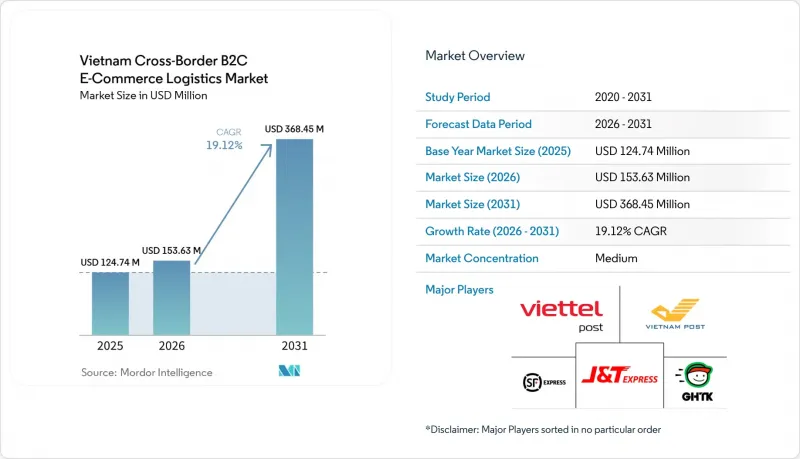
Vietnam's cross-border B2C e-commerce logistics market is currently experiencing rapid expansion, driven by soaring internet penetration, a burgeoning middle class with rising disposable incomes, and the widespread adoption of social commerce formats such as livestreaming. This report is Segmented by Product Category (Foods and Beverages, Personal and Household Care, Fashion and Lifestyle, Consumer Electronics and Household Appliances, and More), by Logistics Function (Transportation, Value-Added Services, and More), by Delivery Speed (Express, Standard), and by Flow Direction (Inbound, Outbound). The Market Forecasts are Provided in Terms of Value (USD).
Vietnam Cross-Border B2C E-Commerce Logistics Market Trends and Insights
Rapid Expansion of Vietnam Online Retail Demand
The Vietnam cross-border B2C e-commerce logistics market benefits from both sides of that flow, because Vietnamese consumers are buying more from foreign sellers while local SMEs are using digital channels to sell abroad. That dual movement increases parcel volumes, customs touchpoints, return handling, and fulfillment complexity faster than order counts alone would suggest. It also moves the value pool away from stand-alone delivery toward providers that can manage warehouse-to-door visibility and cross-border service coordination. As this demand base broadens, the Vietnam cross-border B2C e-commerce logistics market becomes less dependent on a single category or corridor and more reliant on service reliability across multiple use cases.
FTA-Led and ASEAN-Enabled Trade Corridor Expansion
Vietnam's trade corridors are supported by major agreements such as RCEP, CPTPP, EVFTA, and ASEAN frameworks, which lower tariff friction and make cross-border movement more predictable for shippers and marketplaces. The Greater Mekong Subregion Cross-Border Transport Facilitation Agreement route linked China to the Long Bien Inland Container Depot in May 2025, widening practical routing options for inbound parcels and outbound goods moving through northern Vietnam. In the Vietnam cross-border B2C e-commerce logistics market, this matters because corridor growth also increases documentation requirements, which favor operators with integrated customs and brokerage capabilities. The same FTAs that expand trade are also lifting the operational premium on compliance-ready logistics services, especially for sellers moving through multiple destination markets.
VAT and Low-Value Import Tax Tightening
Vietnam tightened the tax treatment of low-value imports in 2025, ending the old VAT exemption for imported goods under VND 1 million (USD 38) delivered through express services, and it also moved e-commerce platform operators toward VAT withholding at the point of transaction confirmation. In the Vietnam cross-border B2C e-commerce logistics market, this directly affects inbound parcel economics, as low-ticket shipments have less room to absorb additional compliance costs. Operators must now handle declarations and tax treatment with more accuracy, which raises the processing burden per parcel and weakens the low-value import model that drove earlier volume growth. This also narrows the benefit of scale for players that relied mainly on dense, low-ticket inbound traffic. Providers with automated tax and customs workflows are better placed to preserve margins than operators that still depend on manual intervention.
Other drivers and restraints analyzed in the detailed report include:
- NSW and ASW Customs Data Integration
- Reallocation of E-Commerce Air Capacity into Southeast Asia
- Fragmented Infrastructure and Customs Complexity
For complete list of drivers and restraints, kindly check the Table Of Contents.
Segment Analysis
Fashion and lifestyle accounted for 29% of the Vietnam cross-border B2C e-commerce logistics market share in 2025, making it the largest product segment in the category mix. That position reflects Vietnam's deep apparel and footwear base, which supports both inbound flows from international brands and outbound shipments from local producers. The segment benefits from repeat ordering patterns, light parcel formats, and a large seller base that fits marketplace-led cross-border trade.
Foods and beverages are projected to expand at a 20.11% CAGR through 2031, making it the fastest-growing product line in the Vietnam cross-border B2C e-commerce logistics market. Growth in that segment is tied to premium agri-food exports moving through digital channels, especially seafood, coffee, specialty rice, and tropical fruit formats that need better cold-chain handling. This trend is driving demand for temperature-controlled storage, compliant packaging, and faster international shipping solutions to preserve product quality. It also reflects increasing alignment between e-commerce platforms and exporters to enable direct-to-consumer cross-border sales. As a result, logistics providers are scaling specialized cold chain capabilities and end-to-end visibility solutions to support perishable product flows.
Transportation accounted for 57.46% of the Vietnam cross-border B2C e-commerce logistics market size in 2025, making it the largest logistics function by revenue contribution. That position is expected because every cross-border shipment still depends first on movement across road, air, rail, or sea links. Road remains central on China-Vietnam and intra-ASEAN movements, while air carries the time-sensitive and higher-value portion of the flow.
Warehousing, distribution, and inventory management are forecast to expand at a 24.29% CAGR through 2031, which is the fastest pace among logistics functions in the Vietnam cross-border B2C e-commerce logistics market. The growth gap shows that cross-border fulfillment is moving from pass-through handling to inventory positioning near customs gateways. This shift is enabling faster last-mile delivery timelines and reducing cross-border transit uncertainties. It also reflects increasing investments in bonded warehousing, localized fulfillment centers, and technology-driven inventory optimization to support rising e-commerce volumes. As a result, logistics providers are transitioning toward integrated, value-added service models rather than pure transportation offerings
Complete Report Scope:
- By Product Category
- Foods and Beverages
- Personal and Household Care
- Fashion and Lifestyle (Accessories, Apparel, Footwear)
- Furniture
- Consumer Electronics and Household Appliances
- Other Products
- By Logistics Function
- Transportation
- Road
- Air
- Sea and Inland Waterways
- Rail
- Warehousing, Distribution and Inventory Management
- Value-added Services and Others
- Transportation
- By Delivery Speed
- Express
- Standard
- By Flow Direction
- Outbound (Exports)
- North America
- Europe
- Asia-Pacific
- Middle East and Africa
- South America
- Inbound (Imports)
- North America
- Europe
- Asia-Pacific
- Middle East and Africa
- South America
- Outbound (Exports)
List of Companies Covered in this Report:
- DHL
- FedEx
- UPS
- Cainiao Network
- SF Express
- J&T Express
- Viettel Post
- BEST Express
- Kerry Express
- VNPost EMS
- GHN (Giao Hang Nhanh)
- GHTK (Giao Hang Tiet Kiem)
- CJ Logistics
- Sagawa Express
- Kuehne+Nagel
- Maersk Logistics
- Yusen Logistics
- Aramex
- Boxme Global
- 4PX Express
- YunExpress
- ECMS Express
Additional Benefits:
- The market estimate (ME) sheet in Excel format
- 3 months of analyst support
TABLE OF CONTENTS
1 Introduction
- 1.1 Study Assumptions & Market Definition
- 1.2 Scope of the Study
2 Research Methodology
3 Executive Summary
4 Market Landscape
- 4.1 Market Overview & Role of Cross-border E-commerce Logistics in E-commerce Market
- 4.2 Trends in E-Commerce Industry
- 4.3 Consumer Behavior and Demand-Supply Analysis
- 4.4 Regulatory Framework
- 4.5 Value Chain and Distribution Channel Analysis
- 4.6 Market Drivers
- 4.6.1 Rapid Expansion of Vietnam Online Retail Demand
- 4.6.2 FTA-Led and ASEAN-Enabled Trade Corridor Expansion
- 4.6.3 Bonded Warehousing and Fulfillment Investment Near Gateways
- 4.6.4 Rising Willingness to Pay for Faster Cross-Border Delivery
- 4.6.5 NSW and ASW Customs Data Integration
- 4.6.6 Reallocation of E-Commerce Air Capacity into Southeast Asia
- 4.7 Market Restraints
- 4.7.1 VAT and Low-Value Import Tax Tightening
- 4.7.2 Fragmented Infrastructure and Customs Complexity
- 4.7.3 Express-Speed Economics and Emissions Pressure
- 4.7.4 Data Fragmentation Across Logistics Systems
- 4.8 Technology Innovations Outlook
- 4.9 Porter's Five Forces
- 4.9.1 Threat of New Entrants
- 4.9.2 Bargaining Power of Suppliers
- 4.9.3 Bargaining Power of Buyers
- 4.9.4 Threat of Substitutes
- 4.9.5 Rivalry Among Competitors
- 4.10 Evolution of Cross-border E-commerce Logistics Requirements
- 4.11 Impact of Geo-Political Events on Supply Chain Shifts
5 Market Size & Growth Forecasts (Value and Volume, 2020-2031)
- 5.1 By Product Category
- 5.1.1 Foods and Beverages
- 5.1.2 Personal and Household Care
- 5.1.3 Fashion and Lifestyle (Accessories, Apparel, Footwear)
- 5.1.4 Furniture
- 5.1.5 Consumer Electronics and Household Appliances
- 5.1.6 Other Products
- 5.2 By Logistics Function
- 5.2.1 Transportation
- 5.2.1.1 Road
- 5.2.1.2 Air
- 5.2.1.3 Sea and Inland Waterways
- 5.2.1.4 Rail
- 5.2.2 Warehousing, Distribution and Inventory Management
- 5.2.3 Value-added Services and Others
- 5.2.1 Transportation
- 5.3 By Delivery Speed
- 5.3.1 Express
- 5.3.2 Standard
- 5.4 By Flow Direction
- 5.4.1 Outbound (Exports)
- 5.4.1.1 North America
- 5.4.1.2 Europe
- 5.4.1.3 Asia-Pacific
- 5.4.1.4 Middle East and Africa
- 5.4.1.5 South America
- 5.4.2 Inbound (Imports)
- 5.4.2.1 North America
- 5.4.2.2 Europe
- 5.4.2.3 Asia-Pacific
- 5.4.2.4 Middle East and Africa
- 5.4.2.5 South America
- 5.4.1 Outbound (Exports)
6 Competitive Landscape
- 6.1 Market Concentration
- 6.2 Key Strategic Moves
- 6.3 Market Share Analysis
- 6.4 Company Profiles (includes Global level Overview, Market level overview, Core Segments, Financials as available, Strategic Information, Market Rank/Share for key companies, Products & Services, and Recent Developments)
- 6.4.1 DHL
- 6.4.2 FedEx
- 6.4.3 UPS
- 6.4.4 Cainiao Network
- 6.4.5 SF Express
- 6.4.6 J&T Express
- 6.4.7 Viettel Post
- 6.4.8 BEST Express
- 6.4.9 Kerry Express
- 6.4.10 VNPost EMS
- 6.4.11 GHN (Giao Hang Nhanh)
- 6.4.12 GHTK (Giao Hang Tiet Kiem)
- 6.4.13 CJ Logistics
- 6.4.14 Sagawa Express
- 6.4.15 Kuehne+Nagel
- 6.4.16 Maersk Logistics
- 6.4.17 Yusen Logistics
- 6.4.18 Aramex
- 6.4.19 Boxme Global
- 6.4.20 4PX Express
- 6.4.21 YunExpress
- 6.4.22 ECMS Express
7 Market Opportunities & Future Outlook
- 7.1 White-space & Unmet-Need Assessment

