PUBLISHER: Mordor Intelligence | PRODUCT CODE: 2073184

PUBLISHER: Mordor Intelligence | PRODUCT CODE: 2073184
India Cross-Border B2C E-commerce Logistics - Market Share Analysis, Industry Trends & Statistics, Growth Forecasts (2026 - 2031)
According to Mordor Intelligence, the india cross-border B2C e-commerce logistics market size was valued at USD 280.96 million in 2025, and is expected to reach USD 347.97 million in 2026 and USD 880.60 million by 2031, growing at a CAGR of 20.41% over 2026-2031.
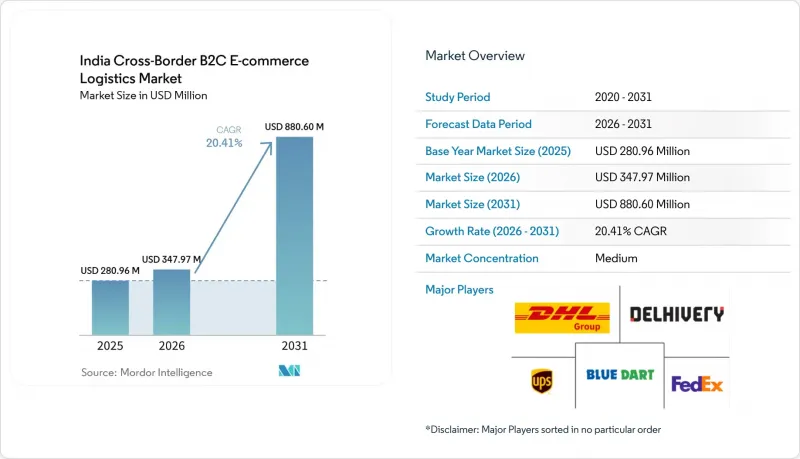
The India cross-border B2C e-commerce logistics market is expanding as regulatory changes have made courier exports easier for merchants that previously had to split shipments or route them through slower cargo channels, and the 2026 reform also introduced a formal return-to-origin path for uncleared parcels. This report is Segmented by Product Category (Fashion and Lifestyle, Consumer Electronics and Household Appliances, Personal and Household Care, and More), by Logistics Function (Transportation [Road, and More], Value-Added Services, and More), by Delivery Speed (Express and Standard), and by Flow Direction (Outbound and Inbound). The Market Forecasts are Provided in Terms of Value (USD).
India Cross-Border B2C E-commerce Logistics Market Trends and Insights
Courier Export Reform and Value-Cap Removal: Structural Unlocking of SME Export Corridors
On April 1, 2026, courier reform removed the long-standing INR 10 lakh (USD 10,510) per-consignment export cap, which had forced higher-value parcels into conventional cargo channels and reduced the speed and cost benefits of courier shipping for B2C sellers. This change matters in the India cross-border B2C e-commerce logistics market because merchants can now move larger orders through the same channel that already fits direct-to-consumer parcel flows, instead of breaking orders into smaller shipments and repeating documentation. The 2026 framework also introduced a formal return-to-origin mechanism for uncleared shipments after 15 days, helping reduce pileups at courier terminals and lowering operational uncertainty associated with failed deliveries. The working-capital effect is important because fewer parcel splits mean fewer handling cycles, fewer duplicate filings, and less cash trapped in fragmented export workflows. In practical terms, the India cross-border B2C e-commerce logistics market becomes more scalable for MSMEs when the legal framework supports higher-value courier consignments and clearer reverse handling.
Diaspora Demand for Indian Lifestyle Categories: Beyond Nostalgia and Into Repeat Cross-Border Demand
The India cross-border B2C e-commerce logistics market continues to draw volume from overseas demand for Indian-origin fashion, wellness, beauty, and household staples, especially in countries with large and affluent diaspora communities. This demand is not limited to occasional festive buying, because repeat purchases depend on product authenticity, fit, cultural familiarity, and availability gaps in overseas retail channels. The strongest effect is visible in fashion and lifestyle goods, where Indian sellers can compete on design relevance and assortment depth rather than only on discounting. Health and beauty are also moving beyond diaspora demand, as Ayurvedic and herbal formulations are reaching broader buyers seeking premium wellness and clean-label alternatives. As a result, the India cross-border B2C e-commerce logistics market benefits from a demand base that supports both frequent lower-ticket orders and more premium export baskets across multiple corridors.
United States De Minimis Loss and EU ICS2 Tightening: Compliance Costs Rise in India's Largest Export Corridors
The United States suspended the USD 800 de minimis exemption globally on August 29, 2025, ending a long period during which low-value commercial shipments could enter with a reduced customs burden. For Indian B2C exporters, this raises landed costs for lower-value categories because every commercial parcel now faces more thorough classification, duty assessment, and entry requirements. The pressure is especially visible in fashion accessories, beauty items, and handicrafts, where customs overhead can absorb a large share of the order value if the parcel is small. Europe is adding its own discipline: ICS2 Release 3 has been fully enforced across the European Union since September 1, 2025, and requires accurate pre-arrival Entry Summary Declarations across all transport modes. The India cross-border B2C e-commerce logistics market can still grow under these rules. Still, only operators with automated filing, better product data, and stronger customs discipline are likely to protect delivery speed and merchant margins.
Other drivers and restraints analyzed in the detailed report include:
- UPI Global and Cross-Border Payment Enablement: Reducing Conversion Friction for Export Sellers
- DDP-By-Default Adoption: Compliance Moves Closer to the Customer Checkout
- Returns and Re-Import Complexity: Reverse Logistics Still Drains Margin
For complete list of drivers and restraints, kindly check the Table Of Contents.
Segment Analysis
Fashion and lifestyle accounted for 41.90% of the India cross-border B2C e-commerce logistics market size in 2025, making it the largest product segment by revenue. The segment benefits from sustained overseas demand for Indian apparel, accessories, and footwear that are often difficult to source with the same variety and authenticity in destination markets. It also aligns with the economics of cross-border parcel shipping because many products are relatively light, can travel by air at a manageable cost, and usually face fewer certification hurdles than electronics or food.
Health and beauty is projected to grow at a 21.39% CAGR through 2031, placing it ahead of every other product category. Growth is tied to stronger demand for ayurvedic wellness products, herbal skincare, and premium beauty lines that carry a distinct Indian-origin identity in overseas channels. That positioning matters because the segment can sell on formulation and brand story rather than relying solely on low pricing, which supports a better export mix over time. Consumer electronics and household appliances are expanding more selectively, as tightening BIS requirements and the 2026 Quality Control Order add certification time and cost for many categories before they can scale cleanly through regulated channels.
Transportation accounted for 73.02% of the India cross-border B2C e-commerce logistics market share in 2025, underscoring the industry's continued reliance on the basic need to move parcels quickly and reliably across borders. Air freight remains central because many cross-border B2C shipments are time sensitive, and platform sellers cannot easily compete with transit times that stretch into multiple weeks. Sea freight still has a role for bulky and less urgent categories, but it does not align well with the delivery expectations that shape most parcel-based online retail purchases.
Value-added services are forecast to grow at a 25.58% CAGR through 2031, the fastest rate among the logistics functions. This reflects a structural change because merchants increasingly need duty calculation, HS classification, importer support, customs visibility, and compliance guidance alongside physical parcel movement. In the India cross-border B2C e-commerce logistics market, those tasks are no longer optional extras for regulated corridors such as the United States and Europe.
Complete Report Scope:
- By Product Category
- Foods and Beverages
- Personal and Household Care
- Fashion and Lifestyle (Accessories, Apparel, Footwear)
- Furniture
- Consumer Electronics and Household Appliances
- Other Products
- By Logistics Function
- Transportation
- Road
- Air
- Sea and Inland Waterways
- Rail
- Warehousing, Distribution and Inventory Management
- Value-added Services and Others
- Transportation
- By Delivery Speed
- Express
- Standard
- By Flow Direction
- Outbound (Exports)
- North America
- Europe
- Asia-Pacific
- Middle East and Africa
- South America
- Inbound (Imports)
- North America
- Europe
- Asia-Pacific
- Middle East and Africa
- South America
- Outbound (Exports)
List of Companies Covered in this Report:
- Delhivery
- Blue Dart Express
- DHL Group
- FedEx
- UPS
- Aramex
- DTDC Express
- Xpressbees
- Shadowfax
- Ekart Logistics
- Shiprocket X
- NimbusPost
- Pickrr
- IThink Logistics
- Easyship
- ShipGlobal.in
- Cogoport
- Allcargo Gati Ltd.
- Mahindra Logistics
- Safexpress
- India Post
- Shypmax
Additional Benefits:
- The market estimate (ME) sheet in Excel format
- 3 months of analyst support
TABLE OF CONTENTS
1 Introduction
- 1.1 Study Assumptions & Market Definition
- 1.2 Scope of the Study
2 Research Methodology
3 Executive Summary
4 Market Landscape
- 4.1 Market Overview & Role of Cross-border E-commerce Logistics in E-commerce Market
- 4.2 Trends in E-Commerce Industry
- 4.3 Consumer Behavior and Demand-Supply Analysis
- 4.4 Regulatory Framework
- 4.5 Value Chain and Distribution Channel Analysis
- 4.6 Market Drivers
- 4.6.1 Courier Export Reform and Value-Cap Removal
- 4.6.2 E-Commerce Export Hubs and Postal Export Rails
- 4.6.3 Diaspora Demand for Indian Lifestyle Categories
- 4.6.4 UPI Global and Cross-Border Payment Enablement
- 4.6.5 DDP-By-Default Adoption
- 4.6.6 Compliance-Platform Aggregators
- 4.7 Market Restraints
- 4.7.1 Returns and Re-Import Complexity
- 4.7.2 No-De-Minimis and Landed-Cost Burden
- 4.7.3 US De Minimis Loss and EU ICS2 Tightening
- 4.7.4 Localization and Category-Compliance Burden
- 4.8 Technology Innovations Outlook
- 4.9 Porter's Five Forces
- 4.9.1 Threat of New Entrants
- 4.9.2 Bargaining Power of Suppliers
- 4.9.3 Bargaining Power of Buyers
- 4.9.4 Threat of Substitutes
- 4.9.5 Rivalry Among Competitors
- 4.10 Evolution of Cross-border E-commerce Logistics Requirements
- 4.11 Impact of Geo-Political Events on Supply Chain Shifts
5 Market Size & Growth Forecasts (Value and Volume, 2020-2031)
- 5.1 By Product Category
- 5.1.1 Foods and Beverages
- 5.1.2 Personal and Household Care
- 5.1.3 Fashion and Lifestyle (Accessories, Apparel, Footwear)
- 5.1.4 Furniture
- 5.1.5 Consumer Electronics and Household Appliances
- 5.1.6 Other Products
- 5.2 By Logistics Function
- 5.2.1 Transportation
- 5.2.1.1 Road
- 5.2.1.2 Air
- 5.2.1.3 Sea and Inland Waterways
- 5.2.1.4 Rail
- 5.2.2 Warehousing, Distribution and Inventory Management
- 5.2.3 Value-added Services and Others
- 5.2.1 Transportation
- 5.3 By Delivery Speed
- 5.3.1 Express
- 5.3.2 Standard
- 5.4 By Flow Direction
- 5.4.1 Outbound (Exports)
- 5.4.1.1 North America
- 5.4.1.2 Europe
- 5.4.1.3 Asia-Pacific
- 5.4.1.4 Middle East and Africa
- 5.4.1.5 South America
- 5.4.2 Inbound (Imports)
- 5.4.2.1 North America
- 5.4.2.2 Europe
- 5.4.2.3 Asia-Pacific
- 5.4.2.4 Middle East and Africa
- 5.4.2.5 South America
- 5.4.1 Outbound (Exports)
6 Competitive Landscape
- 6.1 Market Concentration
- 6.2 Key Strategic Moves
- 6.3 Market Share Analysis
- 6.4 Company Profiles (includes Global level Overview, Market level overview, Core Segments, Financials as available, Strategic Information, Market Rank/Share for key companies, Products & Services, and Recent Developments)
- 6.4.1 Delhivery
- 6.4.2 Blue Dart Express
- 6.4.3 DHL Group
- 6.4.4 FedEx
- 6.4.5 UPS
- 6.4.6 Aramex
- 6.4.7 DTDC Express
- 6.4.8 Xpressbees
- 6.4.9 Shadowfax
- 6.4.10 Ekart Logistics
- 6.4.11 Shiprocket X
- 6.4.12 NimbusPost
- 6.4.13 Pickrr
- 6.4.14 iThink Logistics
- 6.4.15 Easyship
- 6.4.16 ShipGlobal.in
- 6.4.17 Cogoport
- 6.4.18 Allcargo Gati Ltd.
- 6.4.19 Mahindra Logistics
- 6.4.20 Safexpress
- 6.4.21 India Post
- 6.4.22 Shypmax
7 Market Opportunities & Future Outlook
- 7.1 White-space & Unmet-Need Assessment

