PUBLISHER: Mordor Intelligence | PRODUCT CODE: 2073609

PUBLISHER: Mordor Intelligence | PRODUCT CODE: 2073609
North America Micronutrient Fertilizer - Market Share Analysis, Industry Trends & Statistics, Growth Forecasts (2026 - 2031)
According to Mordor Intelligence, the north america micronutrient fertilizer market size is projected to grow from USD 0.64 billion in 2025 to USD 0.71 billion in 2026 and is forecast to reach USD 0.98 billion by 2031 at 7.16% CAGR over 2026-2031.
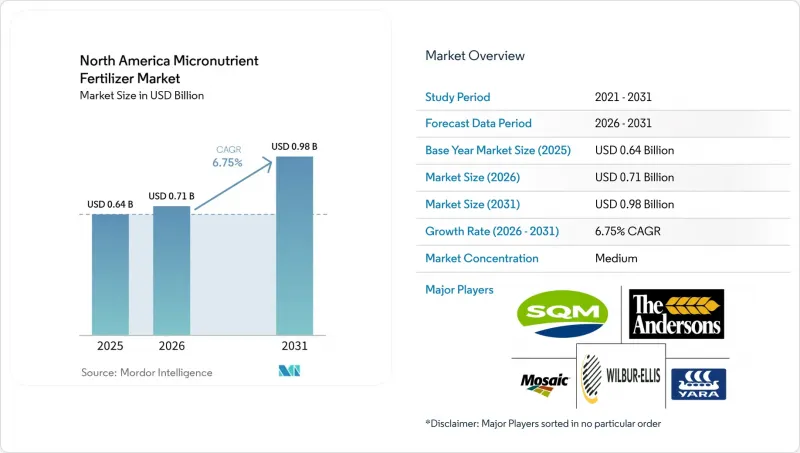
This report is Segmented by Product (Boron, Copper, Zinc, and More), Form (Conventional and Specialty), Specialty Type (Liquid Fertilizer and More), Application Mode (Fertigation, Foliar, and More), Crop Type (Field Crops, Horticultural Crops, and More), and Geography (Canada, United States, and More). The Market Forecasts are Provided in Terms of Value (USD) and Volume (Metric Tons).
North America Micronutrient Fertilizer Market Trends and Insights
Rising Soil Micronutrient Deficiencies Verified by Soil-Test Results
Laboratory reports show zinc deficiency in 35% of tested soils during 2024, up from 28% four years earlier. Yield losses of 15-20% in deficient corn fields highlight the economic hit. High-pH prairie soils worsen the issue because alkaline conditions lock micronutrients in unavailable forms. Similar trends surface for boron on sandy or high-rainfall sites, where leaching intensifies losses. Growers now integrate site-specific prescriptions into seeding and fertilization runs, making micronutrient application a core element rather than a rescue measure. This data-driven shift hastens movement away from blanket NPK blends toward targeted formulas that close observable gaps.
Expansion of GM-Crop Acreage with Higher Micronutrient Requirements
Ninety-four percent of U.S. corn and 96% of soybean acreage used GM traits in 2024. Newer hybrids with enhanced protein need roughly 25% more zinc and manganese, while herbicide-tolerant soybeans pull more copper and iron to maintain photosynthesis under chemical stress. Seed firms now bundle genetics with nutrient recommendations, creating bundled demand that rides every wave of trait adoption. Field trials also reveal that deeper roots from biotech lines access subsoil stores better, but only when the profile holds enough available micronutrients, setting the stage for supplemental programs that release full genetic potential.
Higher Per-Acre Cost Versus Bulk NPK Blends
Micronutrient programs cost USD 35-45 per acre against USD 8-12 for standard NPK, a 300-400% premium that narrows margins when commodity prices soften. Tenants on annual leases hesitate to invest in soil health that outlives their contracts. Some insurers now offer coverage tied to documented deficiencies, nudging uptake, but widespread relief likely hinges on lower-cost sources such as recycled boron or bundling incentives from seed and input suppliers.
Other drivers and restraints analyzed in the detailed report include:
- Government Subsidies for Precision Micronutrient Application
- Integrated Retailer Distribution Networks Improving Accessibility
- Regulatory Uncertainty on Heavy-Metal Limits in Formulations
For complete list of drivers and restraints, kindly check the Table Of Contents.
Segment Analysis
Zinc retained the largest share of the North America micronutrient fertilizer market in 2025, with 24.1%, because alkaline soils with a pH above 7.5 limit natural zinc availability. Deficiency signs, stunted growth, and interveinal chlorosis are easy for growers to spot, so zinc is often the first micronutrient added to standard blends. Copper followed at a significant share, largely because specialty and organic producers value its dual nutrition and fungicidal traits. Molybdenum ranked close behind, reflecting its role in nitrogen fixation for legume crops even as battery makers tighten global supply lines. Iron is secured by targeting high-pH soils that lock up native iron, while manganese focuses on soybeans grown in no-till fields rich in organic matter.
Boron showed the fastest momentum with a 7.3% CAGR through 2031 as fruit and vegetable acreage expands and buyers demand uniform fruit set. Emerging elements such as nickel and silicon are in the "Others" bucket and are growing in importance as research highlights their value in intensive systems. Innovation centers on chelation chemistries and dust-free granules that raise bioavailability and allow lower application rates. These improvements ease cost pressure in broad-acre programs while helping high-value crops hit strict quality grades. Suppliers also test multi-element mixes that address multiple deficiencies simultaneously, reducing labor and field passes. Together, these shifts keep zinc on top yet open space for boron and other rising nutrients to capture share as agronomic knowledge spreads.
Conventional granular and powder products accounted for 78.0% of 2025 sales because they fit into existing spreaders and planters without additional equipment or training. Lower production costs and established supply chains keep prices competitive, which matters on large corn and soybean farms that track every input dollar. Steady adoption is evident as more fields test for shortfalls in zinc, boron, or both.
Specialty formulations are the fastest-growing, with a 6.6% CAGR through 2031, driven by premium crops and precision systems that reward nutrient-use efficiency. Specialty products use chelation, slow-release coatings, and multi-element blends to deliver more nutrients per pound. This higher efficiency can offset the sticker price by trimming the total rate and cutting extra trips across the field. Growers in horticulture, organic programs, and controlled-environment sites accept the premium because crop value is high and quality standards are tight. Continuous product innovation also supports environmental goals by reducing runoff risk, a growing concern for regulators and buyers alike.
Complete Report Scope:
- Product
- Boron
- Copper
- Iron
- Manganese
- Molybdenum
- Zinc
- Others
- Form
- Conventional
- Specialty
- Specialty Type
- Liquid Fertilizer
- Water Soluble
- Application Mode
- Fertigation
- Foliar
- Soil
- Crop Type
- Field Crops
- Horticultural Crops
- Turf and Ornamental
- Geography
- Canada
- Mexico
- United States
- Rest of North America
List of Companies Covered in this Report:
- The Mosaic Company
- The Andersons Inc.
- Yara International ASA
- Wilbur-Ellis Company LLC
- Sociedad Quimica y Minera de Chile SA
- Nutrien Ltd.
- Compass Minerals International Inc.
- BASF SE
- Helena Agri-Enterprises LLC
- AgroLiquid
- ICL Group Ltd.
- Koch Agronomic Services LLC
- Brandt Consolidated Inc.
- Alltech Crop Science
- Valagro S.p.A.
Additional Benefits:
- The market estimate (ME) sheet in Excel format
- 3 months of analyst support
TABLE OF CONTENTS
1 Introduction
- 1.1 Study Assumptions and Market Definition
- 1.2 Scope of the Study
- 1.3 Research Methodology
2 Report Offers
3 Executive Summary and Key Findings
4 Key Industry Trends
- 4.1 Acreage of Major Crop Types
- 4.1.1 Field Crops
- 4.1.2 Horticultural Crops
- 4.2 Average Nutrient Application Rates
- 4.2.1 Micronutrients
- 4.3 Agricultural Land Equipped for Irrigation
- 4.4 Regulatory Framework
- 4.5 Value Chain & Distribution Channel Analysis
- 4.6 Market Drivers
- 4.6.1 Rising soil micronutrient deficiencies verified by soil-test results
- 4.6.2 Expansion of GM-crop acreage with higher micronutrient requirements
- 4.6.3 Government subsidies for precision micronutrient application
- 4.6.4 Integrated retailer distribution networks improving accessibility
- 4.6.5 Adoption of chelated liquids in indoor and vertical farms
- 4.6.6 E-waste-derived boron lowering input costs
- 4.7 Market Restraints
- 4.7.1 Higher per-acre cost versus bulk NPK blends
- 4.7.2 Regulatory uncertainty on heavy-metal limits in formulations
- 4.7.3 Molybdenum ore supply diverted to battery sector
- 4.7.4 Advisor knowledge gap on nutrient stacking effects
5 Market Size and Growth Forecasts (Value and Volume)
- 5.1 Product
- 5.1.1 Boron
- 5.1.2 Copper
- 5.1.3 Iron
- 5.1.4 Manganese
- 5.1.5 Molybdenum
- 5.1.6 Zinc
- 5.1.7 Others
- 5.2 Form
- 5.2.1 Conventional
- 5.2.2 Specialty
- 5.3 Specialty Type
- 5.3.1 Liquid Fertilizer
- 5.3.2 Water Soluble
- 5.4 Application Mode
- 5.4.1 Fertigation
- 5.4.2 Foliar
- 5.4.3 Soil
- 5.5 Crop Type
- 5.5.1 Field Crops
- 5.5.2 Horticultural Crops
- 5.5.3 Turf and Ornamental
- 5.6 Geography
- 5.6.1 Canada
- 5.6.2 Mexico
- 5.6.3 United States
- 5.6.4 Rest of North America
6 Competitive Landscape
- 6.1 Key Strategic Moves
- 6.2 Market Share Analysis
- 6.3 Company Landscape
- 6.4 Company Profiles (includes Global Level Overview, Market Level Overview, Core Segments, Financials as available, Strategic Information, Market Rank/Share for key companies, Products and Services, and Recent Developments)
- 6.4.1 The Mosaic Company
- 6.4.2 The Andersons Inc.
- 6.4.3 Yara International ASA
- 6.4.4 Wilbur-Ellis Company LLC
- 6.4.5 Sociedad Quimica y Minera de Chile SA
- 6.4.6 Nutrien Ltd.
- 6.4.7 Compass Minerals International Inc.
- 6.4.8 BASF SE
- 6.4.9 Helena Agri-Enterprises LLC
- 6.4.10 AgroLiquid
- 6.4.11 ICL Group Ltd.
- 6.4.12 Koch Agronomic Services LLC
- 6.4.13 Brandt Consolidated Inc.
- 6.4.14 Alltech Crop Science
- 6.4.15 Valagro S.p.A.
7 Key Strategic Questions for Fertilizer CEOs

