PUBLISHER: Mordor Intelligence | PRODUCT CODE: 2097058

PUBLISHER: Mordor Intelligence | PRODUCT CODE: 2097058
Africa Alfalfa - Market Share Analysis, Industry Trends & Statistics, Growth Forecasts (2026 - 2031)
According to Mordor Intelligence, the Africa alfalfa market size has grown from USD 550 million in 2025 to USD 600 million in 2026 and is forecast to reach USD 915 million by 2031, registering a CAGR of 8.8% during 2026-2031.
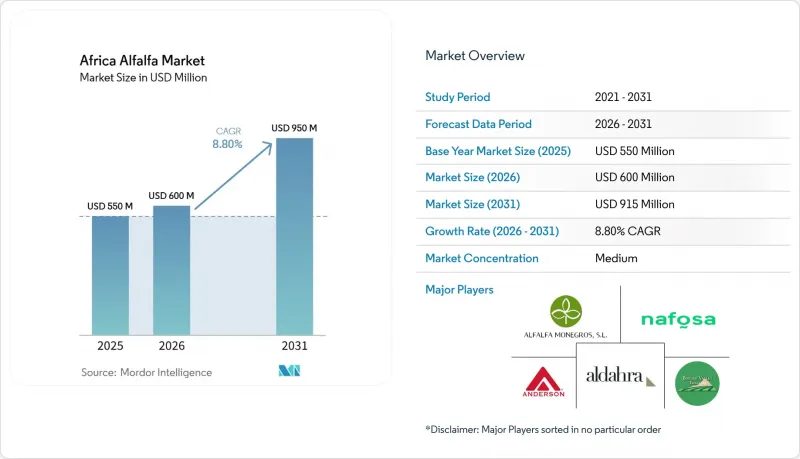
This report is Segmented by Product Type (Bales, Pellets, and More), by Application (Dairy Cattle Feed, Beef Cattle Feed, and More), by End Use Sector (Commercial Farms, Compound Feed Manufacturers, and More) and Geography (Egypt, South Africa, and More). The Market Forecasts are Provided in Terms of Value (USD) and Volume (Metric Tons).
Africa Alfalfa Market Trends and Insights
Increasing Demand for Protein-Rich Dairy Feed Rations
The market is closely linked to the region's dairy feed transition, as commercial farms shift from low-yield feeding systems to more balanced rations. Alfalfa remains central to this transition because its protein density supports total mixed ration programs used by modern dairy operations. This dynamic stabilizes demand in countries where processors consistently reward higher milk volume and quality. The shift is also extending beyond large farms, as cooperative-linked producers increasingly adopt structured feed programs to improve herd output and milk quality.
Growth in Export-Oriented Forage Markets
Global forage trade dynamics will also shape the market, with supply resilience becoming as important as price. In early 2025, China imposed a 125% tariff on U.S. alfalfa, disrupting trade flows before lowering the levy to 7% in May 2025. This kind of policy shock is likely to push suppliers to diversify destination markets and reroute volumes more flexibly. For Africa, Egypt and South Africa may emerge as practical buffer markets for buyers seeking continuity of supply. The trend should further strengthen multi-origin procurement strategies among import-dependent customers across the region. Suppliers with access to multiple production origins will therefore be better positioned to absorb freight disruptions, policy shifts, and demand swings.
Water Availability Constraints and Irrigation Policy Challenges
Water scarcity remains the clearest long-term restraint on the African alfalfa market, as alfalfa requires 400-600 m3 of water per metric ton of dry matter. Morocco has experienced six consecutive years of drought since 2018 to 2025, and pressure remains more severe because much of its cultivated land relies on rain-fed conditions. Algeria also faces rising irrigation demand, which could exceed sustainable aquifer recharge if current patterns continue. The issue extends to Egypt, where the largest consuming market must manage both domestic feed demand and the water cost embedded in forage production amid tighter Nile-related pressures. These conditions increase local production costs and limit how quickly the African alfalfa market can expand through domestic acreage alone.
Other drivers and restraints analyzed in the detailed report include:
- Rising Preference for Organic and Non-Gmo Products
- Growing Carbon Credit Potential from Legume Crop Rotations
- Volatility in Freight Costs and Export Logistics
For complete list of drivers and restraints, kindly check the Table Of Contents.
Segment Analysis
Bales retained a 45% market share of the Africa alfalfa market in 2025, reflecting the format's suitability for low-infrastructure handling across dairy and livestock farms. Farmers can store 50-100-kilogram bales in basic sheds and move them without specialized handling systems, making them practical for small and mid-sized operators. Compressed bales continue to support export-oriented trade, where container efficiency matters more than farm-level convenience. Cubes remain a smaller but stable format for buyers who require cleaner handling and more uniform feed quality.
Pellets are the fastest-growing product type in the market and are projected to register a 12.2% CAGR between 2026 and 2031. Their appeal is strongest among urban-fringe feed mills and integrated livestock systems that already use automated handling. Pellets reduce transport inefficiencies, extend storage life, and fit mechanized feeding lines more easily than loose or standard baled forage. This trend is gradually shifting the industry away from format decisions based solely on basic availability and toward choices driven by logistics efficiency and processing compatibility. Over time, wider power access and improved feed infrastructure are anticipated to narrow the gap between traditional bales and higher-density processed formats.
Complete Report Scope:
- By Product Type
- Bales
- Pellets
- Cubes
- Compressed Bales
- By Application
- Dairy Cattle Feed
- Beef Cattle Feed
- Poultry Feed
- Equine Feed
- Small Ruminant Feed
- Camelids and Other Livestock Feed
- By End Use Sector
- Commercial Farms
- Compound Feed Manufacturers
- Household and Hobby Animal Owners
- Pet Food and Specialty Nutrition
- By Geography
- Egypt
- South Africa
- Kenya
- Morocco
- Algeria
- Nigeria
- Ethiopia
- Rest of Africa
List of Companies Covered in this Report:
- Anderson Hay and Grain Inc.
- Al Dahra ACX Global Inc.
- Border Valley Trading
- Alfalfa Monegros SL
- Grupo Oses Agroalimentaria S.L. (NAFOSA S.A.)
- Gruppo Carli
- Bailey Farms International
- SL Follen Company
- Doulier Hay France SAS
- El-Meena Farms Ltd
Additional Benefits:
- The market estimate (ME) sheet in Excel format
- 3 months of analyst support
TABLE OF CONTENTS
1 INTRODUCTION
- 1.1 Study Assumptions and Market Definition
- 1.2 Scope of the Study
2 RESEARCH METHODOLOGY
3 EXECUTIVE SUMMARY
4 MARKET LANDSCAPE
- 4.1 Market Overview
- 4.2 Market Drivers
- 4.2.1 Increasing demand for protein-rich dairy feed rations
- 4.2.2 Growth in export-oriented forage markets
- 4.2.3 Rising preference for organic and non-GMO products
- 4.2.4 Growing carbon credit potential from legume crop rotations
- 4.2.5 Advances in precision drying and moisture management after harvest
- 4.2.6 Expanding demand from equine and specialty livestock feed
- 4.3 Market Restraints
- 4.3.1 Water availability constraints and irrigation policy challenges
- 4.3.2 Freight Volatility and Export Logistics Risk
- 4.3.3 Competitive pressure from grass hay and silage alternatives
- 4.3.4 Compliance challenges related to phytosanitary standards and residue limits
- 4.4 Regulatory Landscape
- 4.5 Technological Outlook
- 4.6 Porter's Five Forces Analysis
- 4.6.1 Threat of New Entrants
- 4.6.2 Bargaining Power of Buyers
- 4.6.3 Bargaining Power of Suppliers
- 4.6.4 Threat of Substitutes
- 4.6.5 Intensity of Competitive Rivalry
5 MARKET SIZE AND GROWTH FORECASTS (VALUE AND VOLUME)
- 5.1 By Product Type
- 5.1.1 Bales
- 5.1.2 Pellets
- 5.1.3 Cubes
- 5.1.4 Compressed Bales
- 5.2 By Application
- 5.2.1 Dairy Cattle Feed
- 5.2.2 Beef Cattle Feed
- 5.2.3 Poultry Feed
- 5.2.4 Equine Feed
- 5.2.5 Small Ruminant Feed
- 5.2.6 Camelids and Other Livestock Feed
- 5.3 By End Use Sector
- 5.3.1 Commercial Farms
- 5.3.2 Compound Feed Manufacturers
- 5.3.3 Household and Hobby Animal Owners
- 5.3.4 Pet Food and Specialty Nutrition
- 5.4 By Geography
- 5.4.1 Egypt
- 5.4.2 South Africa
- 5.4.3 Kenya
- 5.4.4 Morocco
- 5.4.5 Algeria
- 5.4.6 Nigeria
- 5.4.7 Ethiopia
- 5.4.8 Rest of Africa
6 COMPETITIVE LANDSCAPE
- 6.1 Market Concentration
- 6.2 Strategic Moves
- 6.3 Market Share Analysis
- 6.4 Company Profiles (includes Global Level Overview, Market Level Overview, Core Segments, Financials as Available, Strategic Information, Market Rank/Share, Products and Services, Recent Developments)
- 6.4.1 Anderson Hay and Grain Inc.
- 6.4.2 Al Dahra ACX Global Inc.
- 6.4.3 Border Valley Trading
- 6.4.4 Alfalfa Monegros SL
- 6.4.5 Grupo Oses Agroalimentaria S.L. (NAFOSA S.A.)
- 6.4.6 Gruppo Carli
- 6.4.7 Bailey Farms International
- 6.4.8 SL Follen Company
- 6.4.9 Doulier Hay France SAS
- 6.4.10 El-Meena Farms Ltd
7 MARKET OPPORTUNITIES AND FUTURE OUTLOOK

