PUBLISHER: Mordor Intelligence | PRODUCT CODE: 2097068

PUBLISHER: Mordor Intelligence | PRODUCT CODE: 2097068
Europe Alfalfa - Market Share Analysis, Industry Trends & Statistics, Growth Forecasts (2026 - 2031)
According to Mordor Intelligence, the Europe alfalfa market size is projected to increase from USD 4.00 billion in 2025 to USD 4.11 billion in 2026 and reach USD 4.68 billion by 2031, registering a CAGR of 2.64% from 2026 to 2031.
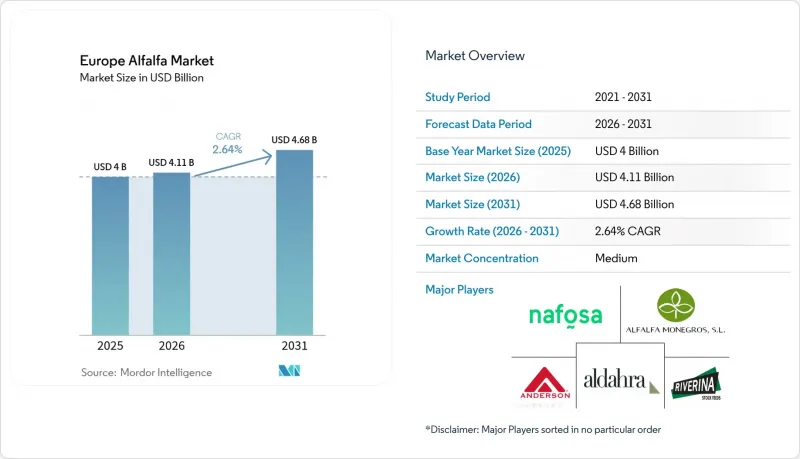
This report is Segmented by Product Type (Bales, Pellets, and More), by Application (Dairy Cattle, Beef Cattle and More), by End Use Sector (Commercial Farms, Compound Feed Manufacturers, and More), and by Geography (Spain, France, and More). The Market Forecasts are Provided in Terms of Value (USD) and Volume (Metric Tons).
Europe Alfalfa Market Trends and Insights
Increasing Adoption of High-Protein Alfalfa in European Dairy Rations
The Europe alfalfa market continues to benefit from dairy farms seeking dependable, protein-rich forage amid volatile feed costs. Teagasc in 2025 notes that intensive dairy feeding programs require a strong nutritional balance, and alfalfa fits well because it helps meet crude protein targets without relying solely on higher-cost concentrate inputs. The evidence also shows that dairy cooperatives in Castile and Leon and Galicia, Spain, have raised per-cow alfalfa inclusion rates by 9% since 2024, as protein-linked forward contracts have become more common. A 2025 study in Frontiers in Sustainable Food Systems found that fodder legumes can reduce greenhouse gas emissions in dairy systems when they replace rapeseed-extraction meal as a protein source. This combination of nutritional value, ration flexibility, and emissions-reduction benefits keeps dairy demand as the most stable volume base in the Europe alfalfa market.
Growth in Export-Driven Alfalfa Forage Trade Across Key European Corridors
The market also gains support from a stronger export position, particularly in Spain and France. Spanish Association of Dehydrated Alfalfa Manufacturers (AEFA) data indicate that Spanish dehydrated alfalfa exports reached 1,080,641 metric tons in 2025, a 43.5% increase from 2024, reflecting a strong recovery in overseas demand. The same source indicates that the United Arab Emirates received 133,622 metric tons of bale exports during the 2024-2025 campaign, while South Korea significantly increased its purchases from Spain, highlighting the expansion of trade relationships beyond a narrow buyer base. La Cooperation Agricole states that France's Luzerne de France network operates 24 dehydration plants, providing the French side of the Europe alfalfa market with a broad processing base and a stable platform for intra-European sales. The wider trade environment also remains supportive, as the European Commission reported a European Union agri-food trade surplus of EUR 49.9 billion in 2025, equivalent to USD 53.892 billion, confirming the structural strength of export-oriented agricultural supply chains.Collectively, this export momentum signals to buyers across Asia and the Gulf that European alfalfa supply chains are structurally reliable, reducing the procurement-risk premium that has historically pushed long-term contract buyers toward North American suppliers, and reinforcing Europe's position as a primary, rather than supplementary, source of high-quality dehydrated forage.
Limited Water Availability and Tightening Irrigation Policies
Water access remains the most significant structural supply constraint in the Europe alfalfa market. Alfalfa can produce multiple cuttings per season, but this output requires reliable irrigation, especially in Mediterranean production zones where summer moisture stress is common. This factor is particularly important in Spain, as the country serves as the main production base for export-grade dehydrated alfalfa and supports a large share of the Europe alfalfa market's tradable supply. When irrigation allocations tighten, the second and third cuttings become more vulnerable, and processors experience lower throughput and less consistent raw material quality. As a result, the market can continue to grow only if productivity gains and water-efficient agronomy offset the hard ceiling created by stricter water management.
Other drivers and restraints analyzed in the detailed report include:
- Rising Demand for Certified Organic and Non-GMO Alfalfa Forage
- Carbon Credit Opportunities in Alfalfa-Inclusive Crop Rotations
- Shipping Rate Instability and Export Logistics Uncertainty
For complete list of drivers and restraints, kindly check the Table Of Contents.
Segment Analysis
Bales held 44.10% of the Europe alfalfa market share in 2025, maintaining their position as the leading product format across large dairy operations in Germany, France, and Spain. Bale handling supports automated feeding systems, requires less processing than pellets, and moves efficiently through established regional supply chains, which continues to strengthen their market position. Standard bale formats also meet the needs of buyers that prioritize volume, feed familiarity, and lower unit costs over premium presentation. Compressed bales serve a narrower but important role by improving container fill rates and reducing freight costs per metric ton in export programs.
Pellets represent the strongest growth format, with the Europe alfalfa market size for pellets projected to expand at a CAGR of 7.80% from 2026 to 2031. Pellets are gaining traction because they offer better moisture stability, more uniform density, and easier handling in precision feeding systems and dust-sensitive equine settings. The analysis also indicates that pellet capacity expansion remains concentrated among a limited number of vertically integrated Spanish operators, which means supply additions may occur in uneven phases rather than follow a smooth trajectory. Cubes remain a useful middle ground because they provide better density than loose bales while retaining appeal in specialist feeding programs that value palatability and leaf retention.
Complete Report Scope:
- By Product Type
- Bales
- Pellets
- Cubes
- Compressed Bales
- By Application
- Dairy Cattle Feed
- Beef Cattle Feed
- Poultry Feed
- Equine Feed
- Small Ruminant Feed
- Camelids and Other Livestock Feed
- By End Use Sector
- Commercial Farms
- Compound Feed Manufacturers
- Household and Hobby Animal Owners
- Pet Food and Specialty Nutrition
- By Geography
- Spain
- France
- United Kingdom
- Germany
- Russia
- Rest of Europe
List of Companies Covered in this Report:
- Anderson Hay and Grain Inc.
- Standlee Premium Products LLC
- Border Valley Trading
- Alfalfa Monegros SL
- Grupo Oses Agroalimentaria S.L. (NAFOSA S.A.)
- Grupo Carli
- Green Prairie International Inc.
- Cubeit Hay Company
- Riverina Pty Ltd.
- Al Dahra ACX Global Inc.
- Desialis
- Doulier Hay France SAS
- California Alfalfa Products Inc.
- S.A. Campos de Castilla
- McCracken Hay Company
- Haykingdom Inc.
- Bailey Farms International
- M and C Hay LLC
- The Gombos Company LLC
- Hay USA Inc.
Additional Benefits:
- The market estimate (ME) sheet in Excel format
- 3 months of analyst support
TABLE OF CONTENTS
1 INTRODUCTION
- 1.1 Study Assumptions and Market Definition
- 1.2 Scope of the Study
2 RESEARCH METHODOLOGY
3 EXECUTIVE SUMMARY
4 MARKET LANDSCAPE
- 4.1 Market Overview
- 4.2 Market Drivers
- 4.2.1 Increasing adoption of high-protein alfalfa in European dairy rations
- 4.2.2 Growth in export-driven alfalfa forage trade across key European corridors
- 4.2.3 Rising demand for certified organic and non-GMO alfalfa forage
- 4.2.4 Carbon credit opportunities in alfalfa-inclusive crop rotations
- 4.2.5 Advances in post-harvest precision drying and moisture management
- 4.2.6 Rising alfalfa adoption in equine and specialty livestock nutrition
- 4.3 Market Restraints
- 4.3.1 Limited water availability and tightening irrigation policies
- 4.3.2 Shipping rate instability and export logistics uncertainty
- 4.3.3 Competitive pressure from grass hay and silage as feed substitutes
- 4.3.4 Compliance burden from phytosanitary and residue regulations
- 4.4 Regulatory Landscape
- 4.5 Technological Outlook
- 4.6 Porter's Five Forces Analysis
- 4.6.1 Threat of New Entrants
- 4.6.2 Bargaining Power of Buyers
- 4.6.3 Bargaining Power of Suppliers
- 4.6.4 Threat of Substitutes
- 4.6.5 Intensity of Competitive Rivalry
5 MARKET SIZE AND GROWTH FORECASTS (VALUE AND VOLUME)
- 5.1 By Product Type
- 5.1.1 Bales
- 5.1.2 Pellets
- 5.1.3 Cubes
- 5.1.4 Compressed Bales
- 5.2 By Application
- 5.2.1 Dairy Cattle Feed
- 5.2.2 Beef Cattle Feed
- 5.2.3 Poultry Feed
- 5.2.4 Equine Feed
- 5.2.5 Small Ruminant Feed
- 5.2.6 Camelids and Other Livestock Feed
- 5.3 By End Use Sector
- 5.3.1 Commercial Farms
- 5.3.2 Compound Feed Manufacturers
- 5.3.3 Household and Hobby Animal Owners
- 5.3.4 Pet Food and Specialty Nutrition
- 5.4 By Geography
- 5.4.1 Spain
- 5.4.2 France
- 5.4.3 United Kingdom
- 5.4.4 Germany
- 5.4.5 Russia
- 5.4.6 Rest of Europe
6 COMPETITIVE LANDSCAPE
- 6.1 Market Concentration
- 6.2 Strategic Moves
- 6.3 Market Share Analysis
- 6.4 Company Profiles (includes Global Level Overview, Market Level Overview, Core Segments, Financials as available, Strategic Information, Market Rank/Share, Products and Services, Recent Developments)
- 6.4.1 Anderson Hay and Grain Inc.
- 6.4.2 Standlee Premium Products LLC
- 6.4.3 Border Valley Trading
- 6.4.4 Alfalfa Monegros SL
- 6.4.5 Grupo Oses Agroalimentaria S.L. (NAFOSA S.A.)
- 6.4.6 Grupo Carli
- 6.4.7 Green Prairie International Inc.
- 6.4.8 Cubeit Hay Company
- 6.4.9 Riverina Pty Ltd.
- 6.4.10 Al Dahra ACX Global Inc.
- 6.4.11 Desialis
- 6.4.12 Doulier Hay France SAS
- 6.4.13 California Alfalfa Products Inc.
- 6.4.14 S.A. Campos de Castilla
- 6.4.15 McCracken Hay Company
- 6.4.16 Haykingdom Inc.
- 6.4.17 Bailey Farms International
- 6.4.18 M and C Hay LLC
- 6.4.19 The Gombos Company LLC
- 6.4.20 Hay USA Inc.
7 MARKET OPPORTUNITIES AND FUTURE OUTLOOK

