PUBLISHER: Mordor Intelligence | PRODUCT CODE: 2097089

PUBLISHER: Mordor Intelligence | PRODUCT CODE: 2097089
Asia-Pacific Alfalfa - Market Share Analysis, Industry Trends & Statistics, Growth Forecasts (2026 - 2031)
According to Mordor Intelligence, the Asia Pacific alfalfa market size is anticipated to grow from USD 10.90 billion in 2025 and USD 11.35 billion in 2026 to reach USD 14.60 billion by 2031 at a 5.17% CAGR from 2026 to 2031.
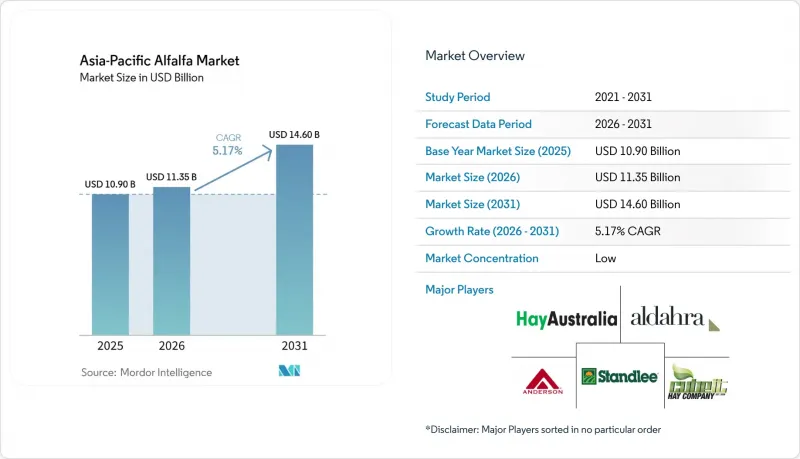
This report is Segmented by Product Type (Bales, Pellets, and More), by Application (Dairy Cattle Feed, Beef Cattle Feed, and More), by End Use Sector (Commercial Farms, Compound Feed Manufacturers, and More), and by Geography (China, Japan, India, Australia, South Korea, and the Rest of Southeast Asia). The Market Forecasts are Provided in Terms of Value (USD) and Volume (Metric Tons).
Asia-Pacific Alfalfa Market Trends and Insights
Rising Commercial Dairy Consolidation in China
China's dairy sector is in a recovery and restructuring phase in 2026 after several years of oversupply and weak milk prices. Mega-farms now account for more than 68.0% of national milk output in 2025, according to the United States Department of Agriculture (USDA), and that shift keeps demand concentrated among fewer but much larger buyers in the Asia Pacific alfalfa market. These farms depend on standardized high-protein rations, which raises the need for a dependable alfalfa supply throughout every season. During the 125% tariff period on United States alfalfa in early 2025, some Chinese farms reduced daily alfalfa use per cow from 3 kilograms to 1.5 kilograms. That adjustment reduced milk yield and herd health, which showed how difficult premium alfalfa is to replace in high-output systems. Inner Mongolia expanded artificial forage planting to 1.39 million hectares, and total forage supply moved past 75 million metric tons in 2025. Longer procurement contracts are therefore becoming more common, which gives major suppliers better visibility on forward volumes in the Asia Pacific alfalfa market
Premium Forage Adoption in India's Organized Dairy Co-Ops
India's organized dairy system is expanding faster than its premium forage base, which is creating a clear pull for alfalfa in the Asia Pacific alfalfa market. In May 2025, the Government of India announced three multi-state cooperative societies focused on animal feed production, disease control, and dairy development. The initiative is anticipated to strengthen certified fodder procurement, increase demand for quality forage, and support wider adoption of alfalfa in organized dairy supply chains. The Malabar Regional Cooperative Milk Producers' Union distributed USD 882,00 in fodder subsidies in 2025 to help farmers manage higher feed costs. India still faces a structural forage deficit because domestic alfalfa output does not consistently match the protein standards required by larger organized buyers. Seed improvement work with the Indian Grassland and Fodder Research Institute is also moving ahead, which supports medium-term productivity gains. As cooperatives scale milk collection and ration planning, the buying season for premium forage is likely to become longer and more predictable across the Asia Pacific alfalfa market.
Water Stress and Irrigation Competition in Key Producing Belts
Alfalfa is a crop that requires significant water input and consistent irrigation to achieve optimal yields. Seasonal water shortages in northern China and parts of western India hinder the expansion of domestic production. In Punjab and Haryana, groundwater depletion has led to increased regulatory scrutiny of water-intensive crops. Similarly, China's water-use reforms impose restrictions on irrigation in water-stressed provinces. The Central Ground Water Board (CGWB), in collaboration with State Governments, has completed the annual Dynamic Ground Water Resource assessment for the year 2025. According to the Central Groundwater Board (CGWB) of India, the total Annual groundwater recharge in the country is 448.52 Billion Cubic Meters (BCM), while the extractable groundwater resources amount to 407.75 BCM. This shift production to less water-stressed areas, such as Australia's Murray-Darling Basin or China's Xinjiang, where irrigation infrastructure is more developed, though higher transport costs to demand centers remain a challenge.
Other drivers and restraints analyzed in the detailed report include:
- Export Quality Upgrades, Traceability, and Contracted Supply Premiums
- Greenhouse-Grade Forage Demand from Urban and Peri-Urban Livestock Systems
- High Freight Volatility and Port Congestion on Intra-Asia Trade Lanes
For complete list of drivers and restraints, kindly check the Table Of Contents.
Segment Analysis
Bales held 56.2% of the Asia Pacific alfalfa market by value in 2025, making them the leading format across China, Japan, and South Korea. Their lead came from long-standing trade links between exporters in Australia, the United States Pacific Northwest, and Spain, and large dairy buyers that already use bale handling systems. Compressed bales, pellets, and cubes made up the balance of demand, with each format serving different freight, storage, and ration needs in the Asia Pacific alfalfa market.
Pellets are anticipated to record the fastest 7.4% CAGR between 2026 and 2031, supported by better container utilization, lower storage losses, and easier use in automated feeding systems. Cubes continue to appeal to equine and specialty livestock buyers because they are lower-dust and easier to portion at the farm level. Compressed bales remain relevant on long-haul export routes where freight efficiency matters, while standard bales should continue growing at a steadier pace because they remain the most familiar format for large dairy procurement teams. China's tighter feed-grade compliance framework is also strengthening the position of processed formats supplied by certified dehydration plants.
Complete Report Scope:
- By Product Type
- Bales
- Pellets
- Cubes
- Compressed Bales
- By Application
- Dairy Cattle Feed
- Beef Cattle Feed
- Poultry Feed
- Equine Feed
- Small Ruminant Feed
- Camelids and Other Livestock Feed
- By End Use Sector
- Commercial Farms
- Compound Feed Manufacturers
- Household and Hobby Animal Owners
- Pet Food and Specialty Nutrition
- By Geography
- China
- India
- Japan
- Australia
- South Korea
- Rest of Asia Pacific
List of Companies Covered in this Report:
- Al Dahra Holding LLC
- Anderson Hay & Grain Co., Inc.
- Standlee Premium Products, LLC
- Cubeit Hay Company LLC
- Bailey Farms Inc.
- Hay Australia (AgTrade Holdings LLC)
- Calaway Trading, Inc. (Pacific AG Solutions LLC)
- Border Valley Trading Ltd.
- Alfalfa Monegros, S.L.
- Gruppo Carli S.p.A.
- M&C Hay LLC
- Green Prairie International, Inc.
- S.L. Follen Company
- Riverina Pty Ltd (Mitsubishi Corporation)
Additional Benefits:
- The market estimate (ME) sheet in Excel format
- 3 months of analyst support
TABLE OF CONTENTS
1 INTRODUCTION
- 1.1 Study Assumptions and Market Definition
- 1.2 Scope of the Study
2 RESEARCH METHODOLOGY
3 EXECUTIVE SUMMARY
4 MARKET LANDSCAPE
- 4.1 Market Overview
- 4.2 Market Drivers
- 4.2.1 Rising commercial dairy consolidation in China
- 4.2.2 Premium forage adoption in India's organized dairy co-ops
- 4.2.3 Export quality upgrades, traceability, and contracted supply premiums
- 4.2.4 Greenhouse-grade forage demand from urban and peri-urban livestock systems
- 4.2.5 Mechanized dehydration and pelletization expanding shelf-life and trade reach
- 4.2.6 Climate risk hedging through multi-origin feed procurement
- 4.3 Market Restraints
- 4.3.1 Water stress and irrigation competition in key producing belts
- 4.3.2 High freight volatility and port congestion on intra-Asia trade lanes
- 4.3.3 Land costs and yield uncertainty near export corridors
- 4.3.4 Limited salt-tolerant and heat-tolerant varietal commercialization
- 4.4 Regulatory Landscape
- 4.5 Technological Outlook
- 4.6 Porter's Five Forces Analysis
- 4.6.1 Threat of New Entrants
- 4.6.2 Bargaining Power of Buyers
- 4.6.3 Bargaining Power of Suppliers
- 4.6.4 Threat of Substitutes
- 4.6.5 Intensity of Competitive Rivalry
5 MARKET SIZE AND GROWTH FORECASTS (VALUE AND VOLUME)
- 5.1 By Product Type
- 5.1.1 Bales
- 5.1.2 Pellets
- 5.1.3 Cubes
- 5.1.4 Compressed Bales
- 5.2 By Application
- 5.2.1 Dairy Cattle Feed
- 5.2.2 Beef Cattle Feed
- 5.2.3 Poultry Feed
- 5.2.4 Equine Feed
- 5.2.5 Small Ruminant Feed
- 5.2.6 Camelids and Other Livestock Feed
- 5.3 By End Use Sector
- 5.3.1 Commercial Farms
- 5.3.2 Compound Feed Manufacturers
- 5.3.3 Household and Hobby Animal Owners
- 5.3.4 Pet Food and Specialty Nutrition
- 5.4 By Geography
- 5.4.1 China
- 5.4.2 India
- 5.4.3 Japan
- 5.4.4 Australia
- 5.4.5 South Korea
- 5.4.6 Rest of Asia Pacific
6 COMPETITIVE LANDSCAPE
- 6.1 Market Concentration
- 6.2 Strategic Moves
- 6.3 Market Share Analysis
- 6.4 Company Profiles (Includes Global Level Overview, Market Level Overview, Core Segments, Financials as available, Strategic Information, Market Rank/Share, Products and Services, Recent Developments)
- 6.4.1 Al Dahra Holding LLC
- 6.4.2 Anderson Hay & Grain Co., Inc.
- 6.4.3 Standlee Premium Products, LLC
- 6.4.4 Cubeit Hay Company LLC
- 6.4.5 Bailey Farms Inc.
- 6.4.6 Hay Australia (AgTrade Holdings LLC)
- 6.4.7 Calaway Trading, Inc. (Pacific AG Solutions LLC)
- 6.4.8 Border Valley Trading Ltd.
- 6.4.9 Alfalfa Monegros, S.L.
- 6.4.10 Gruppo Carli S.p.A.
- 6.4.11 M&C Hay LLC
- 6.4.12 Green Prairie International, Inc.
- 6.4.13 S.L. Follen Company
- 6.4.14 Riverina Pty Ltd (Mitsubishi Corporation)
7 MARKET OPPORTUNITIES AND FUTURE OUTLOOK

