PUBLISHER: Mordor Intelligence | PRODUCT CODE: 2097085

PUBLISHER: Mordor Intelligence | PRODUCT CODE: 2097085
United States Alfalfa - Market Share Analysis, Industry Trends & Statistics, Growth Forecasts (2026 - 2031)
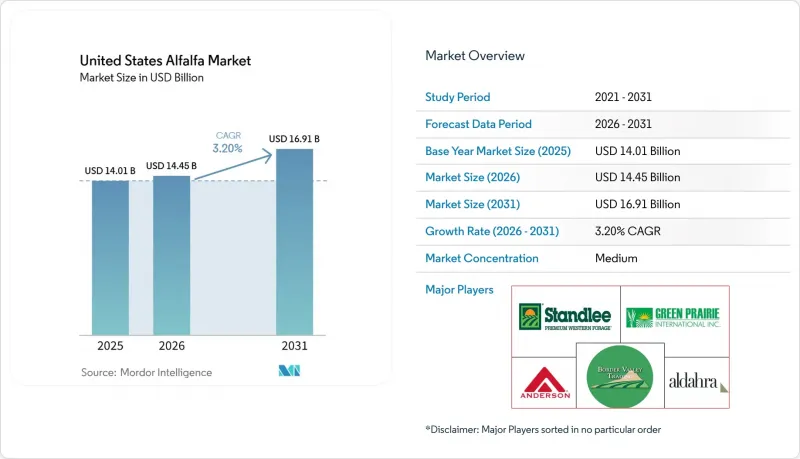
According to Mordor Intelligence, the United States alfalfa market was valued at USD 14.01 billion in 2025 and is estimated to grow from USD 14.45 billion in 2026 to USD 16.91 billion by 2031, at a CAGR of 3.2% during the forecast period from 2026 to 2031.
This report is Segmented by Product Type (Bales, Pellets, and More), Application (Dairy Cattle Feed, Beef Cattle Feed, and More), and by End Use Sector (Commercial Farms, Compound Feed Manufacturers, and More). The Market Forecasts are Provided in Terms of Value (USD) and Volume (Metric Tons).
United States Alfalfa Market Trends and Insights
Export Pull from Asia-Pacific and Middle East Feed Buyers
The market continues to benefit from structural import dependence in East Asian and Gulf dairy systems, despite weaker Chinese buying in 2025. Saudi Arabia and the United Arab Emirates (UAE) rely on imported forage, as water scarcity and food security policies limit local production, keeping offshore demand relevant for United States exporters. In 2025, Japan imported 329,559 metric tons of United States alfalfa, South Korea imported 210,746 metric tons, and Saudi Arabia imported 277,987 metric tons, creating a broad alternative demand base as China reduced purchases. The shift away from China is reshaping trade relationships rather than reducing overall export demand, helping the United States alfalfa market maintain value in premium supply chains tied to established buyers. Producers with established export infrastructure in California and Washington are better positioned to capture this redirected demand than operators serving only domestic spot markets.
Rising Demand for High-Protein Dairy and Beef Rations
The United States alfalfa market continues to draw strength from dairy and beef feed systems, as alfalfa remains difficult to replace in high-performance rations. The United States Department of Agriculture Economic Research Service (USDA ERS) projected the dairy cow inventory at 9.45 million head in 2025 and annual milk yield per cow at 24,255 pounds (11,001.8 Kg), supporting continued demand for nutrient-dense forage. A 2025 Purina Mills study on beef-on-dairy crossbreeding showed that such breedings declined by 5% in 2024, prompting herd managers to focus more on milking efficiency and replacement heifers, both of which favor high-specification feed inputs. The National Animal Nutrition Research Association (NANRA) reported in 2025 that more than 60% of added feed ingredients went into dairy and beef cattle diets, confirming where feed demand is concentrated. This keeps the United States alfalfa market closely tied to large livestock systems where fiber digestibility and protein density are critical at the ration level.
Water Allocation Limits in Drought-Stressed Production States
Water access remains the most significant structural constraint on the United States alfalfa market, as western production is closely tied to drought-stressed basins and regulated groundwater systems. Arizona's agricultural allocation for Colorado River water was fully cut off in both 2023 and 2024, and central Arizona alfalfa cultivation declined by 48% between 2022 and 2024 in the affected farming areas. In December 2024, the Arizona Attorney General filed a lawsuit against Fondomonte LLC, a subsidiary of Almarai, over groundwater extraction in La Paz County, indicating that regulatory attention was shifting beyond general water policy toward direct enforcement. As the regulations tighten, larger operators that can more effectively manage compliance, water rights, and legal exposure are likely to gain an advantage over smaller farms in the United States alfalfa market.
Other drivers and restraints analyzed in the detailed report include:
- Adoption of Certified Seed, Heat-Tolerant Varieties, and Precision Irrigation
- Expansion of Irrigated Alfalfa Acreage in High-Yield Western Corridors
- High Pumping, Drying, and Baling Costs
For complete list of drivers and restraints, kindly check the Table Of Contents.
Segment Analysis
Bales held 53.5% of the United States alfalfa market share in 2025, maintaining their position as the leading product type by revenue due to their deep integration into large dairy and beef operations. Cubes continue to serve equine and specialty small animal demand where lower dust levels and controlled intake are priorities. Compressed formats remain important for export-oriented supply chains, as they are better suited to long-distance handling and container logistics than loose bulk movement. This has resulted in a market structure where commodity bales preserve the volume base while pellets and related processed formats capture a greater share of value growth.
Pellets are the fastest growing product type in the United States alfalfa market, with this segment forecast to grow at a 3.0% CAGR from 2026 to 2031. Demand is rising because pellets are well suited to commercial equine feeding, specialty animal nutrition, and export channels that value consistent density, easier handling, and lower storage risk. The broader shift toward precision feeding is also making standardized product formats more attractive to buyers seeking repeatable ration performance over bulk commodity variation.
Complete Report Scope:
- By Product Type
- Bales
- Pellets
- Cubes
- Compressed Bales
- By Application
- Dairy Cattle Feed
- Beef Cattle Feed
- Poultry Feed
- Equine Feed
- Small Ruminant Feed
- Camelids and Other Livestock Feed
- By End Use Sector
- Commercial Farms
- Compound Feed Manufacturers
- Household and Hobby Animal Owners
- Pet Food and Specialty Nutrition
List of Companies Covered in this Report:
- Anderson Hay & Grain Co., Inc.
- Al Dahra ACX Global Inc.
- Standlee Premium Products LLC
- Green Prairie International Inc.
- Border Valley Trading, Ltd.
- Cubeit Hay Company
- Bailey Farms International
- Ward Rugh Inc.
- Oregon Hay Products, Inc.
- Haykingdom Inc.
- Barr-Ag Ltd.,
- SL Follen Co.
- Oxbow Enterprises, Inc. (Manna Pro Products LLC)
- M&C Hay LLC
Additional Benefits:
- The market estimate (ME) sheet in Excel format
- 3 months of analyst support
TABLE OF CONTENTS
1 INTRODUCTION
- 1.1 Study Assumptions and Market Definition
- 1.2 Scope of the Study
2 RESEARCH METHODOLOGY
3 EXECUTIVE SUMMARY
4 MARKET LANDSCAPE
- 4.1 Market Overview
- 4.2 Market Drivers
- 4.2.1 Expansion of irrigated alfalfa acreage in high-yield western corridors
- 4.2.2 Export pull from Asia-Pacific and Middle East feed buyers
- 4.2.3 Shift toward higher-margin forage crops on water-constrained farmland
- 4.2.4 Rising demand for high-protein dairy and beef rations
- 4.2.5 Adoption of certified seed, heat-tolerant varieties, and precision irrigation
- 4.2.6 Soil health value from alfalfa in rotation systems
- 4.3 Market Restraints
- 4.3.1 Water allocation limits in drought-stressed production states
- 4.3.2 High pumping, drying, and baling costs
- 4.3.3 Freight and handling losses in long-distance export chains
- 4.3.4 Quality downgrades from heat, dust, and inconsistent Storage
- 4.4 Regulatory Landscape
- 4.5 Technological Outlook
- 4.6 Porter's Five Forces Analysis
- 4.6.1 Threat of New Entrants
- 4.6.2 Bargaining Power of Buyers
- 4.6.3 Bargaining Power of Suppliers
- 4.6.4 Threat of Substitutes
- 4.6.5 Intensity of Competitive Rivalry
5 MARKET SIZE AND GROWTH FORECASTS (VALUE AND VOLUME)
- 5.1 By Product Type
- 5.1.1 Bales
- 5.1.2 Pellets
- 5.1.3 Cubes
- 5.1.4 Compressed Bales
- 5.2 By Application
- 5.2.1 Dairy Cattle Feed
- 5.2.2 Beef Cattle Feed
- 5.2.3 Poultry Feed
- 5.2.4 Equine Feed
- 5.2.5 Small Ruminant Feed
- 5.2.6 Camelids and Other Livestock Feed
- 5.3 By End Use Sector
- 5.3.1 Commercial Farms
- 5.3.2 Compound Feed Manufacturers
- 5.3.3 Household and Hobby Animal Owners
- 5.3.4 Pet Food and Specialty Nutrition
6 COMPETITIVE LANDSCAPE
- 6.1 Market Concentration
- 6.2 Strategic Moves
- 6.3 Market Share Analysis
- 6.4 Company Profiles (Includes Global Level Overview, Market Level Overview, Core Segments, Financials as available, Strategic Information, Market Rank/Share, Products and Services, Recent Developments)
- 6.4.1 Anderson Hay & Grain Co., Inc.
- 6.4.2 Al Dahra ACX Global Inc.
- 6.4.3 Standlee Premium Products LLC
- 6.4.4 Green Prairie International Inc.
- 6.4.5 Border Valley Trading, Ltd.
- 6.4.6 Cubeit Hay Company
- 6.4.7 Bailey Farms International
- 6.4.8 Ward Rugh Inc.
- 6.4.9 Oregon Hay Products, Inc.
- 6.4.10 Haykingdom Inc.
- 6.4.11 Barr-Ag Ltd.,
- 6.4.12 SL Follen Co.
- 6.4.13 Oxbow Enterprises, Inc. (Manna Pro Products LLC)
- 6.4.14 M&C Hay LLC
7 MARKET OPPORTUNITIES AND FUTURE OUTLOOK

