PUBLISHER: Mordor Intelligence | PRODUCT CODE: 2097081

PUBLISHER: Mordor Intelligence | PRODUCT CODE: 2097081
Spain Alfalfa - Market Share Analysis, Industry Trends & Statistics, Growth Forecasts (2026 - 2031)
According to Mordor Intelligence, the Spain alfalfa market size is expected to increase from USD 452 million in 2025 to USD 472.07 million in 2026 and reach USD 586.66 million by 2031, growing at a CAGR of 4.44% over 2026-2031.
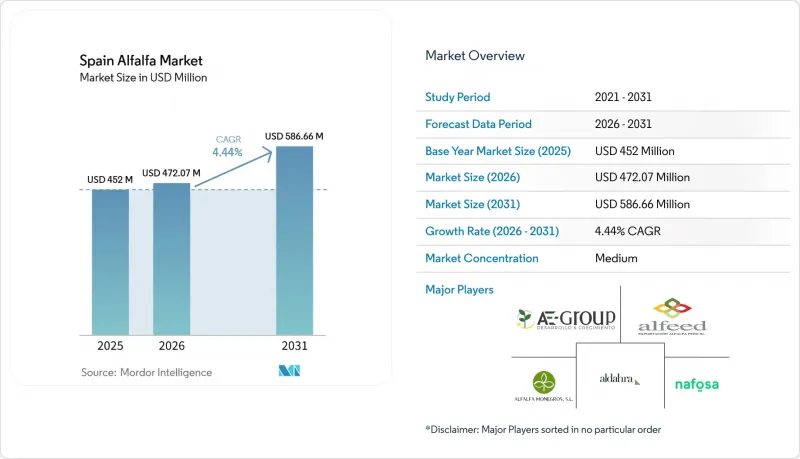
This report is Segmented by Product Type (Bales, Pellets, and More), by Application (Dairy Cattle Feed, Beef Cattle Feed, and More), by End Use Sector (Commercial Farms, Compound Feed Manufacturers, and More). The Market Forecasts are Provided in Terms of Value (USD) and Volume (Metric Tons).
Spain Alfalfa Market Trends and Insights
Aragon and Catalonia Dehydration Corridor Expansion
The processing density in the Aragon and Catalonia corridor gives the Spain alfalfa market an advantage that other European suppliers struggle to match at industrial scale. The Los Monegros X and XI modernization project covers 6,800 hectares and is anticipated to be completed in 2026, with EUR 55 million (USD 59.4 million) in investment supporting pressure-fed irrigation networks to replace older systems. This transition reduces water use per hectare, improves field consistency, and shortens the time between cutting and plant intake, enabling processors to manage moisture more precisely before drying. It also supports private expansion decisions in the Spain alfalfa market, as processing plants add capacity more confidently when the surrounding raw material base becomes more reliable.
Export Demand from Gulf Feed and Equine Buyers
Export demand from Saudi Arabia and the UAE continues to anchor the Spain alfalfa market, with those two destinations together accounting for more than 280,000 metric tons in the 2024/25 campaign, representing approximately 40% of total export volume. These buyers are significant not only because of their volume but also because they source steady quantities of dehydrated forage for organized dairy, equine, and camel feeding systems that require consistent product quality and reliable shipping, with Spain being one of the key suppliers. South Korea strengthened external demand in 2024-25, with procurement rising 548.4%, indicating that Spanish processed formats retain room to penetrate East Asian feed channels. Morocco also increased purchases by 387.2% in the same campaign, reflecting how drought-related feed gaps in nearby markets can generate a secondary source of demand when conditions tighten elsewhere. This broader buyer mix makes the Spain alfalfa market more resilient than when the Gulf corridor dominated nearly all export planning, even though Gulf-bound trade still sets the basic tone for processor utilization and inventory strategy. The strong rebound in 2025 export volumes confirms that external demand remains the clearest near-term support for market growth.
Water Allocation Pressure in Irrigated Growing Zones
Water policy remains the most significant structural risk to the Spain alfalfa market, as the most productive areas also depend heavily on irrigation. The Confederacion Hidrografica del Ebro (CHE) originally proposed cutting Ebro basin irrigation allocations by 12% to 15% for the 2028 to 2033 period, which raised concerns about raw material availability in the main production corridor. Aragon's regional government filed objections, and irrigator groups argued that lower allocations would weaken double-cropping economics and reduce the value of recent modernization works. The CHE signaled in November 2025 that it was reconsidering the proposal, but the issue remains relevant to medium-term planning. Drought conditions have already demonstrated how quickly supply risk can shift from policy debate to physical constraint, as seen in the 50% cut in irrigated crop area at the Ebro Delta during the Catalonia drought in 2024. The 14% decline reported for Aragon's 2026 campaign confirms that weather and water volatility are active operating issues for the Spain alfalfa market, not distant concerns.
Other drivers and restraints analyzed in the detailed report include:
- CAP Incentives for Rotational Forage Crops
- Irrigated Production Advantage in the Ebro Valley
- Competition From Alternative Feed and Forage Sources
For complete list of drivers and restraints, kindly check the Table Of Contents.
Segment Analysis
Bales held the largest share of 46.0% of the Spain alfalfa market in 2025, remaining the dominant format by value and the primary product form driving Spain's export activity. Their dominance reflects continued reliance by Gulf and Korean buyers on bale shipments for dairy, equine, and feed operations that require stable moisture and high protein retention. Cubes play a smaller but functional role in markets where storage space is limited, particularly in North Africa and parts of East Asia that require denser packaged forage. Compressed bales serve a distinct premium niche, as Gulf equine buyers prefer high-density formats that are easier to store and handle through port logistics. These product distinctions indicate that the Spain alfalfa market supplies a range of processed formats designed around different shipping, storage, and end-animal requirements, rather than a single standard feed item. This product mix also allows processors to spread risk across buyers with different handling systems and nutrition goals.
The Spain alfalfa market size for pellets is projected to grow the fastest at a 6.7% CAGR between 2026 and 2031. Pellet demand is rising across two fronts simultaneously, with large-volume fibrous pellets moving into livestock feed channels and smaller premium pellets moving into specialty nutrition applications. This shift is significant because pellet growth is no longer tied solely to commodity livestock rations, allowing processors to target higher-value channels with stricter specifications. In the market, this change favors operators that can control particle size, microbial quality, and batch traceability without disrupting throughput. Asociacion Espanola de Fabricantes de Alfalfa Deshidratada's (AEFA) 2026 promotion efforts in Vietnam and China reflect the market's attempt to broaden processed-format demand beyond the Gulf corridor. These efforts support the broader Spain alfalfa market by opening underpenetrated Asian channels for products that ship and store efficiently. Over time, pellets are likely to matter less for volume alone and more for their contribution to average realized value across the product mix. This makes pellets central to growth quality, even though bales continue to dominate current revenue.
Complete Report Scope:
- By Product Type
- Bales
- Pellets
- Cubes
- Compressed Bales
- By Application
- Dairy Cattle Feed
- Beef Cattle Feed
- Poultry Feed
- Equine Feed
- Small Ruminant Feed
- Camelids and Other Livestock Feed
- By End Use Sector
- Commercial Farms
- Compound Feed Manufacturers
- Household and Hobby Animal Owners
- Pet Food and Specialty Nutrition
List of Companies Covered in this Report:
- Al Dahra Agriculture LLC
- Alfalfa Monegros S.L.
- Alfeed (Exportacion Alfalfa Feed SL.)
- AE Desarrollo & Crecimiento, S.L. (AE Group, S.L.)
- Forrajes San Agustin, S.L.
- COFOCYL, S.L.
- La Pastora Quinto S.L.
- Desialis, S.L.
- Grupo Oses Agroalimentaria S.L. (NAFOSA)
- Forrajes y Proteinas, S.L.
- Forrajes de Ribaforada, S.L.
- Forrajes H. Nueno, S.L.
- Molinos Afau, S.L.
- Mesta Green Leafs Spain, S.L.
- Premium Pellets Spain, S.L.
- APISA, S.L.
Additional Benefits:
- The market estimate (ME) sheet in Excel format
- 3 months of analyst support
TABLE OF CONTENTS
1 INTRODUCTION
- 1.1 Study Assumptions and Market Definition
- 1.2 Scope of the Study
2 RESEARCH METHODOLOGY
3 EXECUTIVE SUMMARY
4 MARKET LANDSCAPE
- 4.1 Market Overview
- 4.2 Market Drivers
- 4.2.1 Aragon and Catalonia dehydration corridor expansion
- 4.2.2 Export demand from Gulf feed and equine buyers
- 4.2.3 CAP incentives for rotational forage crops
- 4.2.4 Irrigated production advantage in the Ebro valley
- 4.2.5 Industrial dehydration and processing network
- 4.2.6 Shift toward traceable, high-protein forage formats
- 4.3 Market Restraints
- 4.3.1 Water allocation pressure in irrigated growing zones
- 4.3.2 Heavy export dependence on a narrow buyer base
- 4.3.3 Fuel cost sensitivity in dehydration plants
- 4.3.4 Competition from alternative feed and forage sources
- 4.4 Regulatory Landscape
- 4.5 Technological Outlook
- 4.6 Porter's Five Forces Analysis
- 4.6.1 Threat of New Entrants
- 4.6.2 Bargaining Power of Buyers
- 4.6.3 Bargaining Power of Suppliers
- 4.6.4 Threat of Substitutes
- 4.6.5 Intensity of Competitive Rivalry
5 MARKET SIZE AND GROWTH FORECASTS (VALUE AND VOLUME)
- 5.1 By Product Type
- 5.1.1 Bales
- 5.1.2 Pellets
- 5.1.3 Cubes
- 5.1.4 Compressed Bales
- 5.2 By Application
- 5.2.1 Dairy Cattle Feed
- 5.2.2 Beef Cattle Feed
- 5.2.3 Poultry Feed
- 5.2.4 Equine Feed
- 5.2.5 Small Ruminant Feed
- 5.2.6 Camelids and Other Livestock Feed
- 5.3 By End Use Sector
- 5.3.1 Commercial Farms
- 5.3.2 Compound Feed Manufacturers
- 5.3.3 Household and Hobby Animal Owners
- 5.3.4 Pet Food and Specialty Nutrition
6 COMPETITIVE LANDSCAPE
- 6.1 Market Concentration
- 6.2 Strategic Moves
- 6.3 Market Share Analysis
- 6.4 Company Profiles (includes Global Level Overview, Market Level Overview, Core Segments, Financials as available, Strategic Information, Market Rank/Share, Products and Services, Recent Developments)
- 6.4.1 Al Dahra Agriculture LLC
- 6.4.2 Alfalfa Monegros S.L.
- 6.4.3 Alfeed (Exportacion Alfalfa Feed SL.)
- 6.4.4 AE Desarrollo & Crecimiento, S.L. (AE Group, S.L.)
- 6.4.5 Forrajes San Agustin, S.L.
- 6.4.6 COFOCYL, S.L.
- 6.4.7 La Pastora Quinto S.L.
- 6.4.8 Desialis, S.L.
- 6.4.9 Grupo Oses Agroalimentaria S.L. (NAFOSA)
- 6.4.10 Forrajes y Proteinas, S.L.
- 6.4.11 Forrajes de Ribaforada, S.L.
- 6.4.12 Forrajes H. Nueno, S.L.
- 6.4.13 Molinos Afau, S.L.
- 6.4.14 Mesta Green Leafs Spain, S.L.
- 6.4.15 Premium Pellets Spain, S.L.
- 6.4.16 APISA, S.L.
7 MARKET OPPORTUNITIES AND FUTURE OUTLOOK

