PUBLISHER: Mordor Intelligence | PRODUCT CODE: 2097087

PUBLISHER: Mordor Intelligence | PRODUCT CODE: 2097087
France Alfalfa - Market Share Analysis, Industry Trends & Statistics, Growth Forecasts (2026 - 2031)
According to Mordor Intelligence, the France alfalfa market size is projected to expand from USD 1.20 billion in 2025 and USD 1.25 billion in 2026 to USD 1.55 billion by 2031, registering a CAGR of 4.34% between 2026 to 2031.
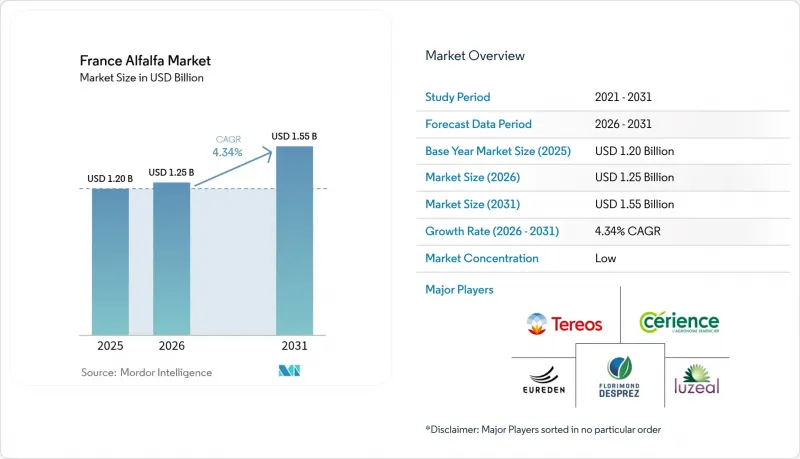
This report is Segmented by Product Type (Bales, Pellets, Cubes, and Compressed Bales), by Application (Dairy Cattle Feed, Beef Cattle Feed, Poultry Feed, and More), by End Use Sector (Commercial Farms, Compound Feed Manufacturers, Household and Hobby Animal Owners, and Pet Food and Specialty Nutrition). Market Forecasts are Provided in Value (USD) and Volume (Metric Tons).
France Alfalfa Market Trends and Insights
Rising Dairy And Beef Herd Demand In France
France's bovine herd kept shrinking in 2025, but feed demand per animal remained firm because productivity expectations continued to rise. According to the French Ministry of Agriculture and Food Sovereignty (Agreste), the dairy cow population fell to 3.22 million head in 2025, yet milk collection still rose to 24.2 million metric tons as milk yield per cow increased 5.2%. That pattern matters for the France alfalfa market because higher-output herds need more stable fiber and protein inputs across the year, especially in tightly managed feeding systems. This shift to robotized feeding and more precise ration design supports the continued use of dehydrated alfalfa even when total herd numbers decline. The France alfalfa market also draws support from horses, which already represented dehydrated alfalfa consumption in France and gives the sector a buffer outside cattle feed demand.
Protein Sovereignty Push For Domestic Feed Inputs
Market is closely tied to the country's effort to reduce dependence on imported soybean meal and strengthen domestic protein supply. Analysis cited in the shows that dehydrated alfalfa in a 3-year rotation can reduce synthetic nitrogen use by 53 kilograms per hectare each year and can generate 284,000 metric tons of digestible intestinal protein annually in France. That evidence gives the France alfalfa market a measurable role in domestic feed substitution rather than only an agronomic role in crop rotation. Certification also supports this position because non-GMO and Feed Chain Alliance standards make French alfalfa more usable for compound feed manufacturers facing traceability and emissions reporting requirements in Europe.
Competition From Maize Silage And Alternative Forages
The market still competes against maize silage, which remains the main incumbent feed option in many ruminant systems. ARVALIS reported national maize forage yield at 11.8 metric tons of dry matter per hectare in 2025, and the crop's energy quality improved from earlier years, which made it a stronger substitute in dairy rations. When maize silage is both cheaper and nutritionally stronger, feed formulators can shift away from dehydrated alfalfa and reduce demand at cooperative plants. La Cooperation Agricole - Luzerne de France openly recognized this substitution risk at the November 2025 World Alfalfa Congress, which is why the sector is pushing harder into equine and porcine channels. This remains a real brake on the France alfalfa market because commodity forage competition affects volumes more quickly than newer specialty uses can replace them.
Other drivers and restraints analyzed in the detailed report include:
- Expansion Of Low-Carbon And Organic Livestock Specifications
- Expansion Of Dehydration Capacity And Plant Consolidation
- Farm Labor Scarcity During Harvest And Transport Windows
For complete list of drivers and restraints, kindly check the Table Of Contents.
Segment Analysis
Bales were the largest segment, accounting for 46.2% of the France alfalfa market share in 2025. It remained important for direct farm use where handling simplicity mattered more than precision feeding, while compressed bales added value in export channels by improving freight efficiency. Equine buyers are driving that growth because cube formats support portion control, palatability, and digestive management more effectively than standard hay products. France Luzerne, Desialis, and Lab To Field launched the In-PULSA research program in December 2024 to study dehydrated alfalfa and its impact on equine gastric health, which supports stronger premium positioning for DESIALIS cube products. The same logic is opening new room in the pigs, poultry, and specialty retail channels, helping the France alfalfa industry reduce its dependence on bulk commodity formats.
Pellet are the fastest segment, and the France alfalfa market size for cubes is projected to expand at a 5.9% CAGR from 2026 to 2031. Pellets were the largest segment and held 46.2% of France alfalfa market share in 2025. Their position reflects strong fit with automated total mixed ration (TMR) systems and the needs of compound feed manufacturers that want dense, consistent, and easy-to-dose material. Pellet processing also improves moisture control and reduces dust, which supports transport, storage, and formulation quality in the France alfalfa market.
Complete Report Scope:
- By Product Type
- Bales
- Pellets
- Cubes
- Compressed Bales
- By Application
- Dairy Cattle Feed
- Beef Cattle Feed
- Poultry Feed
- Equine Feed
- Small Ruminant Feed
- Camelids and Other Livestock Feed
- By End Use Sector
- Commercial Farms
- Compound Feed Manufacturers
- Household and Hobby Animal Owners
- Pet Food and Specialty Nutrition
List of Companies Covered in this Report:
- Groupe Florimond Desprez SAS
- Tereos SCA
- Groupe Luzeal
- Cooperative Agricole de Deshydratation de l'Aisne (CAD)
- Cavac Deshydratation (Groupe Cavac)
- Eureden Group
- Usines cooperatives de deshydratation du Vexin (UCDV)
- Cerience SAS (Terrena Group)
- Alfalfa Mediterranee
- Valorex SAS
- Agrial Cooperative Group (Agrial)
- Vivescia Cooperative Group
- Groupe Limagrain
- Germinal Holdings Limited
- DLF Seeds A/S
Additional Benefits:
- The market estimate (ME) sheet in Excel format
- 3 months of analyst support
TABLE OF CONTENTS
1 INTRODUCTION
- 1.1 Study Assumptions and Market Definition
- 1.2 Scope of the Study
2 RESEARCH METHODOLOGY
3 EXECUTIVE SUMMARY
4 MARKET LANDSCAPE
- 4.1 Market Overview
- 4.2 Market Drivers
- 4.2.1 Rising dairy and beef herd demand in France
- 4.2.2 Protein sovereignty push for domestic feed inputs
- 4.2.3 Expansion of low-carbon and organic livestock specifications
- 4.2.4 Expansion of dehydration capacity and plant consolidation
- 4.2.5 Carbon-monetized legume rotations and low-emission pellets
- 4.2.6 Climate-resilient forage planning in arable-livestock interfaces
- 4.3 Market Restraints
- 4.3.1 Competition from maize silage and alternative forages
- 4.3.2 Farm labor scarcity during harvest and transport windows
- 4.3.3 Export freight and energy cost volatility
- 4.3.4 Nitrate-zone compliance and administrative burden
- 4.4 Regulatory Landscape
- 4.5 Technological Outlook
- 4.6 Porter's Five Forces Analysis
- 4.6.1 Threat of New Entrants
- 4.6.2 Bargaining Power of Buyers
- 4.6.3 Bargaining Power of Suppliers
- 4.6.4 Threat of Substitutes
- 4.6.5 Intensity of Competitive Rivalry
5 MARKET SIZE AND GROWTH FORECAST (VALUE AND VOLUME)
- 5.1 By Product Type
- 5.1.1 Bales
- 5.1.2 Pellets
- 5.1.3 Cubes
- 5.1.4 Compressed Bales
- 5.2 By Application
- 5.2.1 Dairy Cattle Feed
- 5.2.2 Beef Cattle Feed
- 5.2.3 Poultry Feed
- 5.2.4 Equine Feed
- 5.2.5 Small Ruminant Feed
- 5.2.6 Camelids and Other Livestock Feed
- 5.3 By End Use Sector
- 5.3.1 Commercial Farms
- 5.3.2 Compound Feed Manufacturers
- 5.3.3 Household and Hobby Animal Owners
- 5.3.4 Pet Food and Specialty Nutrition
6 COMPETITIVE LANDSCAPE
- 6.1 Market Concentration
- 6.2 Strategic Moves
- 6.3 Market Share Analysis
- 6.4 Company Profiles (Includes Global Level Overview, Market Level Overview, Core Segments, Financials as available, Strategic Information, Market Rank/Share, Products and Services, Recent Developments)
- 6.4.1 Groupe Florimond Desprez SAS
- 6.4.2 Tereos SCA
- 6.4.3 Groupe Luzeal
- 6.4.4 Cooperative Agricole de Deshydratation de l'Aisne (CAD)
- 6.4.5 Cavac Deshydratation (Groupe Cavac)
- 6.4.6 Eureden Group
- 6.4.7 Usines cooperatives de deshydratation du Vexin (UCDV)
- 6.4.8 Cerience SAS (Terrena Group)
- 6.4.9 Alfalfa Mediterranee
- 6.4.10 Valorex SAS
- 6.4.11 Agrial Cooperative Group (Agrial)
- 6.4.12 Vivescia Cooperative Group
- 6.4.13 Groupe Limagrain
- 6.4.14 Germinal Holdings Limited
- 6.4.15 DLF Seeds A/S
7 MARKET OPPORTUNITIES AND FUTURE OUTLOOK

