PUBLISHER: Mordor Intelligence | PRODUCT CODE: 2099773

PUBLISHER: Mordor Intelligence | PRODUCT CODE: 2099773
Italy Alfalfa - Market Share Analysis, Industry Trends & Statistics, Growth Forecasts (2026 - 2031)
According to Mordor Intelligence, the Italy alfalfa market size is forecasted to increase from USD 650 billion in 2025 to USD 686.53 billion in 2026 and reach USD 902.48 billion by 2031, growing at a CAGR of 5.62% between 2026 and 2031.
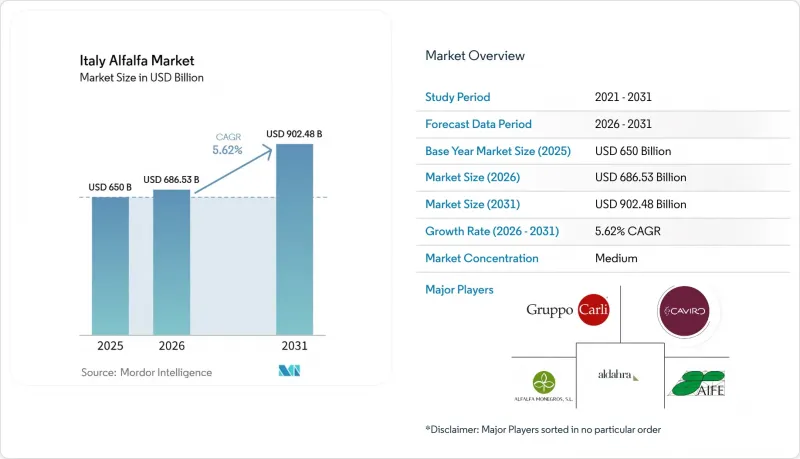
This report is Segmented by Product Type (Bales, Pellets, and More), by Application (Dairy Cattle Feed, Beef Cattle Feed, and More), by End Use Sector (Commercial Farms, Compound Feed Manufacturers, and More). The Market Forecasts are Provided in Terms of Value (USD) and Volume (Metric Tons).
Italy Alfalfa Market Trends and Insights
Parmigiano-Reggiano and Grana Padano Feed Quality Requirements
The Italy alfalfa market has a steady demand base because premium Protected Designation of Origin (PDO) cheese production depends on dry forage quality rather than short-term feed price movements. Parmigiano Reggiano regulations require cows to receive at least 50% of their forage dry matter as locally produced hay, and silage is not permitted in the feed ratio. This requirement links alfalfa purchases directly to cheese output and limits producers' ability to substitute alfalfa with lower-grade alternatives. According to Great Italian Food Trade in 2024, 66% of the 4.07 million Parmigiano Reggiano wheels produced came from herds fed primarily on alfalfa, reflecting the direct link between certified cheese output and forage demand. Grana Padano also depends on reliable dry forage, so the broader northern dairy system continues to support recurring alfalfa offtake even where feed regulations are not identical. As Italian agri-food exports grew, growth in PDO cheese trade further supported procurement of compliant forage within the Italy alfalfa market.
Po Valley Dairy Herd Density and Stable Forage Offtake
The market is closely tied to the Po Valley, as the region combines large dairy herds, consistent feed demand, and short transport distances between farms and processors. Agronomic data for Emilia-Romagna indicate that well-managed alfalfa fields yield 10 to 12 metric tons of dry matter per hectare with 5 to 7 cuts per season, supporting regular plant throughput when weather conditions are favorable. Local dehydration within 48 hours of cutting helps retain protein and carotene levels, giving domestic processors an advantage over imported material that spends longer in transit. The adoption of Total Mixed Ration systems in larger herds has also supported demand for protein-consistent forage, as ration precision is more critical in high-yield dairy operations. This links the Italy alfalfa market to herd modernization rather than confining it to traditional forage demand. Italy's agriculture, forestry, and fishing sector generated EUR 80.1 billion (USD 86.9 billion) in output in 2025, and this broader farm economy continued to support dairy investment and feed procurement capacity.
Water Allocation Pressure and Summer Heat Risk in the Po Valley
The most significant operating risk in the Italy alfalfa market stems from water availability in the Po Valley, where production and processing are concentrated. Fluctuations in water availability affect cutting schedules, yield consistency, and the ability of farms to supply dehydration plants on time. In summer 2025, the Emilia Centrale Irrigation Consortium received 200 to 300 emergency water requests per day from agricultural users as stress on the Po River returned. Each missed cut reduces seasonal dry matter volume and spreads fixed plant overhead across fewer metric tons, weakening margins in the Italy alfalfa market. Flood-related soil damage from the previous two years also reduced fertility in core production zones, adding further uncertainty to field performance.
Other drivers and restraints analyzed in the detailed report include:
- CAP Rotation Support for Protein Crops in Core Crop Belts
- Export Pull From Premium Mediterranean and Gulf Feed Channels
- Fuel and Drying Cost Sensitivity for Dehydration Facilities
For complete list of drivers and restraints, kindly check the Table Of Contents.
Segment Analysis
Bales held 51.2% of the Italy alfalfa market in 2025, reflecting the dominant role of direct supply to dairy farms in Northern Italy. AIFE's 2024 national production split of 65% bales and 35% pellets indicates the same broad format preference across the dehydrated forage chain. Large bales remain practical for farms that buy in volume and use regular deliveries under cooperative or forward supply arrangements. In these systems, lower handling complexity matters more than compactness because throughput is high and storage routines are already built around bale intake. Cubes fill a smaller but useful role for equine farms and smaller livestock operators that prefer easier portion control and cleaner handling.
Pellets are the fastest-growing product type in the Italy alfalfa market at 8.0% CAGR forecasted from 2026 to 2031, as they are more compatible with automated feeding systems and standardized feed blending than loose bale formats. Compound feed manufacturers and larger barns use pellets when they require tighter protein dosing, denser storage, and simpler movement through mechanical systems. Compressed bales remain more relevant for export trade because container efficiency and freight economics improve with higher bulk density. As a result, the product mix is gradually widening rather than shifting away from bales entirely. Gruppo Carli's real-time traceability application and the company's 140,000 metric ton annual processing capacity demonstrate how suppliers are building data-backed product positioning for premium pellet sales in external markets.
Complete Report Scope:
- By Product Type
- Bales
- Pellets
- Cubes
- Compressed Bales
- By Application
- Dairy Cattle Feed
- Beef Cattle Feed
- Poultry Feed
- Equine Feed
- Small Ruminant Feed
- Camelids and Other Livestock Feed
- By End Use Sector
- Commercial Farms
- Compound Feed Manufacturers
- Household and Hobby Animal Owners
- Pet Food and Specialty Nutrition
List of Companies Covered in this Report:
- Gruppo Carli
- Caviro Extra S.p.A.
- AIFE (Associazione Italiana Foraggi Essiccati)
- Al Dahra ACX Global Inc.
- Alfalfa Monegros SL
- Anderson Hay and Grain Co., Inc.
- Standlee Premium Products, LLC
- Border Valley Trading, LTD
- Green Prairie International Inc.
- Gruppo Oses
- NAFOSA
- Agricole Forte S.a.r.l
- Italpaglia Srl
- Gruppo Pagliari
- Societa Produzioni Erbe Disidratate
- Vitagri Srl
- Biselli Foraggi Group SRL
- Fratelli Lodi
- ACX Global
- Al Dahra Agriculture LLC
Additional Benefits:
- The market estimate (ME) sheet in Excel format
- 3 months of analyst support
TABLE OF CONTENTS
1 INTRODUCTION
- 1.1 Study Assumptions and Market Definition
- 1.2 Scope of the Study
2 RESEARCH METHODOLOGY
3 EXECUTIVE SUMMARY
4 MARKET LANDSCAPE
- 4.1 Market Overview
- 4.2 Market Drivers
- 4.2.1 Parmigiano reggiano and grana padano feed quality requirements
- 4.2.2 Po valley dairy herd density and stable forage offtake
- 4.2.3 Northern Italy dehydration plant use and cooperative procurement
- 4.2.4 CAP rotation support for protein crops
- 4.2.5 Export pull from mediterranean and gulf feed channels
- 4.2.6 Traceability premium for protein verified dehydrated alfalfa
- 4.3 Market Restraints
- 4.3.1 Competition with irrigated high value crops in Northern Italy
- 4.3.2 Water allocation pressure and summer heat risk in the po valley
- 4.3.3 Fuel and drying cost sensitivity for dehydration facilities
- 4.3.4 Fragmented southern production and uneven forage quality
- 4.4 Regulatory Landscape
- 4.5 Technological Outlook
- 4.6 Porter's Five Forces Analysis
- 4.6.1 Threat of New Entrants
- 4.6.2 Bargaining Power of Buyers
- 4.6.3 Bargaining Power of Suppliers
- 4.6.4 Threat of Substitutes
- 4.6.5 Intensity of Competitive Rivalry
5 MARKET SIZE AND GROWTH FORECASTS (VALUE AND VOLUME)
- 5.1 By Product Type
- 5.1.1 Bales
- 5.1.2 Pellets
- 5.1.3 Cubes
- 5.1.4 Compressed Bales
- 5.2 By Application
- 5.2.1 Dairy Cattle Feed
- 5.2.2 Beef Cattle Feed
- 5.2.3 Poultry Feed
- 5.2.4 Equine Feed
- 5.2.5 Small Ruminant Feed
- 5.2.6 Camelids and Other Livestock Feed
- 5.3 By End Use Sector
- 5.3.1 Commercial Farms
- 5.3.2 Compound Feed Manufacturers
- 5.3.3 Household and Hobby Animal Owners
- 5.3.4 Pet Food and Specialty Nutrition
6 COMPETITIVE LANDSCAPE
- 6.1 Market Concentration
- 6.2 Strategic Moves
- 6.3 Market Share Analysis
- 6.4 Company Profiles (includes Global Level Overview, Market Level Overview, Core Segments, Financials as available, Strategic Information, Market Rank/Share, Products and Services, Recent Developments)
- 6.4.1 Gruppo Carli
- 6.4.2 Caviro Extra S.p.A.
- 6.4.3 AIFE (Associazione Italiana Foraggi Essiccati)
- 6.4.4 Al Dahra ACX Global Inc.
- 6.4.5 Alfalfa Monegros SL
- 6.4.6 Anderson Hay and Grain Co., Inc.
- 6.4.7 Standlee Premium Products, LLC
- 6.4.8 Border Valley Trading, LTD
- 6.4.9 Green Prairie International Inc.
- 6.4.10 Gruppo Oses
- 6.4.11 NAFOSA
- 6.4.12 Agricole Forte S.a.r.l
- 6.4.13 Italpaglia Srl
- 6.4.14 Gruppo Pagliari
- 6.4.15 Societa Produzioni Erbe Disidratate
- 6.4.16 Vitagri Srl
- 6.4.17 Biselli Foraggi Group SRL
- 6.4.18 Fratelli Lodi
- 6.4.19 ACX Global
- 6.4.20 Al Dahra Agriculture LLC
7 MARKET OPPORTUNITIES AND FUTURE OUTLOOK

