PUBLISHER: Mordor Intelligence | PRODUCT CODE: 2100654

PUBLISHER: Mordor Intelligence | PRODUCT CODE: 2100654
Vietnam Prefabricated Buildings - Market Share Analysis, Industry Trends & Statistics, Growth Forecasts (2026 - 2031)
According to Mordor Intelligence, the Vietnam prefabricated buildings market size was valued at USD 6.20 billion in 2025 and estimated to grow from USD 6.67 billion in 2026 to reach USD 9.6 billion by 2031, at a CAGR of 7.56% during the forecast period (2026-2031).
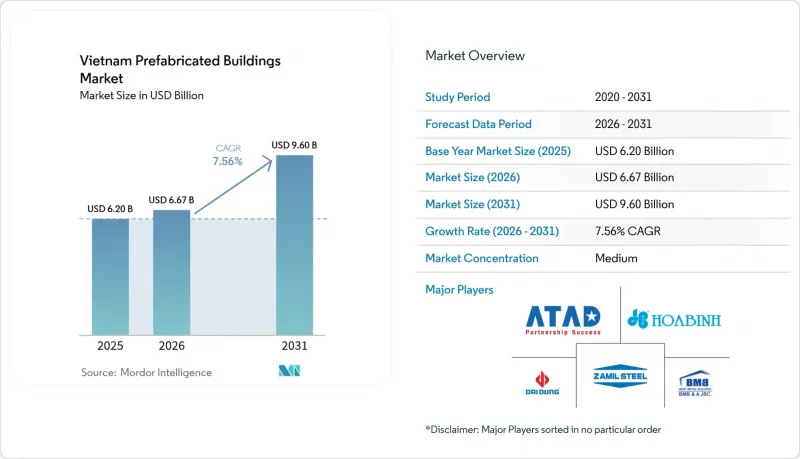
This report is Segmented by Material (Concrete, Glass, Metal, Timber, and Other Materials), by Application (Residential, Commercial, and Others), by Product Type (Modular Buildings, Panelized & Componentized Systems, and Other Prefab Types), and by Key Cities (Ho Chi Minh City, Hanoi, Danang, and the Rest of Vietnam). The Market Forecasts are Provided in Terms of Value (USD).
Vietnam Prefabricated Buildings Market Trends and Insights
Government "One Million Social Homes 2025-2035" scheme unlocking prefab tenders
The social-housing initiative is Vietnam's single largest demand trigger for modular systems. It has already delivered 117 schemes totaling 85,275 units and launched another 159 projects aimed at 135,563 units that must be handed over by end-2025. Resolution 155/NQ-CP fast-tracks permitting and creates a national housing fund, so contractors with factory-built modules hold an execution edge. Provincial variation remains wide-Nghe An has exceeded housing targets while Ha Tĩnh lags-yet uniform pressure to meet ministry targets keeps Vietnam's prefabricated buildings market momentum high. The program also overlaps with worker dormitory needs in industrial parks, compounding its pull on prefab capacity.
FDI-led industrial-park dormitories needing rapid deployment
FDI inflows totaled USD 38.23 billion in 2024, with USD 25.58 billion flowing into processing and manufacturing projects that demand on-site accommodation. Logistics parks such as BW-ESR's 112,000 m2 Nam Son Hap Linh and 162,000 m2 Yen Phong hubs illustrate how multinational tenants specify fast-assembly dorms. Tight production ramp-up schedules mean factory-fabricated rooms are preferred over conventional masonry, putting another growth stream into the Vietnam prefabricated buildings market. Provinces courting investors with tax breaks intensify this timing imperative and make modular units the practical solution for labor housing.
Volatile steel prices are squeezing contractor margins
A surge in green-steel investments and external shocks like the EU Carbon Border Adjustment Mechanism have sent Vietnamese steel prices on a roller-coaster ride. Prefab firms, locked into fixed-price contracts built on heavy steel frames, absorb much of the fluctuation, eroding profit. While tax incentives ease some pressure, unpredictable input costs remain a near-term brake on Vietnam's prefabricated buildings market expansion.
Other drivers and restraints analyzed in the detailed report include:
- Coastal resort boom compressing construction timelines
- Skilled-labor shortages spurring off-site productivity gains
- Fragmented provincial building codes are delaying type approval
For complete list of drivers and restraints, kindly check the Table Of Contents.
Segment Analysis
Concrete commanded a 50.78% Vietnam prefabricated buildings market share in 2025, sustained by well-established precast supply chains and cultural familiarity with solid structures. Precast wall panels and hollow-core slabs underpin social-housing and industrial contracts, letting developers keep costs predictable. Timber, although smaller, is the fastest-growing material with an 8.28% CAGR through 2031, propelled by carbon-reduction targets and wider acceptance of engineered wood products in mid-rise projects. Manufacturers such as Trần Dức are investing in automated lines for cross-laminated and glulam components, aiming to capture green-credit demand. Metal systems continue to find traction in logistics parks, while hybrid composite modules emerge in luxury coastal resorts that emphasize glass facades and corrosion resistance.
The shift toward sustainable inputs reflects Vietnam's pledge to reach net-zero by 2050 and to trim building-sector emissions 9-27% by 2030. Contractors blending concrete cores with timber interiors offer a cost-effective bridge between familiarity and sustainability, positioning them for future tenders under Resolution 122/NQ-CP. As the supply of domestically produced CLT widens, the Vietnam prefabricated buildings market size for wood-based frames is projected to expand steadily, helping diversify away from steel-heavy methods sensitive to global price swings.
Complete Report Scope:
- By Material
- Concrete
- Glass
- Metal
- Timber
- Other Materials
- By Application
- Residential
- Commercial
- Others
- By Product Type
- Modular Buildings
- Panelized & Componentized Systems
- Other Prefab Types
- By Key Cities
- Ho Chi Minh City
- Hanoi
- Danang
- Rest of Vietnam
List of Companies Covered in this Report:
- ATAD Steel Structure Corp.
- Zamil Steel Buildings Vietnam
- BMB Steel
- Dai Dung Metallic Structure
- Hoa Binh Construction Group
- Coteccons Construction
- Unicons Investment Construction
- COFICO
- Lilama 18 Engineering & Construction
- Smart Modular Vietnam (SMV)
- UTRACON Vietnam
- PanelWorld JSC
- VREC Modular Housing
- LS Modular Vietnam
- GSB Prefab Solutions
- NS BlueScope Lysaght Vietnam
- Minh Ngoc Pre-engineered Buildings
- Seico Steel Structures
- Zeta Prefab (VN)
- Sika Prefab Systems Vietnam
Additional Benefits:
- The market estimate (ME) sheet in Excel format
- 3 months of analyst support
TABLE OF CONTENTS
1 Introduction
- 1.1 Study Assumptions & Market Definition
- 1.2 Scope of the Study
2 Research Methodology
3 Executive Summary
4 Market Landscape
- 4.1 Market Overview
- 4.2 Market Drivers
- 4.2.1 Government "One-Million Social Homes 2025-2035" scheme unlocking prefab tenders
- 4.2.2 FDI-led industrial-park dormitories needing rapid deployment
- 4.2.3 Coastal resort boom compressing construction timelines
- 4.2.4 Skilled-labour shortages spurring off-site productivity gains
- 4.2.5 Offshore-wind service hubs adopting floatel modules (under-reported)
- 4.2.6 Green-credit incentives for low-carbon modular buildings (under-reported)
- 4.3 Market Restraints
- 4.3.1 Fragmented provincial building codes delaying type approval
- 4.3.2 Cultural preference for masonry homes in urban centres
- 4.3.3 Volatile steel prices squeezing contractor margins
- 4.3.4 Limited domestic CLT / glulam capacity amid export pull (under-reported)
- 4.4 Value / Supply-Chain Analysis
- 4.5 Regulatory Landscape
- 4.6 Technological Outlook
- 4.7 Porter's Five Forces
- 4.7.1 Threat of New Entrants
- 4.7.2 Bargaining Power of Buyers
- 4.7.3 Bargaining Power of Suppliers
- 4.7.4 Threat of Substitutes
- 4.7.5 Intensity of Competitive Rivalry
- 4.8 Brief on Different Structures Used in Prefabricated Buildings
- 4.9 Cost Structure Analysis of Prefabricated Buildings
5 Market Size & Growth Forecasts (Value)
- 5.1 By Material
- 5.1.1 Concrete
- 5.1.2 Glass
- 5.1.3 Metal
- 5.1.4 Timber
- 5.1.5 Other Materials
- 5.2 By Application
- 5.2.1 Residential
- 5.2.2 Commercial
- 5.2.3 Others
- 5.3 By Product Type
- 5.3.1 Modular Buildings
- 5.3.2 Panelized & Componentized Systems
- 5.3.3 Other Prefab Types
- 5.4 By Key Cities
- 5.4.1 Ho Chi Minh City
- 5.4.2 Hanoi
- 5.4.3 Danang
- 5.4.4 Rest of Vietnam
6 Competitive Landscape
- 6.1 Strategic Moves
- 6.2 Market Share Analysis
- 6.3 Company Profiles (includes Global-level Overview, Market-level Overview, Core Segments, Financials as available, Strategic Information, Market Rank/Share, Products & Services, Recent Developments)
- 6.3.1 ATAD Steel Structure Corp.
- 6.3.2 Zamil Steel Buildings Vietnam
- 6.3.3 BMB Steel
- 6.3.4 Dai Dung Metallic Structure
- 6.3.5 Hoa Binh Construction Group
- 6.3.6 Coteccons Construction
- 6.3.7 Unicons Investment Construction
- 6.3.8 COFICO
- 6.3.9 Lilama 18 Engineering & Construction
- 6.3.10 Smart Modular Vietnam (SMV)
- 6.3.11 UTRACON Vietnam
- 6.3.12 PanelWorld JSC
- 6.3.13 VREC Modular Housing
- 6.3.14 LS Modular Vietnam
- 6.3.15 GSB Prefab Solutions
- 6.3.16 NS BlueScope Lysaght Vietnam
- 6.3.17 Minh Ngoc Pre-engineered Buildings
- 6.3.18 Seico Steel Structures
- 6.3.19 Zeta Prefab (VN)
- 6.3.20 Sika Prefab Systems Vietnam
7 Market Opportunities & Future Outlook
- 7.1 White-Space & Unmet-Need Assessment

