PUBLISHER: Mordor Intelligence | PRODUCT CODE: 2115908

PUBLISHER: Mordor Intelligence | PRODUCT CODE: 2115908
China Prefabricated Buildings - Market Share Analysis, Industry Trends & Statistics, Growth Forecasts (2026 - 2031)
According to Mordor Intelligence, the China prefabricated buildings market size was valued at USD 65.18 billion in 2025 and estimated to grow from USD 69.74 billion in 2026 to reach USD 97.86 billion by 2031, at a CAGR of 6.99% during the forecast period (2026-2031).
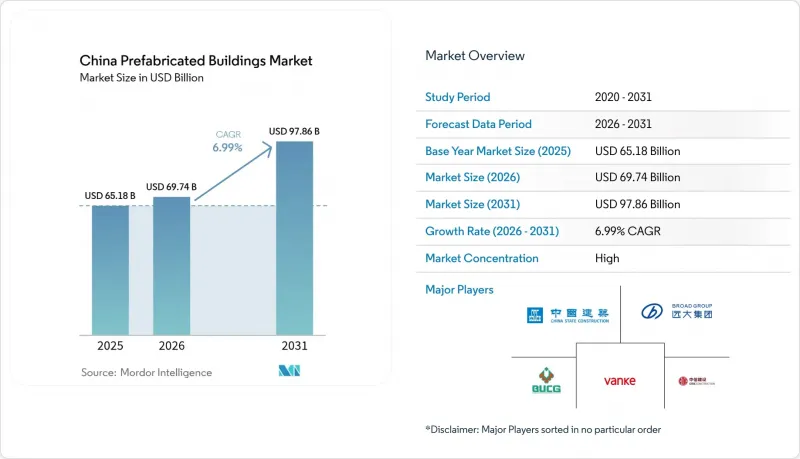
This report is Segmented by Material Type (Concrete, Glass, Metal, Timber, and Other Material Types), by Application (Residential, Commercial, Others), by Product Type (Modular Buildings, Panelized and Componentized Systems, Other Prefab Types), by Cities (Shenzhen, Beijing, Shanghai, Hangzhou, Guangzhou, Other Cities). The Market Forecasts are Provided in Terms of Value (USD).
China Prefabricated Buildings Market Trends and Insights
National "Assembly Building" Quota Targets for Public Projects
The Ministry of Housing and Urban-Rural Development (MOHURD) requires 30% of new urban floor area to incorporate prefabricated methods by 2027, guaranteeing a minimum demand floor even during down-cycles. The 14th Five-Year Plan adds 50 million m2 of ultra-low-energy buildings that must hit strict performance scores, effectively locking in factory-built envelopes. Multiple provinces have slashed permit processing times for qualifying projects, and Jiangsu has piloted one-stop approvals that cut paperwork by 45%.
Accelerated Affordable-Housing Starts amid Post-COVID Stimulus
Special-purpose bonds topping USD 100 billion in 2024 boosted city-level housing starts that favor the 30-60 day delivery cycle achievable with modular components. Beijing's Baiziwan complex used 80% off-site elements across 4,000 units, setting a precedent for tier-2 cities eyeing rapid social-housing rollouts. Subsidies now reimburse up to 15% of component costs once specified assembly rates are verified, enhancing project cash-flow profiles.
Higher Upfront CAPEX vs. Conventional for <30 k m2 Projects
Projects under 30,000 m2 rarely achieve economy-of-scale pricing on molds and logistics, leaving a 15-25% component premium despite tax holidays and fee waivers. Break-even shifts nearer 50,000 m2, discouraging smaller private developers from adopting industrialized methods. Provincial subsidies mitigate but do not erase the gap because payments arrive only after field inspections certify assembly-rate targets.
Other drivers and restraints analyzed in the detailed report include:
- Carbon-Neutrality Mandates Favoring Low-Waste Off-Site Methods
- Rising Labor Costs & Safety Enforcement Boosting Factory Adoption
- Property-Developer Liquidity Crunch Delaying Prefab Factory Payments
For complete list of drivers and restraints, kindly check the Table Of Contents.
Segment Analysis
Concrete dominated with 58.40% China prefabricated buildings market share in 2025 due to entrenched supply chains and economical per-m2 costs for mass housing. Timber CLT/LVL, however, is on track for a 7.45% CAGR, propelled by embodied-carbon credits and design flexibility valued by eco-conscious developers.
Chinese suppliers are piloting ultra-high-performance concrete (UHPC) that incorporates recycled aggregates and in-plant carbon-capture agents, aiming to protect margins against timber encroachment. Meanwhile, the Ministry's 2025 guidance promotes structural steel and engineered timber in rural revitalization, signaling policy support for a diversified material mix.
Complete Report Scope:
- By Material Type
- Concrete
- Glass
- Metal
- Timber
- Other Materials
- By Application
- Residential
- Commercial
- Others
- By Product Type
- Modular Buildings
- Panelized & Componentized Systems
- Other Prefab Types
- By Key Cities
- Shenzhen
- Beijing
- Shanghai
- Hangzhou
- Guangzhou
- Other Key Cities
List of Companies Covered in this Report:
- China State Construction Engineering Corp. (CSCEC)
- Broad Group
- China Railway Construction Corp.
- Vanke Industrialized Building
- Beijing Urban Construction Group (BUCG)
- CITIC Construction - Prefabricated Division
- Shanghai Construction Group
- Jiangsu Huning Modular Housing
- Honglu Steel Structure
- Shenzhen Yihua Prefab
- CSCEC Xiong
- Yuanda Modular Construction
- Zhejiang Yongnan Steel Structure
- Xiong'an
- Far East Integrated Building Co.
- Guangdong Rongtai Intelligent Housing
- Gammon Construction (China)
- Skanska
- LafargeHolcim
- China Lesso Prefabricated Building Systems
Additional Benefits:
- The market estimate (ME) sheet in Excel format
- 3 months of analyst support
TABLE OF CONTENTS
1 Introduction
- 1.1 Study Assumptions & Market Definition
- 1.2 Scope of the Study
2 Research Methodology
3 Executive Summary
4 Market Landscape
- 4.1 Market Overview
- 4.2 Market Drivers
- 4.2.1 National "Assembly Building" quota targets for public projects
- 4.2.2 Accelerated affordable-housing starts amid post-COVID stimulus
- 4.2.3 Carbon-neutrality mandates favouring low-waste off-site methods
- 4.2.4 Rising labour costs & safety enforcement boosting factory adoption
- 4.2.5 Shenzhen BIM-Digital-Twin mandate for prefabricated bids
- 4.2.6 Idle HSR module yards repurposed for urban micro-apartments
- 4.3 Market Restraints
- 4.3.1 Higher upfront CAPEX vs. conventional for greater than 30 km2 projects
- 4.3.2 Non-uniform provincial certification slows nationwide roll-outs
- 4.3.3 40-year land-lease cycles deter long-term module-plant investment
- 4.3.4 Property-developer liquidity crunch delaying prefab factory payments
- 4.4 Value / Supply-Chain Analysis
- 4.5 Regulatory Landscape
- 4.6 Technological Outlook
- 4.7 Porter's Five Forces
- 4.7.1 Threat of New Entrants
- 4.7.2 Bargaining Power of Buyers
- 4.7.3 Bargaining Power of Suppliers
- 4.7.4 Threat of Substitutes
- 4.7.5 Intensity of Competitive Rivalry
- 4.8 Brief on Different Structures Used in Prefabricated Buildings
- 4.9 Cost Structure Analysis of Prefabricated Buildings
5 Market Size & Growth Forecasts (Value)
- 5.1 By Material Type
- 5.1.1 Concrete
- 5.1.2 Glass
- 5.1.3 Metal
- 5.1.4 Timber
- 5.1.5 Other Materials
- 5.2 By Application
- 5.2.1 Residential
- 5.2.2 Commercial
- 5.2.3 Others
- 5.3 By Product Type
- 5.3.1 Modular Buildings
- 5.3.2 Panelized & Componentized Systems
- 5.3.3 Other Prefab Types
- 5.4 By Key Cities
- 5.4.1 Shenzhen
- 5.4.2 Beijing
- 5.4.3 Shanghai
- 5.4.4 Hangzhou
- 5.4.5 Guangzhou
- 5.4.6 Other Key Cities
6 Competitive Landscape
- 6.1 Market Concentration
- 6.2 Strategic Moves
- 6.3 Market Share Analysis
- 6.4 Company Profiles (includes Global-level Overview, Market-level Overview, Core Segments, Financials, Strategic Information, Market Rank/Share, Products & Services, Recent Developments)
- 6.4.1 China State Construction Engineering Corp. (CSCEC)
- 6.4.2 Broad Group
- 6.4.3 China Railway Construction Corp.
- 6.4.4 Vanke Industrialized Building
- 6.4.5 Beijing Urban Construction Group (BUCG)
- 6.4.6 CITIC Construction - Prefabricated Division
- 6.4.7 Shanghai Construction Group
- 6.4.8 Jiangsu Huning Modular Housing
- 6.4.9 Honglu Steel Structure
- 6.4.10 Shenzhen Yihua Prefab
- 6.4.11 CSCEC Xiong
- 6.4.12 Yuanda Modular Construction
- 6.4.13 Zhejiang Yongnan Steel Structure
- 6.4.14 Xiong'an
- 6.4.15 Far East Integrated Building Co.
- 6.4.16 Guangdong Rongtai Intelligent Housing
- 6.4.17 Gammon Construction (China)
- 6.4.18 Skanska
- 6.4.19 LafargeHolcim
- 6.4.20 China Lesso Prefabricated Building Systems
7 Market Opportunities & Future Outlook
- 7.1 White-space & Unmet-Need Assessment

