PUBLISHER: Mordor Intelligence | PRODUCT CODE: 2116129

PUBLISHER: Mordor Intelligence | PRODUCT CODE: 2116129
Thailand Prefabricated Buildings Industry - Market Share Analysis, Industry Trends & Statistics, Growth Forecasts (2026 - 2031)
According to Mordor Intelligence, Thailand prefabricated buildings market size in 2026 is estimated at USD 1.27 billion, growing from 2025 value of USD 1.19 billion with 2031 projections showing USD 1.8 billion, growing at 7.12% CAGR over 2026-2031.
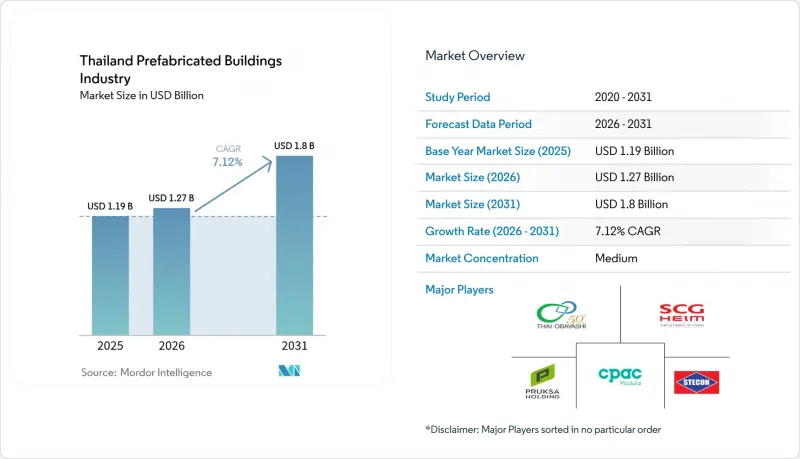
This report is Segmented by Material Type (Concrete, Glass, Metal, Timber, Other Materials), by Application (Residential, Commercial, Others), by Product Type (Modular Buildings, Panelized & Componentized Systems, Other Prefab Types), and by Geography (Central, Eastern, Northeastern, Northern, Southern, Rest of Thailand). The Market Forecasts are Provided in Terms of Value (USD).
Thailand Prefabricated Buildings Industry Trends and Insights
Eastern Economic Corridor Turnkey Industrial Parks Driving Dormitory Modules
The EEC is attracting hundreds of foreign manufacturers, creating immediate pressure for 200,000 worker beds that conventional construction cannot supply on schedule. Prefabricated dormitories shorten delivery cycles by up to 70%, aligning with the USD 38.3 billion Huai Yai smart-city timeline. Developers favor modular systems with integrated utilities to comply with higher living-standard mandates for advanced-manufacturing staff. Land-sale momentum at WHA industrial estates confirms robust demand for fast-track accommodation, while the new 10-year EEC visa deepens the need for semi-permanent modular housing.
Urban Labor-Cost Inflation Catalyzing Factory-Built Components
Bangkok builders face wage escalation and skilled-worker shortages that erode on-site productivity. Factory fabrication shifts repetitive tasks to controlled environments, lowering rework and minimizing site congestion. SCG's merger with JWD created an ASEAN-wide logistics backbone that slashes last-mile costs, making factory-to-site delivery of precast frames and panels more economical than traditional formwork. Logistics now represents 13.7% of national GDP, so time-compressed deliveries reinforce the cost-benefit of modular production.
Fragmented Municipal Permitting and Prefab Standards
Thailand's decentralized approval regime forces developers to navigate varying municipal rules, prolonging lead-times for factory-built components. Additional inspections are often required because local officials lack familiar templates for certifying off-site fabrication. The recent revocation of a high-rise permit over access-road disputes underscored regulatory unpredictability and heightened caution among investors. Harmonized prefab codes remain a work in progress, tempering short-term uptake despite national interest.
Other drivers and restraints analyzed in the detailed report include:
- BOI Tax Incentives Rewarding Low-Waste Green Construction Materials
- Post-COVID Hospital Upgrades Leaning on Modular Wards
- Conservative Developer Perception of Quality Risk
For complete list of drivers and restraints, kindly check the Table Of Contents.
Segment Analysis
Concrete retained 51.70% of Thailand's prefabricated buildings market share in 2025, buoyed by entrenched cement supply and design familiarity. The Thailand prefabricated buildings market size for concrete solutions is projected to rise alongside low-carbon cement substitution that meets BOI sustainability thresholds. Timber, led by CLT panels, is sprinting ahead at an 8.05% CAGR as developers chase embodied-carbon cuts and accelerated erection times. Supply bottlenecks from Thailand's logging moratorium spur imports of plantation rubberwood and engineered bamboo, nudging manufacturers to localize processing capacity under the BOI's green-material stimulus. Composite and metal sub-segments orbit niche industrial enclosures and facade retrofits, whereas glass modules underpin premium facade upgrades that demand precision glazing.
The concrete value chain is modernizing to defend its lead: Siam City Cement reported 36% EBITDA growth in H1 2024 after launching cement variants that claim 20% lower CO2 per ton. Timber's climb forms a counter-balance, unlocking architectural expressions aligned with eco-resort branding and flood-resilient stilts. Research into laminated bamboo shows strength-to-weight ratios comparable with tropical hardwood, foreshadowing future material turnover as supply chains mature. Overall, shifting material preferences highlight Thailand's prefabricated buildings industry orientation toward cost-plus-sustainability metrics rather than lowest-cost-first criteria.
Complete Report Scope:
- By Material Type
- Concrete
- Glass
- Metal
- Timber
- Other Materials
- By Application
- Residential
- Commercial
- Others
- By Product Type
- Modular Buildings
- Panelized & Componentized Systems
- Other Prefab Types
- By Key Regions
- Central
- Eastern
- Northeastern
- Northern
- Southern
- Rest of Thailand
List of Companies Covered in this Report:
- SCG Heim Co., Ltd.
- Pruksa Precast Co., Ltd.
- CPAC Modular (Siam Cement Group)
- Sino-Thai Engineering & Construction PCL
- Thai Obayashi Corp., Ltd.
- Ritta Co., Ltd. (Prefab Division)
- Seacon Construction Systems
- Toyo-Thai Corporation PCL (Modular)
- Christiani & Nielsen (Thai) PCL
- STP&I Public Co., Ltd.
- BuilderSmart PCL (BUILK Prefab)
- PanelHome Co., Ltd.
- Sahapat Construction Co., Ltd.
- King Wai Group (Thailand) Industrial Housing Modules
- Italian-Thai Development PLC (Modular)
- Betong Union Co., Ltd.
- ThaiGerman Precast Co., Ltd.
- AM Precast Co., Ltd.
- Bangkok Integrated Modular Construction Co., Ltd.
Additional Benefits:
- The market estimate (ME) sheet in Excel format
- 3 months of analyst support
TABLE OF CONTENTS
1 Introduction
- 1.1 Study Assumptions & Market Definition
- 1.2 Scope of the Study
2 Research Methodology
3 Executive Summary
4 Market Landscape
- 4.1 Market Overview
- 4.2 Market Drivers
- 4.2.1 "Eastern Economic Corridor" turnkey industrial parks driving dormitory modules
- 4.2.2 Urban labour-cost inflation catalysing factory-built components
- 4.2.3 BOI tax incentives rewarding low-waste green construction materials
- 4.2.4 Post-COVID hospital upgrades leaning on modular wards
- 4.2.5 Tourism-reopening surge in resort pods across islands
- 4.2.6 Flood-resilient elevated modular homes in Chao Phraya basin
- 4.3 Market Restraints
- 4.3.1 Fragmented municipal permitting and prefab standards
- 4.3.2 Conservative developer perception of quality risk
- 4.3.3 Shortage of local CLT (cross-laminated timber) supply chain
- 4.3.4 High logistics cost for oversize modules in narrow urban streets
- 4.4 Value / Supply-Chain Analysis
- 4.5 Regulatory Landscape
- 4.6 Technological Outlook
- 4.7 Porter's Five Forces
- 4.7.1 Threat of New Entrants
- 4.7.2 Bargaining Power of Buyers
- 4.7.3 Bargaining Power of Suppliers
- 4.7.4 Threat of Substitutes
- 4.7.5 Intensity of Competitive Rivalry
- 4.8 Brief on Different Structures Used in Prefabricated Buildings
- 4.9 Cost Structure Analysis of Prefabricated Buildings
5 Market Size & Growth Forecasts (Value)
- 5.1 By Material Type
- 5.1.1 Concrete
- 5.1.2 Glass
- 5.1.3 Metal
- 5.1.4 Timber
- 5.1.5 Other Materials
- 5.2 By Application
- 5.2.1 Residential
- 5.2.2 Commercial
- 5.2.3 Others
- 5.3 By Product Type
- 5.3.1 Modular Buildings
- 5.3.2 Panelized & Componentized Systems
- 5.3.3 Other Prefab Types
- 5.4 By Key Regions
- 5.4.1 Central
- 5.4.2 Eastern
- 5.4.3 Northeastern
- 5.4.4 Northern
- 5.4.5 Southern
- 5.4.6 Rest of Thailand
6 Competitive Landscape
- 6.1 Market Concentration
- 6.2 Strategic Moves
- 6.3 Market Share Analysis
- 6.4 Company Profiles (includes Global-level Overview, Market-level Overview, Core Segments, Financials, Strategic Information, Market Rank/Share, Products & Services, Recent Developments)
- 6.4.1 SCG Heim Co., Ltd.
- 6.4.2 Pruksa Precast Co., Ltd.
- 6.4.3 CPAC Modular (Siam Cement Group)
- 6.4.4 Sino-Thai Engineering & Construction PCL
- 6.4.5 Thai Obayashi Corp., Ltd.
- 6.4.6 Ritta Co., Ltd. (Prefab Division)
- 6.4.7 Seacon Construction Systems
- 6.4.8 Toyo-Thai Corporation PCL (Modular)
- 6.4.9 Christiani & Nielsen (Thai) PCL
- 6.4.10 STP&I Public Co., Ltd.
- 6.4.11 BuilderSmart PCL (BUILK Prefab)
- 6.4.12 PanelHome Co., Ltd.
- 6.4.13 Sahapat Construction Co., Ltd.
- 6.4.14 King Wai Group (Thailand) Industrial Housing Modules
- 6.4.15 Italian-Thai Development PLC (Modular)
- 6.4.16 Betong Union Co., Ltd.
- 6.4.17 ThaiGerman Precast Co., Ltd.
- 6.4.18 AM Precast Co., Ltd.
- 6.4.19 Bangkok Integrated Modular Construction Co., Ltd.
7 Market Opportunities & Future Outlook
- 7.1 White-Space & Unmet-Need Assessment

