PUBLISHER: Mordor Intelligence | PRODUCT CODE: 2113220

PUBLISHER: Mordor Intelligence | PRODUCT CODE: 2113220
Indonesia Prefabricated Buildings - Market Share Analysis, Industry Trends & Statistics, Growth Forecasts (2026 - 2031)
According to Mordor Intelligence, the Indonesia prefabricated buildings market size is expected to grow from USD 8.38 billion in 2025 to USD 8.99 billion in 2026 and is forecast to reach USD 12.73 billion by 2031 at 7.22% CAGR over 2026-2031.
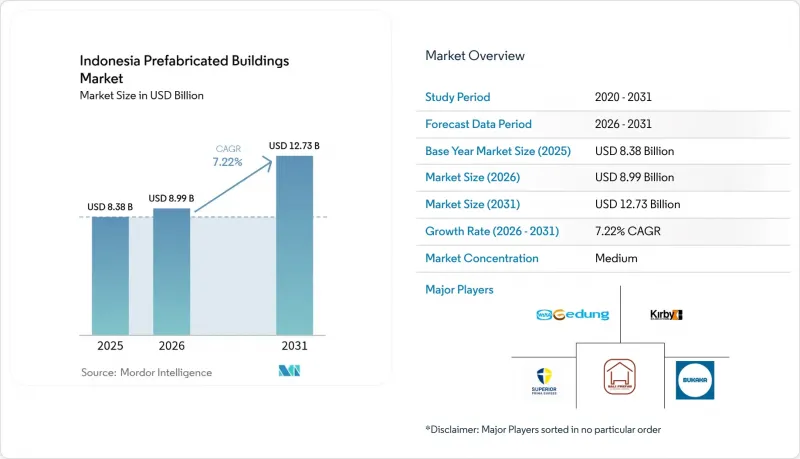
This report is Segmented by Material Type (Concrete, Glass, Metal, Timber, and Other Material Types), Application (Residential, Commercial, and Others), Product Type (Modular Buildings, Panelized and Componentized Systems, and Other Prefab Types), and Key Cities (Jakarta, Surabaya, Bandung, Medan, and Rest of Indonesia). The Market Forecasts are Provided in Terms of Value (USD).
Indonesia Prefabricated Buildings Market Trends and Insights
One-Million Homes Public Housing Push Accelerating Modular Adoption
The shift from the prior "One Million Homes" target to the ambitious "3 Million Homes" program alters the demand calculus in favor of prefabrication. Annual construction quotas surpass the capacity of traditional builders, prompting the Ministry of Public Works and Housing to fast-track standardized RISHA modules priced below IDR 8 million per unit to meet affordability thresholds. Middle-Eastern sovereign investors have pledged financing for up to 1 million units, importing volumetric methods refined in desert housing projects that reduce construction times by 30%-40% compared with in-situ techniques.
Confiscated land from corruption cases lowers acquisition costs, further strengthening the value proposition of the Indonesia prefabricated buildings market for public-sector buyers. Factory pre-installation of plumbing and electrical lines minimizes reliance on scarce site labor, allowing rural projects to proceed on schedule even during monsoon seasons.
Skilled-Labor Gaps in Eastern Islands Favoring Off-Site Production
Indonesia's east-west labor imbalance has widened since 2024 as mega-projects shift outside Java. The Nusantara development alone needs roughly 300,000 construction workers, yet East Kalimantan can supply barely a third of that figure. Prefabricated modules produced in Java travel by roll-on-roll-off vessels, arriving ready-to-assemble so local crews focus on anchoring and finishing rather than skilled trades. With national infrastructure spending set at IDR 422.7 trillion for 2024, contractors increasingly rely on modular methods to arbitrage labor costs between surplus regions and short-supply provinces, thereby sustaining orders for the Indonesia prefabricated buildings market.
Fragmented Permitting Across 38 Provinces Inflates Compliance Cost
Regional autonomy leaves each province free to impose unique documentation, soil-test, and structural-review requirements. Processing times stretch from 14 days in streamlined districts to several months elsewhere, obliging manufacturers to tweak identical modules for differing local codes. The National Standardization Agency issues SNI prefabrication standards, yet uneven enforcement forces companies to budget 3%-5% of project cost for compliance specialists. That drag tempers the addressable growth of the Indonesia prefabricated buildings market.
Other drivers and restraints analyzed in the detailed report include:
- Nusantara New Capital's Fast-Track Demand for Worker Accommodation
- Mandatory Green-Building Rating Spurs Low-Waste Volumetric Timber
- High Up-Front Factory CAPEX vs. Volatile Residential Demand
For complete list of drivers and restraints, kindly check the Table Of Contents.
Segment Analysis
Concrete retained 47.55% of Indonesia prefabricated buildings market share in 2025, reflecting mature supply chains, standardized molds, and robust precast codes. Heritage projects such as Jakarta's MRT employed precast girders that set precedents for structural integrity and lifecycle cost, reinforcing developer confidence in concrete modules. The Indonesia prefabricated buildings market size for concrete solutions is positioned to expand steadily as public-works spending maintains high baseline volumes.
Timber, while accounting for a smaller slice, is growing fastest at a 7.78% CAGR to 2031. Carbon-tax scenarios modeled by the Ministry of Finance assign price pathways that make engineered timber par with reinforced concrete by 2027 on a whole-life-cost basis, accelerating investment in CLT mills. International hotel chains are piloting four-story timber lodges in Labuan Bajo, signaling wider commercial acceptance. Consequently, the Indonesia prefabricated buildings market will likely witness timber capture incremental points of market share each year through the decade.
Complete Report Scope:
- By Material Type
- Concrete
- Glass
- Metal
- Timber
- Other Materials
- By Application
- Residential
- Commercial
- Others
- By Product Type
- Modular Buildings
- Panelized & Componentized Systems
- Other Prefab Types
- By Key Cities
- Jakarta
- Surabaya
- Bandung
- Medan
- Rest of Indonesia
List of Companies Covered in this Report:
- PT Wijaya Karya (WIKA) Building
- PT Superior Prima Sukses
- Kirby Building Systems
- Bali Prefab
- PT Bukaka Teknik Utama Tbk
- PT Hutama Karya (Persero)
- PT Vasanta Indo Properti (Modular)
- PT Pembangunan Perumahan (PP) Prefab
- PT Adhi Karya (Persero) Tbk
- PT Total Bangun Persada
- PT Ciputra Development Modular Division
- PT Gunakarya Nusantara
- PT Kurnia Ciptamoda Gemilang (KCG Modular)
- PT Rucika Modular Systems
- PT Sumber Baja Prima (Light-Steel Structures)
- PT Brantas Abipraya Prefab
- PT Krakatau Steel Fabrication
- PT Inti Karya Persada Tehnik
- PT SMR Utama Modular Mining Camps
- PT Jaya Konstruksi Prefab
Additional Benefits:
- The market estimate (ME) sheet in Excel format
- 3 months of analyst support
TABLE OF CONTENTS
1 Introduction
- 1.1 Study Assumptions & Market Definition
- 1.2 Scope of the Study
2 Research Methodology
3 Executive Summary
4 Market Landscape
- 4.1 Market Overview
- 4.2 Market Drivers
- 4.2.1 "One-Million Homes" Public Housing Push Accelerating Modular Adoption
- 4.2.2 Skilled-Labour Gaps in Eastern Islands Favouring Off-Site Production
- 4.2.3 'Nusantara' New Capital's Fast-Track Demand for Worker Accommodation
- 4.2.4 Mandatory Green-Building Rating Spurs Low-Waste Volumetric Timber
- 4.2.5 Offshore Nickel-Mining Camps Requiring Rapid Relocatable Pods
- 4.2.6 Carbon-Tax Readiness Driving Industrialised Net-Zero Construction
- 4.3 Market Restraints
- 4.3.1 Fragmented Permitting Across 38 Provinces Inflates Compliance Cost
- 4.3.2 High Up-Front Factory CAPEX vs. Volatile Residential Demand
- 4.3.3 Limited Domestic Fire-Testing Facilities Delaying Multi-Storey Timber
- 4.3.4 Inter-Island Logistics Premium on 12-Metre Modules
- 4.4 Value / Supply-Chain Analysis
- 4.5 Regulatory Landscape
- 4.6 Technological Outlook
- 4.7 Porter's Five Forces
- 4.7.1 Threat of New Entrants
- 4.7.2 Bargaining Power of Buyers
- 4.7.3 Bargaining Power of Suppliers
- 4.7.4 Threat of Substitutes
- 4.7.5 Intensity of Competitive Rivalry
- 4.8 Brief on Different Structures Used in Prefabricated Buildings
- 4.9 Cost Structure Analysis of Prefabricated Buildings
5 Market Size & Growth Forecasts (Value)
- 5.1 By Material Type
- 5.1.1 Concrete
- 5.1.2 Glass
- 5.1.3 Metal
- 5.1.4 Timber
- 5.1.5 Other Materials
- 5.2 By Application
- 5.2.1 Residential
- 5.2.2 Commercial
- 5.2.3 Others
- 5.3 By Product Type
- 5.3.1 Modular Buildings
- 5.3.2 Panelized & Componentized Systems
- 5.3.3 Other Prefab Types
- 5.4 By Key Cities
- 5.4.1 Jakarta
- 5.4.2 Surabaya
- 5.4.3 Bandung
- 5.4.4 Medan
- 5.4.5 Rest of Indonesia
6 Competitive Landscape
- 6.1 Market Concentration
- 6.2 Strategic Moves
- 6.3 Market Share Analysis
- 6.4 Company Profiles (includes Global-level Overview, Market-level Overview, Core Segments, Financials, Strategic Information, Market Rank/Share, Products & Services, Recent Developments)
- 6.4.1 PT Wijaya Karya (WIKA) Building
- 6.4.2 PT Superior Prima Sukses
- 6.4.3 Kirby Building Systems
- 6.4.4 Bali Prefab
- 6.4.5 PT Bukaka Teknik Utama Tbk
- 6.4.6 PT Hutama Karya (Persero)
- 6.4.7 PT Vasanta Indo Properti (Modular)
- 6.4.8 PT Pembangunan Perumahan (PP) Prefab
- 6.4.9 PT Adhi Karya (Persero) Tbk
- 6.4.10 PT Total Bangun Persada
- 6.4.11 PT Ciputra Development Modular Division
- 6.4.12 PT Gunakarya Nusantara
- 6.4.13 PT Kurnia Ciptamoda Gemilang (KCG Modular)
- 6.4.14 PT Rucika Modular Systems
- 6.4.15 PT Sumber Baja Prima (Light-Steel Structures)
- 6.4.16 PT Brantas Abipraya Prefab
- 6.4.17 PT Krakatau Steel Fabrication
- 6.4.18 PT Inti Karya Persada Tehnik
- 6.4.19 PT SMR Utama Modular Mining Camps
- 6.4.20 PT Jaya Konstruksi Prefab
7 Market Opportunities & Future Outlook
- 7.1 White-Space & Unmet-Need Assessment

