PUBLISHER: Mordor Intelligence | PRODUCT CODE: 2100676

PUBLISHER: Mordor Intelligence | PRODUCT CODE: 2100676
Italy Luxury Residential Real Estate - Market Share Analysis, Industry Trends & Statistics, Growth Forecasts (2026 - 2031)
According to Mordor Intelligence, the Italy luxury residential real estate market size is expected to increase from USD 1.68 billion in 2025 to USD 1.78 billion in 2026 and reach USD 2.41 billion by 2031, growing at a CAGR of 6.21% over 2026-2031.
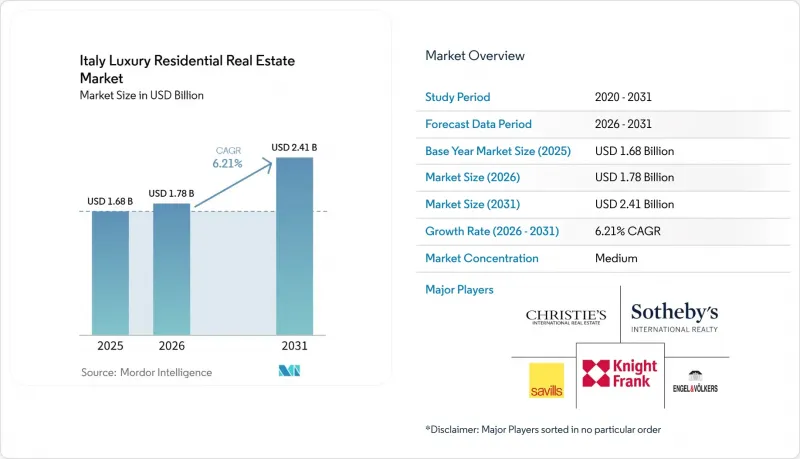
This report is Segmented by Property Type (Apartments and Condominiums, and Villas and Landed Houses), by Business Model (Sales and Rental), by Mode of Sale (Primary (New-Build) and Secondary (Existing-Home Resale)), and by City (Rome, Milan, Venice, Florence, Naples, Turin, Lake Como and Lombardy Lakes Region and More). The Market Forecasts are Provided in Terms of Value (USD).
Italy Luxury Residential Real Estate Market Trends and Insights
Aging Affluent Population & Intra-Family Wealth Transfers
A greying entrepreneurial class is consolidating family fortunes into prime homes that can pass seamlessly to heirs. The country's light inheritance levy makes luxury property a preferred estate-planning vehicle, especially in Lombardy and Emilia-Romagna, where family-owned firms dominate. These households seek assets that hedge currency swings and stock-market volatility, so demand persists even during financial shocks. As more beneficiaries assume operational roles, portfolios tilt further toward prestige real estate. This demographic trend supplies a reliable, slow-moving base of demand that underpins long-run price stability.
High-Net-Worth Immigration via Investor Visa & Tax-Resident Regime
Italy's investor visa now asks newcomers to pay a USD 220,000 flat tax each year, yet the program still looks attractive next to other European gateways. Entry tiers start at USD 275,000 for start-up funding and reach USD 2.2 million for sovereign bonds, giving flexibility to diverse profiles. Grandfathering shields earlier entrants, preserving goodwill in global wealth circles. For many families leaving politically unstable regions, lifestyle quality in Rome or Lake Como offsets the higher tax outlay. The policy continues to funnel fresh capital into the Italy luxury residential real estate market.
Higher Foreign-Buyer Stamp Duties & Luxury Taxes
Tougher fiscal rules now levy capital-gains tax on indirect disposals and remove first-home relief for many overseas purchasers. The added layers of calculation lengthen closing schedules and push advisory costs higher. For marginal investors, the rise in transaction friction narrows spreads, yet core demand from ultra-wealthy families remains intact. The net effect is a near-term slowdown in deal count but limited pressure on prices, given the tight asset base. Over time, clarity on tax treatment may even strengthen market transparency.
Other drivers and restraints analyzed in the detailed report include:
- Historic-Centre Zoning Limits Boosting Vertical Redevelopments
- Global Funds Chasing Ultra-Prime Trophy Palazzos
- Stricter Anti-Money-Laundering (AML) Rules
For complete list of drivers and restraints, kindly check the Table Of Contents.
Segment Analysis
Apartments captured 60.35% of the Italy luxury residential real estate market in 2025, cementing their role as the primary gateway for global investors. Buyers value turnkey security, concierge facilities, and immediate access to cultural venues such as La Scala and the Colosseum. Renovated lofts in Milan's Brera district routinely achieve USD 3,500 per sq ft, while branded residences inside Rome's historic walls trade at even higher premiums. Smart-building features, including centralized energy monitoring, now come as standard to meet rising ESG expectations. Higher liquidity also helps owners refinance quickly, keeping apartments central to family portfolio strategies.Villas and landed houses form a smaller pool, yet they post the fastest growth at a 6.31% CAGR as affluent households seek gardens, pools, and privacy. Lake Como estates attract American buyers willing to spend USD 15 million for waterfront access, whereas countryside farmhouses in Umbria lure European families aiming for long-stay remote work lifestyles. The Italy luxury residential real estate market size attached to villas could therefore double by 2030 if telework patterns persist. Developers able to secure permits for limited new-build countryside compounds gain leverage in a segment defined by extreme scarcity.
Complete Report Scope:
- By Property Type
- Apartments and Condominiums
- Villas and Landed Houses
- By Business Model
- Sales
- Rental
- By Mode of Sale
- Primary (New-build)
- Secondary (Existing-home Resale)
- By City
- Rome
- Milan
- Venice
- Florence
- Naples
- Turin
- Lake Como and Lombardy Lakes Region
- Other Cities
List of Companies Covered in this Report:
- Christie's International Real Estate
- Sotheby's International Realty
- Engel and Volkers Italia
- Knight Frank Italy
- Savills Italy
- Lionard Luxury Real Estate
- Carratelli Real Estate
- Coldwell Banker Global Luxury (Italy)
- Great Estate Group
- Immobilinvest Real Estate
- Chianti Estates SRL
- Abode Italian Real Estate
- Casa and Country Italian Property
- Gate-away.com
- Italy Sotheby's International Realty
- Dimore and Dimore Luxury
- Romolini Christie's
- Lion Heart International
- Prima Immobiliare
- Barnes International Realty Italy
Additional Benefits:
- The market estimate (ME) sheet in Excel format
- 3 months of analyst support
TABLE OF CONTENTS
1 Introduction
- 1.1 Study Assumptions and Market Definition
- 1.2 Scope of the Study
2 Research Methodology
3 Executive Summary
4 Market Landscape
- 4.1 Market Overview
- 4.2 Overview of the Italian Economy and Luxury Residential Market
- 4.3 Luxury Residential Buying Trends - Socio-economic and Demographic Insights
- 4.4 Regulatory Outlook
- 4.5 Technological Outlook
- 4.6 Insights into Rental Yields in the Luxury Residential Segment
- 4.7 Luxury Residential Lending Dynamics
- 4.8 Market Drivers
- 4.8.1 Aging affluent population and intra-family wealth transfers
- 4.8.2 High-net-worth immigration fuelled by Italy's 'Investor Visa' and tax-resident regime
- 4.8.3 Tight historic-centre zoning inflating demand for vertical luxury redevelopments
- 4.8.4 Surge in ultra-prime 'trophy' assets (heritage palazzos) sought by global funds
- 4.8.5 Growing preference for ESG-certified retrofits in historic buildings
- 4.8.6 Crypto and tech-sector millionaires targeting Milan and Turin innovation corridors
- 4.9 Market Restraints
- 4.9.1 Rising foreign-buyer stamp duties and luxury home taxes
- 4.9.2 Escalating construction-material and restoration costs for heritage stock
- 4.9.3 Stricter anti-money-laundering controls on overseas capital inflows
- 4.9.4 Climate-risk-driven insurance premium spikes on coastal/Tuscany hillside estates
- 4.10 Value / Supply-Chain Analysis
- 4.11 Porter's Five Forces
- 4.11.1 Bargaining Power of Suppliers
- 4.11.2 Bargaining Power of Buyers
- 4.11.3 Threat of New Entrants
- 4.11.4 Threat of Substitutes
- 4.11.5 Intensity of Competitive Rivalry
5 Market Size and Growth Forecasts (Value)
- 5.1 By Property Type
- 5.1.1 Apartments and Condominiums
- 5.1.2 Villas and Landed Houses
- 5.2 By Business Model
- 5.2.1 Sales
- 5.2.2 Rental
- 5.3 By Mode of Sale
- 5.3.1 Primary (New-build)
- 5.3.2 Secondary (Existing-home Resale)
- 5.4 By City
- 5.4.1 Rome
- 5.4.2 Milan
- 5.4.3 Venice
- 5.4.4 Florence
- 5.4.5 Naples
- 5.4.6 Turin
- 5.4.7 Lake Como and Lombardy Lakes Region
- 5.4.8 Other Cities
6 Competitive Landscape
- 6.1 Market Concentration
- 6.2 Strategic Moves (MandA, JV, Land-bank Acquisitions, IPOs)
- 6.3 Market Share Analysis
- 6.4 Company Profiles (includes Global-level Overview, Market-level Overview, Core Segments, Financials as available, Strategic Information, Market Rank/Share, Products and Services, Recent Developments)
- 6.4.1 Christie's International Real Estate
- 6.4.2 Sotheby's International Realty
- 6.4.3 Engel and Volkers Italia
- 6.4.4 Knight Frank Italy
- 6.4.5 Savills Italy
- 6.4.6 Lionard Luxury Real Estate
- 6.4.7 Carratelli Real Estate
- 6.4.8 Coldwell Banker Global Luxury (Italy)
- 6.4.9 Great Estate Group
- 6.4.10 Immobilinvest Real Estate
- 6.4.11 Chianti Estates SRL
- 6.4.12 Abode Italian Real Estate
- 6.4.13 Casa and Country Italian Property
- 6.4.14 Gate-away.com
- 6.4.15 Italy Sotheby's International Realty
- 6.4.16 Dimore and Dimore Luxury
- 6.4.17 Romolini Christie's
- 6.4.18 Lion Heart International
- 6.4.19 Prima Immobiliare
- 6.4.20 Barnes International Realty Italy
7 Market Opportunities and Future Outlook
- 7.1 White-space and Unmet-Need Assessment (Branded Residences, Senior-Living, Green-Certified Retrofits, Co-Ownership Models)

