PUBLISHER: Mordor Intelligence | PRODUCT CODE: 2116582

PUBLISHER: Mordor Intelligence | PRODUCT CODE: 2116582
Vietnam Luxury Residential Real Estate - Market Share Analysis, Industry Trends & Statistics, Growth Forecasts (2026 - 2031)
According to Mordor Intelligence, the Vietnam luxury residential real estate market size was valued at USD 3.02 billion in 2025 and estimated to grow from USD 3.42 billion in 2026 to reach USD 6.36 billion by 2031, at a CAGR of 13.22% during the forecast period (2026-2031).
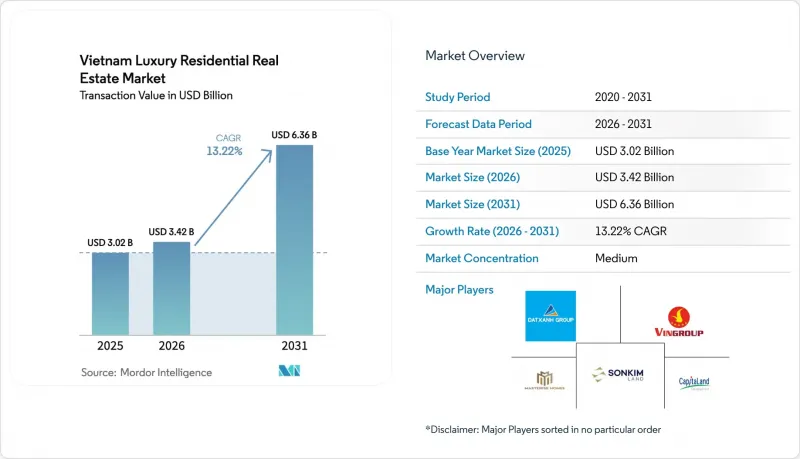
This report is Segmented by Property Type (Apartments & Condominiums, and Villas & Landed Houses), by by Business Model (Sales and Rental), by Mode of Sale (Primary and Secondary), by City (Ho Chi Minh City, Hanoi, Da Nang, Nha Trang and Other Cities). The Report Offers Market Size and Forecast Values (USD) for all the Above Segments.
Vietnam Luxury Residential Real Estate Market Trends and Insights
Aging affluent population drives inter-generational wealth transfer
Vietnam's 16.1 million seniors in 2025 will exceed 20 million by 2030 as prosperity spreads. Asset transfers from first-generation entrepreneurs to younger heirs fuel continuous upgrading toward multi-generational, amenity-rich homes that blend security with lifestyle. Demand for healthcare-integrated compounds rises, creating fresh opportunities for senior-living focused estates.
Elite immigration demand & relaxed long-term visa policies for foreign investors
New 10-year investment visas shorten on-boarding time for foreign millionaires, particularly from East Asia and Europe. Flexible residency drives immediate absorption of serviced penthouses and branded coastal villas, cementing Vietnam luxury residential market as a regional safe-haven.
Expanding foreign-buyer taxes & ownership ratio caps
Though foreign appetite remains strong, quota ceilings of 30% in condominium blocks and 250 landed homes per ward slow absorption once limits are reached. Proposed surcharge revisions could erode net returns and funnel demand toward quota-available districts.
Other drivers and restraints analyzed in the detailed report include:
- Rapid urbanisation of tier-2 coastal cities boosts resort-luxury projects
- Tight land-use quotas in CBD districts push vertical luxury towers
- Land & construction cost inflation pressures pricing
For complete list of drivers and restraints, kindly check the Table Of Contents.
Segment Analysis
Apartments represent 70.35% of Vietnam luxury residential market in 2025, anchored in HCMC and Hanoi CBD stock scarcity. Prime high-rise units trade above USD 14,000/m2 and achieve 75% capital appreciation across five years as transit and amenity clustering magnify liquidity. Luxury villas, though smaller in absolute count, record 13.73% CAGR to 2031, lifted by privacy preferences among tech millionaires and returning diaspora. Waterfront villa estates outside HCMC realise 10-35% premiums over in-city counterparts and deliver sturdy holiday rental income streams.
The apartment subsector benefits from developer finance plans, smart home platforms and international hotel branding, sustaining rapid sell-through even at record prices. Conversely, villa supply grows along ring roads and coastal corridors where larger land parcels allow low-density layouts, golf frontage and private berths. Vietnam luxury residential market size for villas is forecast to rise faster than urban towers, yet absolute dominance remains with apartments through 2031.
Sales retained 84.35% share of Vietnam luxury residential market in 2025 as ownership culture prevails, but professional leasing clusters now expand at 14.62% CAGR on widening expatriate inflows and wealth-management focus. Average gross yields stand at 3.16% in Q1 2025, reaching 3.52% in HCMC. Institutional investors assemble portfolios of branded serviced apartments within prime nodes to secure index-linked income. Vietnam luxury residential market size allocated to rental stock is projected to double by 2031 yet remains a fraction of the sell-to-own stronghold.
Developers respond with leaseback guarantees and co-living floors to attract buy-to-let buyers. Serviced apartment occupancy in HCMC at 85% and rents at USD 42/m2 per month underline robust corporate demand pipelines. Should preferential rates for young first-time buyers widen, rental velocity may moderate, but mainstream ownership incentives are not expected to undercut premium leasing in converted Grade A schemes.
Complete Report Scope:
- By Property Type
- Apartments & Condominiums
- Villas & Landed Houses
- By Business Model
- Sales
- Rental
- By Mode of Sale
- Primary (New-build)
- Secondary (Existing-home Resale)
- By City
- Ho Chi Minh City
- Hanoi
- Da Nang
- Nha Trang
- Other Cities
List of Companies Covered in this Report:
- Vingroup JSC
- SonKim Land Corporation
- Masterise Homes
- NovaLand Group
- CapitaLand Vietnam
- Dat Xanh Group
- Hung Thinh Land
- Phat Dat Real Estate Development Corporation
- Phu My Hung Development Corporation
- Nam Long Investment Corporation
- Filmore Real Estate Development Corporation
- Sun Property Group (Sun Group)
- Keppel Land Vietnam
- Lotte Properties Saigon
- Mapletree Vietnam
- Kusto Home
- Ecopark Corporation JSC
- Gamuda Land Vietnam
- BIM Land
- Sunwah Pearl (Sunwah Group)
Additional Benefits:
- The market estimate (ME) sheet in Excel format
- 3 months of analyst support
TABLE OF CONTENTS
1 Introduction
- 1.1 Study Assumptions & Market Definition
- 1.2 Scope of the Study
2 Research Methodology
3 Executive Summary
4 Market Landscape
- 4.1 Market Overview
- 4.2 Overview of the Economy & Luxury Residential Market
- 4.3 Luxury Residential Buying Trends - Socio-economic & Demographic Insights
- 4.4 Regulatory Outlook
- 4.5 Technological Outlook
- 4.6 Insights into Rental Yields in Luxury Residential Segment
- 4.7 Luxury Residential Lending Dynamics
- 4.8 Market Drivers
- 4.8.1 Aging affluent population & inter-generational wealth transfer
- 4.8.2 Elite immigration demand & relaxed long-term visa policies for foreign investors
- 4.8.3 Rapid urbanisation of tier-2 coastal cities (Da Nang, Nha Trang) boosting resort luxury projects
- 4.8.4 Tight land-use quotas in CBD districts of HCMC & Hanoi pushing vertical luxury towers
- 4.8.5 Growing adoption of green-building certifications (EDGE, LEED) in luxury segment
- 4.8.6 Boom in tech-sector millionaires & crypto wealth in Vietnam's start-up hubs
- 4.9 Market Restraints
- 4.9.1 Expanding foreign-buyer taxes & ownership ratio caps
- 4.9.2 Run-up in land & construction material costs post-Covid
- 4.9.3 Stricter anti-money-laundering scrutiny on offshore capital inflows
- 4.9.4 Climate-risk-driven insurance premium surge on coastal & river-front assets
- 4.10 Value / Supply-Chain Analysis
- 4.11 Porter's Five Forces
- 4.11.1 Bargaining Power of Suppliers
- 4.11.2 Bargaining Power of Buyers
- 4.11.3 Threat of New Entrants
- 4.11.4 Threat of Substitutes
- 4.11.5 Intensity of Competitive Rivalry
5 Market Size & Growth Forecasts (Value)
- 5.1 By Property Type
- 5.1.1 Apartments & Condominiums
- 5.1.2 Villas & Landed Houses
- 5.2 By Business Model
- 5.2.1 Sales
- 5.2.2 Rental
- 5.3 By Mode of Sale
- 5.3.1 Primary (New-build)
- 5.3.2 Secondary (Existing-home Resale)
- 5.4 By City
- 5.4.1 Ho Chi Minh City
- 5.4.2 Hanoi
- 5.4.3 Da Nang
- 5.4.4 Nha Trang
- 5.4.5 Other Cities
6 Competitive Landscape
- 6.1 Market Concentration
- 6.2 Strategic Moves (M&A, JV, Land-bank Acquisitions, IPOs)
- 6.3 Market Share Analysis
- 6.4 Company Profiles (includes Global-level Overview, Market-level Overview, Core Segments, Financials as available, Strategic Information, Market Rank/Share, Products & Services, Recent Developments)
- 6.4.1 Vingroup JSC
- 6.4.2 SonKim Land Corporation
- 6.4.3 Masterise Homes
- 6.4.4 NovaLand Group
- 6.4.5 CapitaLand Vietnam
- 6.4.6 Dat Xanh Group
- 6.4.7 Hung Thinh Land
- 6.4.8 Phat Dat Real Estate Development Corporation
- 6.4.9 Phu My Hung Development Corporation
- 6.4.10 Nam Long Investment Corporation
- 6.4.11 Filmore Real Estate Development Corporation
- 6.4.12 Sun Property Group (Sun Group)
- 6.4.13 Keppel Land Vietnam
- 6.4.14 Lotte Properties Saigon
- 6.4.15 Mapletree Vietnam
- 6.4.16 Kusto Home
- 6.4.17 Ecopark Corporation JSC
- 6.4.18 Gamuda Land Vietnam
- 6.4.19 BIM Land
- 6.4.20 Sunwah Pearl (Sunwah Group)
7 Market Opportunities & Future Outlook

