PUBLISHER: Mordor Intelligence | PRODUCT CODE: 2116590

PUBLISHER: Mordor Intelligence | PRODUCT CODE: 2116590
North America Luxury Residential Real Estate - Market Share Analysis, Industry Trends & Statistics, Growth Forecasts (2026 - 2031)
According to Mordor Intelligence, the North America luxury residential real estate market size was valued at USD 583.94 billion in 2025 and estimated to grow from USD 606.84 billion in 2026 to reach USD 735.48 billion by 2031, at a CAGR of 3.92% during the forecast period (2026-2031).
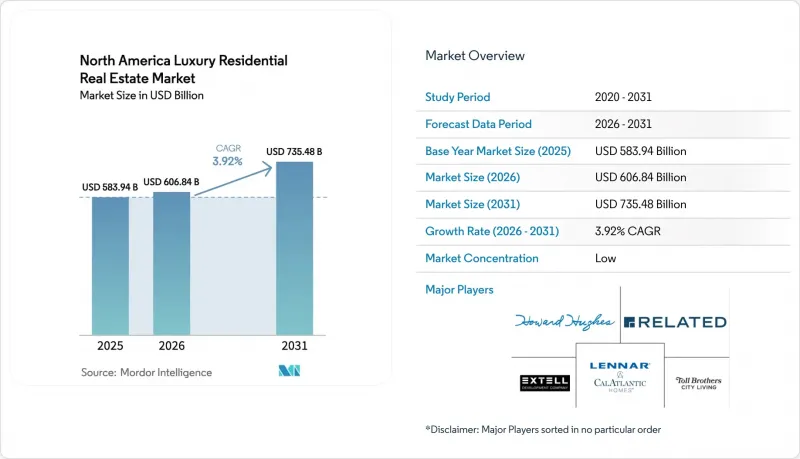
This report is Segmented by Property Type (Apartments & Condominiums, Villas & Landed Houses), by Business Model (Sales and Rental), by Mode of Sale (Primary (New-Build) and Secondary (Existing-Home Resale)), and by Geography (United States, Canada, Mexico). The Report Offers Market Size and Forecasts in Value (USD) for all the Above Segments.
North America Luxury Residential Real Estate Market Trends and Insights
USD 1 trillion tokenized luxury pipelines unlocking fractional ownership
Blockchain-enabled tokenization is lowering entry barriers by splitting prime residences into digital shares that can be traded without conventional escrow delays. Deloitte highlights that a single Canadian tower raised USD 300 million through token sales, demonstrating institutional appetite for the model. Smart contracts automate dividend distribution and compliance checks, cutting middle-agent costs. The St. Regis Aspen precedent further eases regulatory concerns, and North American securities watchdogs are drafting sandbox frameworks expected to go live within three years. Taken together, tokenization increases velocity of capital and broadens participation in the North America luxury residential real estate market.
Surging demand for zero-income-tax Sunbelt states
Florida captured 29,771 high-income households averaging USD 907,013 in adjusted gross income during the latest filing year. Texas and Nevada post similar trends, propelled by corporate relocations such as Citadel's headquarters move to Miami. Over six hundred USD 10 million-plus closings in South Florida last year underscore structural rather than seasonal demand. Builders respond with turnkey condos offering marina berths and private wellness suites, inflating land prices yet sustaining absorption. The pattern accelerates cross-border interest in Mexican resort towns, reinforcing the North America luxury residential real estate market's Sunbelt bias.
Proposed mansion & vacancy taxes in major metros
In Los Angeles, a new tax called Measure ULA, aimed at property sales over USD 5 million, led to a steep 68% drop in those sales within a year. The tax only managed to raise USD 215 million, which was much lower than expected. On the other hand, Honolulu is considering a 3% tax on vacant homes, which could bring in up to USD 306 million in revenue. Investors may route capital toward lower-tax jurisdictions, dampening short-run price momentum in affected nodes of the North America luxury residential real estate market.
Other drivers and restraints analyzed in the detailed report include:
- Geopolitical capital flight of UHNWIs from LATAM & APAC
- Institutional ESG mandates accelerating WELL Platinum projects
- Supply crunch in imported bespoke finishes
For complete list of drivers and restraints, kindly check the Table Of Contents.
Segment Analysis
Apartments and condominiums held a 60.45% slice of the North America luxury residential real estate market in 2025, propelled by demand for lock-and-leave convenience, shared security, and amenity-rich towers. Vista Pointe on New Jersey's Gold Coast exemplifies the model with 73 glass-wrapped units, an infinity pool, and a 24-hour concierge. Institutional buyers back such schemes for stable rental yields, reinforcing pipeline depth. Secondary resales remain active, especially for branded residences that preserve service standards over time. At the opposite end, villas and landed houses outpace at a 4.05% CAGR as clients seek acreage for wellness pavilions and multigenerational living.
Estate lots in Palm Beach, Scottsdale, and Muskoka now feature accessory dwelling units and tech-integrated spas, lifting replacement costs and resale potential. Developers pivot with gated communities offering curated landscaping and private docks, blending privacy with community governance. This mix enables villas to capture lifestyle-centric spending, a tailwind for the overall North America luxury residential real estate market expansion.
Complete Report Scope:
- By Property Type
- Apartments & Condominiums
- Villas & Landed Houses
- By Business Model
- Sales
- Rentals
- By Mode of Sale
- Primary (New-Build)
- Secondary (Existing-Home Resale)
- By Country
- United States
- Canada
- Mexico
List of Companies Covered in this Report:
- Toll Brothers City Living
- Lennar Corp (CalAtlantic Luxury)
- Howard Hughes Corp
- Related Companies
- Extell Development
- Compass Luxury Division
- Sotheby's International Realty
- Coldwell Banker Global Luxury
- Douglas Elliman
- The Agency
- Westbank
- Brookfield Residential
- Hines
- KB Home Prestige Collection
- Tridel USA
- Related Group (Florida)
- Engel & Volkers USA
- Keller Williams Luxury
- Christie's International Real Estate
Additional Benefits:
- The market estimate (ME) sheet in Excel format
- 3 months of analyst support
TABLE OF CONTENTS
1 Introduction
- 1.1 Study Assumptions & Market Definition
- 1.2 Scope of the Study
2 Research Methodology
3 Executive Summary
4 Market Landscape
- 4.1 Overview of the Economy and Luxury Residential Market
- 4.2 Luxury Residential Real Estate Buying Trends - Socio-economic and Demographic Insights
- 4.3 Regulatory Outlook
- 4.4 Technological Outlook
- 4.5 Insights into Rental Yields in Luxury Residential Real Estate Segment
- 4.6 Luxury Residential Real Estate Lending Dynamics
- 4.7 Market Drivers
- 4.7.1 USD 1 trillion tokenized-real-estate pipelines unlocking fractional ownership
- 4.7.2 Surging demand for zero-income-tax Sunbelt states (FL, TX, NV)
- 4.7.3 Geopolitical capital flight of UHNWIs from LATAM & APAC
- 4.7.4 Institutional ESG mandates accelerating WELL Platinum projects
- 4.7.5 Luxury build-to-rent resorts targeting "work-cation" digital nomads
- 4.7.6 Wave of post-pandemic estate expansions (ADUs, wellness pavilions)
- 4.8 Market Restraints
- 4.8.1 Proposed mansion & vacancy taxes in major metros
- 4.8.2 Supply crunch in imported bespoke finishes (Italian marble, smart glass)
- 4.8.3 Escalating WELL/LEED certification compliance costs
- 4.8.4 Equity-market volatility shrinking stock-option-funded purchases
- 4.9 Value / Supply-Chain Analysis
- 4.10 Porter's Five Forces
- 4.10.1 Bargaining Power of Suppliers
- 4.10.2 Bargaining Power of Buyers
- 4.10.3 Threat of New Entrants
- 4.10.4 Threat of Substitutes
- 4.10.5 Intensity of Competitive Rivalry
5 Market Size & Growth Forecasts (Value)
- 5.1 By Property Type
- 5.1.1 Apartments & Condominiums
- 5.1.2 Villas & Landed Houses
- 5.2 By Business Model
- 5.2.1 Sales
- 5.2.2 Rentals
- 5.3 By Mode of Sale
- 5.3.1 Primary (New-Build)
- 5.3.2 Secondary (Existing-Home Resale)
- 5.4 By Country
- 5.4.1 United States
- 5.4.2 Canada
- 5.4.3 Mexico
6 Competitive Landscape
- 6.1 Market Concentration
- 6.2 Strategic Moves (M&A, JV, Land-bank Acquisitions, IPOs)
- 6.3 Market Share Analysis
- 6.4 Company Profiles (includes Global-level Overview, Market-level Overview, Core Segments, Financials as available, Strategic Information, Market Rank/Share, Products & Services, Recent Developments)
- 6.4.1 Toll Brothers City Living
- 6.4.2 Lennar Corp (CalAtlantic Luxury)
- 6.4.3 Howard Hughes Corp
- 6.4.4 Related Companies
- 6.4.5 Extell Development
- 6.4.6 Compass Luxury Division
- 6.4.7 Sotheby's International Realty
- 6.4.8 Coldwell Banker Global Luxury
- 6.4.9 Douglas Elliman
- 6.4.10 The Agency
- 6.4.11 Westbank
- 6.4.12 Brookfield Residential
- 6.4.13 Hines
- 6.4.14 KB Home Prestige Collection
- 6.4.15 Tridel USA
- 6.4.16 Related Group (Florida)
- 6.4.17 Engel & Volkers USA
- 6.4.18 Keller Williams Luxury
- 6.4.19 Christie's International Real Estate
7 Market Opportunities & Future Outlook
- 7.1 White-space & Unmet-Need Assessment (Senior-Living, Net-Zero Homes, Co-Primary Residences)

