PUBLISHER: Mordor Intelligence | PRODUCT CODE: 2116434

PUBLISHER: Mordor Intelligence | PRODUCT CODE: 2116434
France Luxury Residential Real Estate - Market Share Analysis, Industry Trends & Statistics, Growth Forecasts (2026 - 2031)
According to Mordor Intelligence, the France luxury residential real estate market size was valued at USD 82.58 billion in 2025 and is estimated to grow from USD 85.66 billion in 2026 to reach USD 102.85 billion by 2031, at a CAGR of 3.73% during the forecast period (2026-2031).
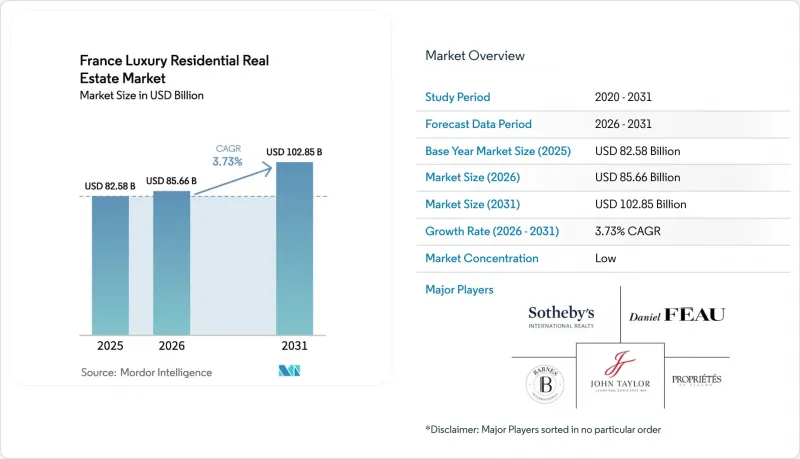
This report is Segmented by Business Model (Sales, Rental), by Property Type (Apartments & Condominiums, Villas & Landed Houses), by Mode of Sale (Primary New-Build, Secondary Existing-Home Resale), and by Geography (Paris, Lyon, Marseille, Rest of France). The Market Forecasts are Provided in Terms of Value (USD).
France Luxury Residential Real Estate Market Trends and Insights
Extreme Scarcity of Ultra-Prime Assets in Paris Golden Triangle
Annual supply of apartments above 300 m2 in Paris's 1st, 6th, 7th, 8th, and 16th arrondissements has stayed below 50 units since 2024, creating a structural shortage that fuels double-digit bidding premiums. Branded conversions such as Maybourne Riviera illustrate the valuation gap, with 2024 launch prices near USD 58,300 per m2, almost twice nearby non-branded stock. Heritage-protection rules prohibit demolition and vertical expansion, permanently capping new inventory. Knight Frank ranked Paris fourth worldwide for ultra-high-net-worth density, yet logged a 12% drop in EUR 10 million-plus trades in 2025 as scarcity outpaced liquidity. Sellers able to wait for the right match now achieve sub-60-day closings, while secondary stock lingers several months longer, reinforcing the scarcity premium.
Global HNW Demand Anchored by Rule-of-Law, Culture, and Schools
France's clear property title regime, absence of capital controls, and concentration of elite schools keep it at the top of relocation shortlists for American, Gulf, and Asian families. Notarial data show 8% average price growth in 2025 around the Musee d'Orsay and Opera Garnier catchments as remote-work professionals sought cultural proximity. GCC buyer volume rose 15% during the year despite tougher European AML checks. Post-Olympics branding in 2024 raised Paris's global visibility, but the enduring magnet remains eurozone legal certainty and European Court of Justice oversight. Institutional landlords accept 2-3% gross yields because wealth preservation, rather than income, drives allocations at the top end.
High Transaction and Ownership Taxes Erode Net Returns
The Impot sur la Fortune Immobiliere imposes a 0.5-1% annual tax on net real-estate wealth above USD 1.38 million, shrinking income streams for non-resident landlords. Buyers also pay 7-8% in notary, registration, and agent fees, equating to USD 371,000-424,000 in upfront costs on a USD 5.3 million Paris purchase. These frictions compress already thin 2-3% gross yields, steering yield-focused capital toward equities or credit markets instead. Senate proposals to ease thresholds stalled in 2025, keeping the levy an enduring drag on market velocity and France luxury residential real estate market growth.
Other drivers and restraints analyzed in the detailed report include:
- Riviera and Alpine Second-Home Markets with Rental Upside
- Euro Weakness Boosts USD/GBP Purchasing Power
- Strict Planning Rules and Energy Mandates Raise Capex and Timelines
For complete list of drivers and restraints, kindly check the Table Of Contents.
Segment Analysis
Sales accounted for 71.2% of France's luxury residential real estate market share in 2025, underscoring the continued dominance of trophy acquisitions for long-term wealth preservation. Owner-occupiers and family offices remain the core buyers, while international investors target secondary-market heritage assets that can be held across generations. Despite this dominance, rental income strategies gain traction in Riviera and Alpine resorts, where short-let regulations are more permissive than in Paris. Institutional vehicles, including insurers and REITs, increasingly view turnkey villas as inflation-hedged alternatives to bonds, raising allocations to the rental pool.
Rental revenue is forecast to expand at a 4.80% CAGR through 2031, outpacing overall market growth. Corporate relocation programs and France's 2024 green-industry tax incentives lift demand for furnished executive housing in Lyon, Marseille, and Toulouse. Branded-residence operators structure fractional-ownership models that guarantee 50-60% of gross rental to owners, blending lifestyle access with predictable cash flow. This hybrid approach blurs the historic divide between sale and lease strategies, further embedding rental economics into acquisition decisions.
Complete Report Scope:
- By Business Model
- Sales
- Rental
List of Companies Covered in this Report:
- Sotheby's International Realty Affiliates LLC
- Daniel Feau
- Barnes International Realty
- John Taylor
- Proprietes Le Figaro
- Haussmann Real Estate
- Junot Immobilier
- Knight Frank France
- Coldwell Banker Global Luxury France
- Emile Garcin
- Engel & Volkers France
- Patrice Besse
- Christie's International Real Estate France
- Groupe Mercure
- Foncia Patrimoine
- Capifrance Luxe & Prestige
- Azur Prestige Immobilier
- Vaneau Immobilier
- Groupe Giboire
- BARNES
Additional Benefits:
- The market estimate (ME) sheet in Excel format
- 3 months of analyst support
TABLE OF CONTENTS
1 Introduction
- 1.1 Study Assumptions & Market Definition
- 1.2 Scope of the Study
2 Research Methodology
3 Executive Summary
4 Market Insight and Dynamics
- 4.1 Market Overview
- 4.2 Market Drivers
- 4.2.1 Extreme scarcity of ultra-prime assets in Paris "golden triangle" and top arrondissements.
- 4.2.2 Global HNW demand and safe-haven appeal of rule-of-law, culture, and top schools.
- 4.2.3 Riviera/Alps second-home markets with strong lifestyle and rental yield potential.
- 4.2.4 Euro weakness at times improves purchasing power for USD/GBP buyers.
- 4.2.5 Value-add premiums from heritage renovations and energy-efficiency upgrades.
- 4.3 Market Restraints
- 4.3.1 High transaction/ownership taxes and IFI wealth tax reduce net returns.
- 4.3.2 Strict planning/heritage rules and energy-retrofit mandates raise capex and timelines.
- 4.3.3 Tighter financing, AML/source-of-funds checks, and thin liquidity at the ultra-prime end.
- 4.4 Value / Supply-Chain Analysis
- 4.5 Regulatory Landscape
- 4.6 Technological Outlook
- 4.7 Porter's Five Forces
- 4.7.1 Bargaining Power of Suppliers
- 4.7.2 Bargaining Power of Buyers
- 4.7.3 Threat of New Entrants
- 4.7.4 Threat of Substitutes
- 4.7.5 Intensity of Competitive Rivalry
5 Residential Real Estate Market Size & Growth Forecasts (Value USD billion)
- 5.1 By Business Model
- 5.1.1 Sales
- 5.1.2 Rental
6 Residential Real Estate Market (Sales Model) Size & Growth Forecasts (Value USD billion)
- 6.1 By Property Type
- 6.1.1 Apartments & Condominiums
- 6.1.2 Villas & Landed Houses
- 6.2 By Mode of Sale
- 6.2.1 Primary (New-Build)
- 6.2.2 Secondary (Existing-Home Resale)
- 6.3 By City
- 6.3.1 Paris
- 6.3.2 Lyon
- 6.3.3 Marseille
- 6.3.4 Rest of France
7 Competitive Landscape
- 7.1 Market Concentration
- 7.2 Strategic Moves
- 7.3 Market Share Analysis
- 7.4 Company Profiles (includes Global level Overview, Market level overview, Core Segments, Financials as available, Strategic Information, Products & Services, and Recent Developments)
- 7.4.1 Sotheby's International Realty Affiliates LLC
- 7.4.2 Daniel Feau
- 7.4.3 Barnes International Realty
- 7.4.4 John Taylor
- 7.4.5 Proprietes Le Figaro
- 7.4.6 Haussmann Real Estate
- 7.4.7 Junot Immobilier
- 7.4.8 Knight Frank France
- 7.4.9 Coldwell Banker Global Luxury France
- 7.4.10 Emile Garcin
- 7.4.11 Engel & Volkers France
- 7.4.12 Patrice Besse
- 7.4.13 Christie's International Real Estate France
- 7.4.14 Groupe Mercure
- 7.4.15 Foncia Patrimoine
- 7.4.16 Capifrance Luxe & Prestige
- 7.4.17 Azur Prestige Immobilier
- 7.4.18 Vaneau Immobilier
- 7.4.19 Groupe Giboire
- 7.4.20 BARNES
8 Market Opportunities & Future Outlook
- 8.1 White-space & Unmet-Need Assessment

