PUBLISHER: Mordor Intelligence | PRODUCT CODE: 2116581

PUBLISHER: Mordor Intelligence | PRODUCT CODE: 2116581
Singapore Luxury Residential Real Estate - Market Share Analysis, Industry Trends & Statistics, Growth Forecasts (2026 - 2031)
According to Mordor Intelligence, The Singapore luxury residential real estate market size was valued at USD 9.48 billion in 2025 and estimated to grow from USD 10.18 billion in 2026 to reach USD 14.57 billion by 2031, at a CAGR of 7.42% during the forecast period (2026-2031).
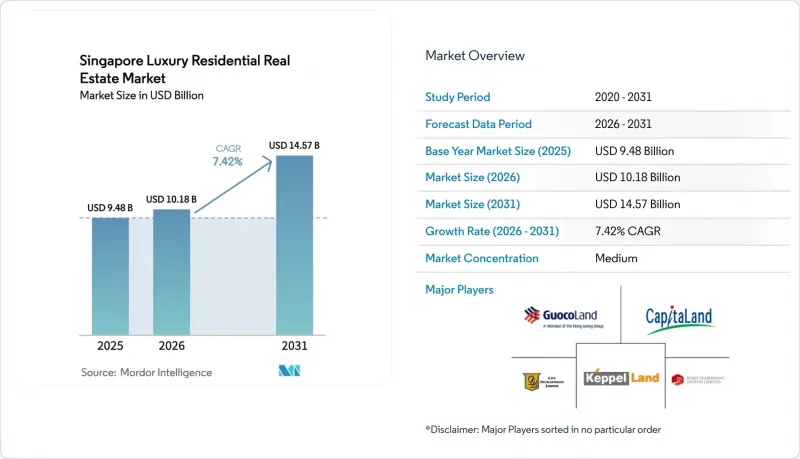
This report is Segmented by Property Type (Apartments & Condominiums, Villas & Landed Houses), by Business Model (Sales and Rental), by Mode of Sale (Primary (New-Build) and Secondary (Existing-Home Resale)), and by District (Central Business District (CBD), Orchard Road and More). The Report Offers Market Size and Forecasts in Value (USD) for all the Above Segments.
Singapore Luxury Residential Real Estate Market Trends and Insights
Robust UHNW inflows & Singapore's safe-haven appeal
Net migration of 3,500 millionaires in 2024 places Singapore third globally for private-wealth inflows. Many of these newcomers establish operational bases rather than passive asset parks, creating durable demand across central districts. Rental caveats in the Core Central Region rose 5.7% as UHNWIs opted to lease premium condominiums before purchasing. The city-state's political stability, transparent regulations, and tax consistency reinforce this inflow momentum. As a result, luxury listings seldom stay on the market long, sustaining price resilience even during policy tightening.
Ultra-low interest rates fuelling hard-asset allocation
Monetary easing across major economies continues to steer global capital toward hard assets. The Monetary Authority of Singapore's measured currency-band adjustments sustain an accommodative backdrop that enhances real estate's inflation-hedge appeal. Crypto-wealthy investors convert volatile digital holdings into tangible property, illustrated by a 52.2% jump in heritage shophouse sales during Q1 2024. Developers leveraging construction automation-robots that lift painting productivity by 30%-help contain build costs, ensuring new launches remain attractive. The driver is set to moderate only when global interest-rate normalization becomes entrenched.
Limited land supply & strict government land-release policies
Singapore's land scarcity is structural, leaving the Government Land Sales (GLS) programme as the main channel for adding supply. Only 8,505 private units are earmarked for release in 1H 2025, marginally above the previous tranche. Competitive bidding drives plot prices higher, as seen in Allgreen's USD 540.3 million Zion Road bid and GuocoLand's unsuccessful offer for Marina Gardens Crescent. Reclamation plans like the Long Island project will not deliver residential plots for at least a decade, keeping prime land a scarce commodity and capping volume growth.
Other drivers and restraints analyzed in the detailed report include:
- Foreign buyer demand leveraging SGD strength & political stability
- Tokenised property platforms enabling crypto-wealth deployment
- Additional Buyer's Stamp Duty (ABSD) on foreign purchases
For complete list of drivers and restraints, kindly check the Table Of Contents.
Segment Analysis
Apartments and condominiums captured 63.25% of the Singapore luxury residential real estate market share in 2025, reflecting the city's high-rise urban model and turnkey appeal to globally mobile investors. Premium towers in Marina Bay and Orchard Road offer hotel-grade concierge services, integrated retail, and rapid transit access, attributes that resonate with time-pressed executives. Condominium values have also benefited from tokenisation pilots that unlock smaller investment tickets without requiring whole-unit ownership.
Landed houses, though smaller in base, are the fastest-growing slice at an 8.05% CAGR through 2031 as UHNWIs chase space and privacy unavailable in vertical living. Supply is inherently capped by zoning controls, with good-class bungalow areas rarely expanded. The USD 29.2 million Ford Avenue transaction underscores buyers' willingness to absorb ABSD for unique assets. Developers respond by retrofitting older landed stock with wellness features and climate-resilient drainage to command even higher premiums, reinforcing the segment's upward trajectory.
Complete Report Scope:
- By Property Type
- Apartments & Condominiums
- Villas & Landed Houses
- By Business Model
- Sales
- Rental
- By Mode of Sale
- Primary (New-build)
- Secondary (Resale)
- By District
- Central Business District (CBD)
- Orchard Road
- Sentosa Cove
- Other Prime Districts
List of Companies Covered in this Report:
- City Developments Limited (CDL)
- CapitaLand Limited
- Keppel Land Limited
- GuocoLand Limited
- Bukit Sembawang Estates Limited
- Hoi Hup Realty Pte Ltd
- MCC Land Limited
- Oxley Holdings Limited
- MCL Land
- Allgreen Properties Limited
- Sotheby's International Realty Singapore
- Knight Frank Singapore
- Savills Singapore
- CBRE Singapore Luxury Division
- ERA Singapore Premium
- PropNex Luxury Division
- Huttons Asia Premium
- Dennis Wee Group Luxury
- OrangeTee & Tie Premium
Additional Benefits:
- The market estimate (ME) sheet in Excel format
- 3 months of analyst support
TABLE OF CONTENTS
1 Introduction
- 1.1 Study Assumptions & Market Definition
- 1.2 Scope of the Study
2 Research Methodology
3 Executive Summary
4 Market Landscape
- 4.1 Overview of the Economy and Luxury Residential Market
- 4.2 Luxury Residential Buying Trends - Socio-economic & Demographic Insights
- 4.3 Regulatory Outlook
- 4.4 Technological Outlook
- 4.5 Luxury Residential Lending Dynamics
- 4.6 Insights into Rental Yields in the Luxury Segment
- 4.7 Market Drivers
- 4.7.1 Robust UHNW inflows & Singapore's safe-haven appeal
- 4.7.2 Ultra-low interest rates fuelling hard-asset allocation
- 4.7.3 Foreign buyer demand leveraging SGD strength & political stability
- 4.7.4 Tokenised property platforms enabling crypto-wealth deployment
- 4.7.5 Wellness-centric "healthy homes" commanding premiums
- 4.7.6 Singapore's fintech & biotech boom boosting prime demand
- 4.8 Market Restraints
- 4.8.1 Limited land supply & strict government land release policies
- 4.8.2 Additional Buyer's Stamp Duty (ABSD) on foreign purchases
- 4.8.3 Climate-risk considerations for waterfront properties
- 4.8.4 Construction cost inflation & labor shortages
- 4.9 Value / Supply-Chain Analysis
- 4.10 Porter's Five Forces
- 4.10.1 Bargaining Power of Suppliers
- 4.10.2 Bargaining Power of Buyers
- 4.10.3 Threat of New Entrants
- 4.10.4 Threat of Substitutes
- 4.10.5 Intensity of Competitive Rivalry
5 Market Size & Growth Forecasts (Value)
- 5.1 By Property Type
- 5.1.1 Apartments & Condominiums
- 5.1.2 Villas & Landed Houses
- 5.2 By Business Model
- 5.2.1 Sales
- 5.2.2 Rental
- 5.3 By Mode of Sale
- 5.3.1 Primary (New-build)
- 5.3.2 Secondary (Resale)
- 5.4 By District
- 5.4.1 Central Business District (CBD)
- 5.4.2 Orchard Road
- 5.4.3 Sentosa Cove
- 5.4.4 Other Prime Districts
6 Competitive Landscape
- 6.1 Market Concentration
- 6.2 Strategic Moves (M&A, JV, Land-bank, IPOs)
- 6.3 Market Share Analysis
- 6.4 Company Profiles
- 6.4.1 City Developments Limited (CDL)
- 6.4.2 CapitaLand Limited
- 6.4.3 Keppel Land Limited
- 6.4.4 GuocoLand Limited
- 6.4.5 Bukit Sembawang Estates Limited
- 6.4.6 Hoi Hup Realty Pte Ltd
- 6.4.7 MCC Land Limited
- 6.4.8 Oxley Holdings Limited
- 6.4.9 MCL Land
- 6.4.10 Allgreen Properties Limited
- 6.4.11 Sotheby's International Realty Singapore
- 6.4.12 Knight Frank Singapore
- 6.4.13 Savills Singapore
- 6.4.14 CBRE Singapore Luxury Division
- 6.4.15 ERA Singapore Premium
- 6.4.16 PropNex Luxury Division
- 6.4.17 Huttons Asia Premium
- 6.4.18 Dennis Wee Group Luxury
- 6.4.19 OrangeTee & Tie Premium
7 Market Opportunities & Future Outlook
- 7.1 White-space & Unmet-Need Assessment

