PUBLISHER: Mordor Intelligence | PRODUCT CODE: 2116526

PUBLISHER: Mordor Intelligence | PRODUCT CODE: 2116526
India Luxury Residential Real Estate - Market Share Analysis, Industry Trends & Statistics, Growth Forecasts (2026 - 2031)
According to Mordor Intelligence, the India luxury residential real estate market size was valued at USD 57.87 billion in 2025 and estimated to grow from USD 64.21 billion in 2026 to reach USD 107.99 billion by 2031, at a CAGR of 10.95% during the forecast period (2026-2031).
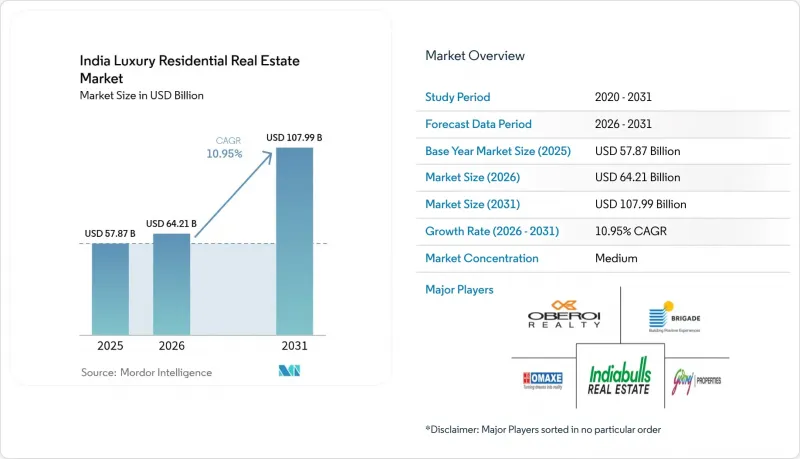
This report is Segmented by Property Type (Apartments & Condominiums, and Villas & Landed Houses), by by Business Model (Sales and Rental), by Mode of Sale (Primary and Secondary), by City (Delhi NCR, Mumbai, Bengaluru, Hyderabad, Pune, Chennai, Kolkata and Other Cities). The Report Offers Market Size and Forecast Values (USD) for all the Above Segments.
India Luxury Residential Real Estate Market Trends and Insights
Economic Growth & Rapid UHNW Wealth Creation
Luxury demand escalates as India hosts 13,600 ultra-high-net-worth individuals who allocate around 32% of portfolios to real estate. Wealth is spreading into Tier-2 corridors, broadening the buyer base beyond legacy metros. Lifestyle-led purchases now rank ahead of purely financial motives, and a growing share of younger millionaires target green-certified developments. International diversification persists; however, competitive domestic yields are redirecting some cross-border capital back into flagship Indian projects.
Urban Infrastructure Upgrades Inflating Core-City Land Values
Major transport links like metro extensions and new airports reprice adjoining land before completion, with premium projects gaining the most. Mumbai clusters such as Sewri recorded pronounced value jumps following connectivity progress, while Pune's luxury launches ride on its evolving ring-road network. Government smart-city programs raise baseline urban services, indirectly lifting the ceiling on luxury pricing as affluent buyers value holistic livability.
Economic & Interest-Rate Volatility
Inventory in Mumbai's USD 12-24 million bracket now needs almost 4 years to clear as buyers pause during equity swings. Expected rate cuts in 2025 may restore confidence, but the linkage between luxury absorption and stock-market performance keeps sentiment delicate in the short run.
Other drivers and restraints analyzed in the detailed report include:
- NRI Remittances & Preference for Trophy Assets
- Fintech-Enabled Fractional Ownership Platforms
- Escalating Land & Construction Material Costs
For complete list of drivers and restraints, kindly check the Table Of Contents.
Segment Analysis
Apartments retain a 62.35% hold on India luxury residential real estate market share in 2025, buoyed by land scarcity in urban cores. Villas and landed homes, however, log an 11.20% CAGR and capture aspirational buyers seeking privacy in Goa and suburban Mumbai. The India luxury residential real estate market size for villas is expected to grow more than twofold by 2031 alongside infrastructure that shortens commute times. Developers respond with branded communities that integrate concierge, wellness pavilions and IGBC Platinum ratings, placing the segment firmly on the premium radar.
Villa growth hinges on limited land banks, so price appreciation often exceeds apartment gains. Ultra-high-rise towers counter by adding private elevators and hotel-grade services, as seen in recent 60-storey launches in Worli. Sustainability standards also converge; both formats now feature energy-efficient glazing and water recycling as standard to please environmentally minded investors.
Sales transactions dominated 80.35% of the India luxury residential real estate market size in 2025, underpinned by trophy ownership aspirations. Rental assets are rising at a 12.25% CAGR, lifted by Bengaluru's 4.45% gross yields and heightened corporate mobility. Lifestyle flexibility attracts younger executives while NRIs favor passive rent streams in prime Mumbai where 2BHK rents start at USD 1,506 per month.
Rental viability strengthens as fractional ownership vehicles bundle high-end homes into yield-oriented portfolios. This hybrid capital flow narrows the gap between outright purchases and structured investments, adding depth to the India luxury residential real estate market.
Complete Report Scope:
- By Property Type
- Apartments & Condominiums
- Villas & Landed Houses
- By Business Model
- Sales
- Rental
- By Mode of Sale
- Primary (New-build)
- Secondary (Resale)
- By City
- Delhi NCR
- Mumbai
- Bengaluru
- Hyderabad
- Pune
- Chennai
- Kolkata
- Other Cities
List of Companies Covered in this Report:
- DLF Ltd
- Macrotech Developers (Lodha)
- Godrej Properties
- Prestige Group
- Oberoi Realty
- Brigade Enterprises
- Sobha Ltd
- Embassy Group
- Mahindra Lifespaces
- Indiabulls Real Estate
- Sunteck Realty
- Panchshil Realty
- Omaxe Ltd
- The Phoenix Mills
- Tata Realty & Infrastructure
- Hiranandani Communities
- Rustomjee Developers
- L&T Realty
- Shapoorji Pallonji Real Estate
- Puravankara Ltd
Additional Benefits:
- The market estimate (ME) sheet in Excel format
- 3 months of analyst support
TABLE OF CONTENTS
1 Introduction
- 1.1 Study Assumptions & Market Definition
- 1.2 Scope of the Study
2 Research Methodology
3 Executive Summary
4 Market Landscape
- 4.1 Overview of the Economy & Luxury Residential Market
- 4.2 Luxury Residential Buying Trends - Socio-economic & Demographic Insights
- 4.3 Regulatory Outlook
- 4.4 Technological Outlook
- 4.5 Luxury Residential Lending Dynamics
- 4.6 Insights into Rental Yields in the Luxury Segment
- 4.7 Market Drivers
- 4.7.1 Economic growth & rapid UHNW wealth creation
- 4.7.2 Urban infrastructure upgrades inflating core-city land values
- 4.7.3 NRI remittances & preference for trophy assets
- 4.7.4 Low penetration of luxury high-rise living
- 4.7.5 Fintech-enabled fractional ownership platforms
- 4.7.6 Branded-residence demand with hotel-grade amenities
- 4.8 Market Restraints
- 4.8.1 Economic & interest-rate volatility
- 4.8.2 Escalating land & construction material costs
- 4.8.3 Stricter AML scrutiny on high-value deals (under-reported)
- 4.8.4 Climate-risk-driven insurance spikes for coastal assets (under-reported)
- 4.9 Value / Supply-Chain Analysis
- 4.10 Porter's Five Forces
- 4.10.1 Bargaining Power of Suppliers
- 4.10.2 Bargaining Power of Buyers
- 4.10.3 Threat of New Entrants
- 4.10.4 Threat of Substitutes
- 4.10.5 Intensity of Competitive Rivalry
5 Market Size & Growth Forecasts (Value)
- 5.1 By Property Type
- 5.1.1 Apartments & Condominiums
- 5.1.2 Villas & Landed Houses
- 5.2 By Business Model
- 5.2.1 Sales
- 5.2.2 Rental
- 5.3 By Mode of Sale
- 5.3.1 Primary (New-build)
- 5.3.2 Secondary (Resale)
- 5.4 By City
- 5.4.1 Delhi NCR
- 5.4.2 Mumbai
- 5.4.3 Bengaluru
- 5.4.4 Hyderabad
- 5.4.5 Pune
- 5.4.6 Chennai
- 5.4.7 Kolkata
- 5.4.8 Other Cities
6 Competitive Landscape
- 6.1 Market Concentration
- 6.2 Strategic Moves (M&A, JV, Land-bank, IPOs)
- 6.3 Market Share Analysis
- 6.4 Company Profiles (includes Global-level Overview, Market-level Overview, Core Segments, Financials as available, Strategic Information, Market Rank/Share, Products & Services, Recent Developments)
- 6.4.1 DLF Ltd
- 6.4.2 Macrotech Developers (Lodha)
- 6.4.3 Godrej Properties
- 6.4.4 Prestige Group
- 6.4.5 Oberoi Realty
- 6.4.6 Brigade Enterprises
- 6.4.7 Sobha Ltd
- 6.4.8 Embassy Group
- 6.4.9 Mahindra Lifespaces
- 6.4.10 Indiabulls Real Estate
- 6.4.11 Sunteck Realty
- 6.4.12 Panchshil Realty
- 6.4.13 Omaxe Ltd
- 6.4.14 The Phoenix Mills
- 6.4.15 Tata Realty & Infrastructure
- 6.4.16 Hiranandani Communities
- 6.4.17 Rustomjee Developers
- 6.4.18 L&T Realty
- 6.4.19 Shapoorji Pallonji Real Estate
- 6.4.20 Puravankara Ltd
7 Market Opportunities & Future Outlook

