PUBLISHER: Mordor Intelligence | PRODUCT CODE: 2100714

PUBLISHER: Mordor Intelligence | PRODUCT CODE: 2100714
B2B E-commerce - Market Share Analysis, Industry Trends & Statistics, Growth Forecasts (2026 - 2031)
According to Mordor Intelligence, the B2B e-commerce market size in terms of gross merchandise value is expected to increase from USD 33.02 trillion in 2025 to USD 36.86 trillion in 2026 and reach USD 61.66 trillion by 2031, growing at a CAGR of 10.84% over 2026-2031.
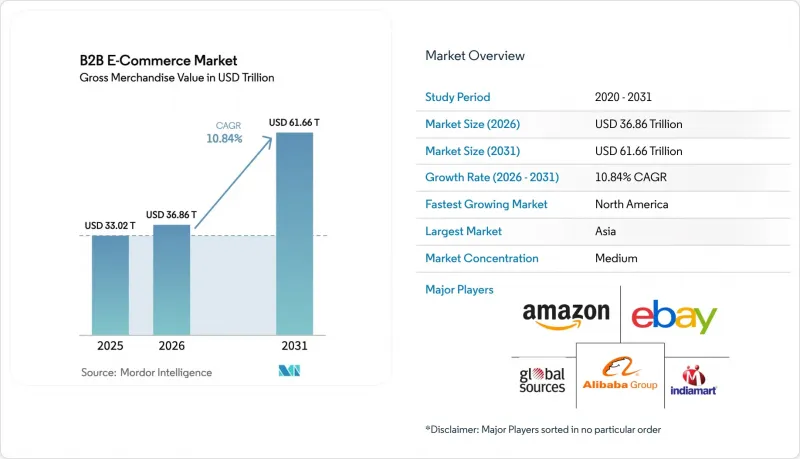
This report is Segmented by Channel (Direct Sales, and Marketplace Sales), Transaction Model (Domestic, and Cross-Border), Payment Method (Bank Transfers and ACH, Credit/Debit Cards, and More), Industry Vertical (Manufacturing, Retail and Wholesale, Healthcare and Life Sciences, Automotive, Construction and Building Materials, and More), and Geography. The Market Forecasts are Provided in Terms of Value (USD).
Global B2B E-commerce Market Trends and Insights
AI-Powered Procurement Platforms Accelerate Self-Service Buying
Machine-learning engines embedded in procurement suites now predict demand, recommend suppliers, and auto-approve low-risk purchases. SAP Ariba rolled out a generative AI assistant in 2025 that studies historical spend to surface renegotiation opportunities, trimming cycle times by 30%. Coupa automated invoice matching the same year, cutting accounts-payable workloads nearly in half. Zip channeled new capital into an AI intake module that routes requisitions to pre-approved vendors, while IBM's natural-language requisition engine converts unstructured requests into RFQs in hours. These capabilities are most pronounced in tail-spend categories where speed outweighs negotiation depth, reinforcing the shift toward buyer autonomy.
Manufacturing SMEs in Asia Digitize Cross-Border Sourcing via Marketplaces
Policy incentives across Asia-Pacific are funneling small manufacturers onto digital platforms. Singapore's SME Go Digital program subsidizes 70% of onboarding costs, fueling a 52% surge in cross-border listings. India's Open Network for Digital Commerce linked 200,000 suppliers to overseas buyers by 2025 through a unified API layer. China's pilot zones grant tax rebates and simplified export paperwork, lifting B2B volumes by 38%. Vietnam's trade ministry partnered with Alibaba to train 50,000 exporters on catalog management. These efforts narrow information gaps and let small firms compete on lead time and specifications rather than brand heft.
Escalating Marketplace Compliance Costs for Hazardous Goods Sellers
Regulations covering hazardous chemicals now impose registration fees, audit requirements, and civil penalties that smaller distributors struggle to absorb. IATA's Dangerous Goods Rules expose U.S. violators to fines up to USD 500,000 per shipment. OSHA mandates updated safety data sheets within 90 days of new hazard findings, costing mid-sized firms USD 50,000-100,000 annually. Europe's REACH regime charges as much as EUR 34,000 (USD 37,400) per substance, forcing catalog rationalization. Marketplaces pass legal risk through higher fees, evidenced by Amazon Business lifting hazmat seller rates 25% in 2025. The upshot is consolidation toward distributors with dedicated regulatory teams.
Other drivers and restraints analyzed in the detailed report include:
- Virtual Cards and BNPL Simplify High-Value Checkout
- API-First Integration Unlocks Real-Time Visibility
- Rising Cross-Border Data Residency Restrictions
For complete list of drivers and restraints, kindly check the Table Of Contents.
Segment Analysis
Marketplace purchasing retained 65.12% B2B E-commerce Market share in 2025 as multi-vendor comparison and transparent pricing eclipsed single-supplier contracts. Vertical-specialist platforms like Thomasnet audit manufacturing capability on-site, attracting aerospace buyers that demand ITAR compliance. Alibaba's 1688.com introduced natural-language supplier matching in 2025, shortening sourcing cycles by one-third. Amazon Business expanded to 185 countries, embedding localized payments and automated customs filing that cut average delivery time to 5 days. Direct channels still serve high-spec segments such as pharmaceuticals, where buyers need customized formulations and long-term service agreements, but hybrid models are emerging. W.W. Grainger's Zoro combines marketplace listings with direct fulfillment, delivering volume discounts and dedicated account managers to corporate accounts.
Marketplaces widen their lead by incorporating embedded finance and logistics. DHgate protects first-time cross-border buyers by holding funds in escrow until inspection, mitigating quality risk. Walmart Business layered third-party integrations onto its proprietary portal, permitting buyers to tap 100,000 external SKUs while retaining consolidated invoicing. As these features mature, the B2B E-commerce Market continues to favor platforms that centralize catalog discovery, compliance, payments, and fulfillment.
Domestic procurement volumes are expanding at a 12.23% CAGR as firms relocate production closer to end markets. Same-day fulfillment networks powered by Shopify inventory pooling deliver within 24 hours to buyers located within 200 miles, a speed that cross-border logistics cannot match. North American manufacturers raise local sourcing plans thanks to clean-energy tax credits, while Mexico records a 52% jump in U.S.-oriented transactions as nearshoring reshapes automotive supply chains. Cross-border trade continues to dominate categories with geographic production clusters, such as rare-earth minerals and advanced semiconductors. The EU-Mercosur accord that removed duties on 91% of goods sparked a 28% uptick in Europe-South America flows, indicating tariffs remain a lever for cross-border growth. Nonetheless, customs paperwork and VAT reconciliation add 5%-8% to landed cost for low-value shipments, blunting price advantages versus local sourcing.
Digital customs and trade-finance tools attempt to offset friction. Amazon and Alibaba integrate tariff classification and origin certificates into checkout, while MercadoLibre's Envios Flex focuses on intraregional shipping to bypass lengthy ocean freight. The result is a nuanced landscape where firms split procurement between local plants for time-sensitive orders and offshore suppliers for cost-sensitive commodities.
Complete Report Scope:
- By Channel
- Direct Sales
- Marketplace Sales
- By Transaction Model
- Domestic
- Cross-Border
- By Payment Method
- Bank Transfers and ACH
- Credit and Debit Cards
- Other Payment Methods
- By Industry Vertical
- Manufacturing
- Retail and Wholesale
- Healthcare and Life Sciences
- Automotive
- Construction and Building Materials
- Other Industry Verticals
- By Geography
- North America
- United States
- Canada
- Mexico
- Europe
- Germany
- United Kingdom
- France
- Italy
- Spain
- Rest of Europe
- Asia-Pacific
- China
- Japan
- South Korea
- India
- Southeast Asia (Singapore, Indonesia, Thailand, Vietnam, Philippines)
- Rest of Asia-Pacific
- South America
- Brazil
- Argentina
- Chile
- Rest of South America
- Middle East
- United Arab Emirates
- Saudi Arabia
- Turkey
- Rest of Middle East
- Africa
- South Africa
- Nigeria
- Kenya
- Rest of Africa
- North America
Geography Analysis
Asia-Pacific produced 69.23% of global B2B e-commerce revenue in 2025, underpinned by China's USD 2.1 trillion export engine where B2B transactions formed 78% of sales. India's market advanced 34% after ONDC unified payments, logistics, and customs APIs for SMEs. Singapore processed more than 20 million electronic declarations through TradeNet, compressing clearance from two days to six hours. Southeast Asian growth is reinforced by mobile-first platforms that integrate local wallets and regional courier networks. Japan and South Korea lag due to entrenched keiretsu and chaebol chains that still prefer negotiated contracts and faxed purchase orders.
North America is the fastest-growing region, tracking a 12.09% CAGR to 2031 as enterprises adopt cloud-native platforms embedded within ERP suites. Amazon Business signed 41% more enterprise accounts in 2025 after extending multi-channel fulfillment, and the Inflation Reduction Act credits spurred a 27% jump in domestic orders for clean-energy components. Canada's Digital Adoption Program subsidized subscription costs, driving a 19% rise in online procurement among mid-sized manufacturers. Nearshoring lifted Mexico-U.S. trade by over half as companies migrated electronics and auto assembly closer to buyers.
Europe sustains moderate expansion shaped by privacy and sustainability policies. Germany's Mercateo layers carbon-footprint calculators on product pages to help buyers satisfy Corporate Sustainability Reporting Directive rules. Post-Brexit customs frictions in the United Kingdom abated once platforms automated VAT and origin documentation. The Middle East and Africa are building digital trade corridors; Dubai's blockchain-based TradeConnect reduced import processing times by 60%, while South Africa's Masterpass QR allowed 15,000 merchants to accept mobile B2B payments. South America sees concentration in Brazil, Argentina, and Chile, where MercadoLibre processed USD 8 billion in 2025, leveraging same-day delivery in urban centers.
- Alibaba Group Holding Ltd.
- Amazon.com Inc. (Amazon Business)
- IndiaMART InterMESH Ltd.
- eBay Inc.
- Global Sources Ltd.
- W.W. Grainger Inc. (Zoro)
- Walmart Inc. (Walmart Business)
- Shopify Inc.
- Mercateo AG
- DHgate.com
- Rakuten Group Inc.
- Flipkart Pvt. Ltd.
- Made-in-China.com (Focus Technology)
- Ozon Holdings PLC
- MercadoLibre Inc.
- BigCommerce Holdings Inc. (B2B Edition)
- Quill LLC (Staples)
- eWorldTrade.com
- Thomas Publishing Company (Thomasnet)
- Xometry Inc.
Additional Benefits:
- The market estimate (ME) sheet in Excel format
- 3 months of analyst support
TABLE OF CONTENTS
1 INTRODUCTION
- 1.1 Study Assumptions and Market Definition
- 1.2 Scope of the Study
2 RESEARCH METHODOLOGY
3 EXECUTIVE SUMMARY
4 MARKET LANDSCAPE
- 4.1 Market Overview
- 4.2 Industry Value Chain Analysis
- 4.3 Market Drivers
- 4.3.1 Rise of AI-Powered Procurement Platforms Accelerating Self-Service Buying
- 4.3.2 Manufacturing SMEs in Asia Digitizing Cross-Border Sourcing via Marketplaces
- 4.3.3 Virtual Cards and BNPL Penetration Simplifying High-Value B2B Checkout in Europe
- 4.3.4 Transition from EDI to API-First Integration Unlocking Real-Time Pricing Visibility
- 4.3.5 Sustainability-Driven Supplier Selection Boosting Verified Low-Carbon Marketplaces
- 4.3.6 Generative AI-Enabled Quote Automation Reducing Sales-Cycle Times for Industrial Distributors
- 4.4 Market Restraints
- 4.4.1 Escalating Marketplace Compliance Costs for Hazardous Goods Sellers
- 4.4.2 Rising Cross-Border Data Residency Restrictions
- 4.4.3 Surge in B2B Payment Fraud and Chargeback Risk for High-Ticket Orders
- 4.4.4 Limited SKU Data Standardization Hindering Predictive Replenishment Algorithms
- 4.5 Regulatory Outlook
- 4.6 Technological Outlook
- 4.7 Porter's Five Forces Analysis
- 4.7.1 Bargaining Power of Suppliers
- 4.7.2 Bargaining Power of Buyers
- 4.7.3 Threat of New Entrants
- 4.7.4 Threat of Substitute Products
- 4.7.5 Intensity of Competitive Rivalry
- 4.8 Impact of Macroeconomic Factors on the Market
- 4.9 Analysis on Prevalent Modes of Payments in B2B E-Commerce
- 4.10 Analysis of Customer Acquisition Trends
- 4.11 Analysis of Major Case Studies
- 4.12 Analysis of B2B E-Commerce Share in Total E-Commerce (Key Countries)
5 MARKET SIZE AND GROWTH FORECASTS (VALUE)
- 5.1 By Channel
- 5.1.1 Direct Sales
- 5.1.2 Marketplace Sales
- 5.2 By Transaction Model
- 5.2.1 Domestic
- 5.2.2 Cross-Border
- 5.3 By Payment Method
- 5.3.1 Bank Transfers and ACH
- 5.3.2 Credit and Debit Cards
- 5.3.3 Other Payment Methods
- 5.4 By Industry Vertical
- 5.4.1 Manufacturing
- 5.4.2 Retail and Wholesale
- 5.4.3 Healthcare and Life Sciences
- 5.4.4 Automotive
- 5.4.5 Construction and Building Materials
- 5.4.6 Other Industry Verticals
- 5.5 By Geography
- 5.5.1 North America
- 5.5.1.1 United States
- 5.5.1.2 Canada
- 5.5.1.3 Mexico
- 5.5.2 Europe
- 5.5.2.1 Germany
- 5.5.2.2 United Kingdom
- 5.5.2.3 France
- 5.5.2.4 Italy
- 5.5.2.5 Spain
- 5.5.2.6 Rest of Europe
- 5.5.3 Asia-Pacific
- 5.5.3.1 China
- 5.5.3.2 Japan
- 5.5.3.3 South Korea
- 5.5.3.4 India
- 5.5.3.5 Southeast Asia (Singapore, Indonesia, Thailand, Vietnam, Philippines)
- 5.5.3.6 Rest of Asia-Pacific
- 5.5.4 South America
- 5.5.4.1 Brazil
- 5.5.4.2 Argentina
- 5.5.4.3 Chile
- 5.5.4.4 Rest of South America
- 5.5.5 Middle East
- 5.5.5.1 United Arab Emirates
- 5.5.5.2 Saudi Arabia
- 5.5.5.3 Turkey
- 5.5.5.4 Rest of Middle East
- 5.5.6 Africa
- 5.5.6.1 South Africa
- 5.5.6.2 Nigeria
- 5.5.6.3 Kenya
- 5.5.6.4 Rest of Africa
- 5.5.1 North America
6 COMPETITIVE LANDSCAPE
- 6.1 Market Concentration
- 6.2 Strategic Moves
- 6.3 Market Share Analysis
- 6.4 Company Profiles (includes Global Level Overview, Market Level Overview, Core Segments, Financials as available, Strategic Information, Market Rank/Share, Products and Services, Recent Developments)
- 6.4.1 Alibaba Group Holding Ltd.
- 6.4.2 Amazon.com Inc. (Amazon Business)
- 6.4.3 IndiaMART InterMESH Ltd.
- 6.4.4 eBay Inc.
- 6.4.5 Global Sources Ltd.
- 6.4.6 W.W. Grainger Inc. (Zoro)
- 6.4.7 Walmart Inc. (Walmart Business)
- 6.4.8 Shopify Inc.
- 6.4.9 Mercateo AG
- 6.4.10 DHgate.com
- 6.4.11 Rakuten Group Inc.
- 6.4.12 Flipkart Pvt. Ltd.
- 6.4.13 Made-in-China.com (Focus Technology)
- 6.4.14 Ozon Holdings PLC
- 6.4.15 MercadoLibre Inc.
- 6.4.16 BigCommerce Holdings Inc. (B2B Edition)
- 6.4.17 Quill LLC (Staples)
- 6.4.18 eWorldTrade.com
- 6.4.19 Thomas Publishing Company (Thomasnet)
- 6.4.20 Xometry Inc.
7 MARKET OPPORTUNITIES AND FUTURE OUTLOOK
- 7.1 White-Space and Unmet-Need Assessment

