PUBLISHER: Mordor Intelligence | PRODUCT CODE: 2113217

PUBLISHER: Mordor Intelligence | PRODUCT CODE: 2113217
India Diabetes Devices - Market Share Analysis, Industry Trends & Statistics, Growth Forecasts (2026 - 2031)
According to Mordor Intelligence, the India diabetes devices market size is estimated at USD 2.67 billion in 2026, and is expected to reach USD 3.02 billion by 2031, at a CAGR of 2.49% during the forecast period (2026-2031).
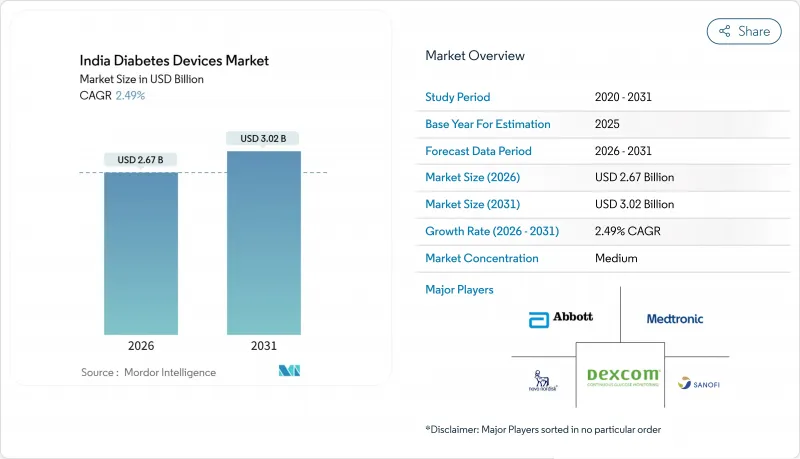
This report is Segmented by Product Type (Monitoring Devices, Management Devices), Patient Type (Type-1 Diabetes, Type-2 Diabetes), and End User (Hospitals & Specialty Clinics, Primary Care & Diabetes Centres, Home-Care Settings). The Market Forecasts are Provided in Terms of Value (USD).
India Diabetes Devices Market Trends and Insights
Rising Prevalence of Obesity Among Youth Accelerating Earlier-Onset Diabetes
India's adolescent obesity wave is pulling diabetes incidence into the under-35 cohort, creating multi-decade device demand. A 2024 Journal of the Endocrine Society study reported 17.9% diabetes prevalence among Indians below 35 years. Device makers are repositioning: Dexcom launched ONE+ in 2024 at INR 4,000 per month, promoting smartphone-linked insights for young Type 2 users. Employer wellness plans follow suit, with MediBuddy data showing 24.40% pre-diabetes prevalence in employees aged 18-45, prompting group policies that bundle CGM rentals. Convergence of dyslipidemia and hypertension in obese youth strengthens the business case for integrated CGM platforms over stand-alone glucometers. The India diabetes devices market increasingly orients product roadmaps around this technology-savvy demographic.
Expanding Public Reimbursement for CGM Sensors
The Central Government Health Scheme raised the ceiling to INR 300,000 for sensor-augmented pumps and INR 4,000 for 14-day CGM use in its 2024 rate list. Although only 4 million beneficiaries currently qualify, the policy shift signals strategic support for continuous monitoring. Tamil Nadu's state plan added annual CGM coverage for Type-1 patients, capping benefits at INR 50,000. Limited physician familiarity stalls uptake: the Indian Diabetes Federation found fewer than 30% of primary-care doctors were trained to interpret ambulatory glucose profiles. Still, the reimbursement tailwind is material to the India diabetes devices market trajectory as other states emulate early adopters.
High Out-of-Pocket Costs on Testing Consumables
SMBG strips cost INR 380-1,993 per pack, implying an annual spend of INR 13,860-19,930 for twice-daily testing. Abbott's FreeStyle Libre 3 sensor at INR 5,000 every 14 days lifts annual CGM spend to INR 130,000. These figures exceed the median household income in many tier-3 cities, forcing patients to ration tests and slowing the transition to CGM. Private insurers cap diabetes consumable reimbursement at around INR 10,000 per year, covering less than 10% of CGM expenses. Affordability remains the sharpest brake on the India diabetes devices market.
Other drivers and restraints analyzed in the detailed report include:
- Rising Prevalence and Earlier Onset of Type-2 Diabetes
- Government PLI Scheme Spurring Local Diabetes-Device Manufacturing
- Low CGM-Prescription Awareness Among Primary-Care Physicians
For complete list of drivers and restraints, kindly check the Table Of Contents.
Segment Analysis
Management devices are forecast to post a 3.53% CAGR through 2031, outstripping monitoring counterparts. Demand rides on rapid insulin-pump uptake among 1.2 million Type-1 patients and swelling disposable-pen use in urban Type-2 cohorts. Medtronic's MiniMed 780G hybrid closed-loop system, launched in 2024, automatically adjusts basal insulin every five minutes and has widened time-in-range by 15% in Indian trials. AgVa Healthcare's INSUL pump, locally priced at INR 24,999, undercuts imported pumps by 90% and integrates Bluetooth dosing logs, capturing value-conscious consumers. Schott's domestic cartridge tubing reduced landed costs on insulin pens by 20%, encouraging Novo Nordisk to phase out vial formats in favor of FlexPen devices.
Monitoring devices still delivered a 61.78% revenue share in 2025, buoyed by 80 million glucometer users; however, their 1.9% CAGR lags behind the market pace. SMBG strips remain the default for price-sensitive buyers, but CGM is the fastest-growing sub-segment. Abbott's Libre 3 sensor measures just 2.9 mm in diameter and beams one-minute readings via Bluetooth, while Dexcom's ONE+ offers a 10-day sensor life at INR 4,000 per month. Combined, these launches have nudged the India diabetes devices market toward continuous data capture, although premium pricing keeps penetration below 7% of diagnosed diabetics.
Complete Report Scope:
- By Product Type
- Monitoring Devices
- Self-Monitoring Blood Glucose Devices
- Continuous Glucose Monitoring
- Management Devices
- Insulin Pumps
- Insulin Syringes
- Insulin Cartridges
- Disposable Pens
- Other Management Devices
- Monitoring Devices
- By Patient Type
- Type-1 Diabetes
- Type-2 Diabetes
- By End User
- Hospitals & Specialty Clinics
- Primary Care & Diabetes Centres
- Home-Care Settings
List of Companies Covered in this Report:
- Abbott Laboratories
- AgVa Healthcare
- Ascensia
- Becton Dickinson (BD)
- Beckton Dickinson
- Dexcom
- Eli Lilly and Company
- HTL-Strefa
- Insulet
- LifeScan (J&J)
- Medtronic
- Nipro
- Novo Nordisk
- Roche
- Sanofi
- Senseonics
- Tandem Diabetes Care
- Terumo
- Ypsomed
Additional Benefits:
- The market estimate (ME) sheet in Excel format
- 3 months of analyst support
TABLE OF CONTENTS
1 Introduction
- 1.1 Study Assumptions & Market Definition
- 1.2 Scope of the Study
2 Research Methodology
3 Executive Summary
4 Market Landscape
- 4.1 Market Overview
- 4.2 Market Drivers
- 4.2.1 Rising Prevalence of Obesity Among Youth Accelerating Earlier-Onset Diabetes
- 4.2.2 Expanding Public Reimbursement for CGM Sensors
- 4.2.3 Rising Prevalence & Earlier Onset of Type-2 Diabetes
- 4.2.4 Government PLI Scheme Spurring Local Diabetes-Device Manufacturing
- 4.2.5 Pharmacy-Led Diabetes-Management Programs Boosting SMBG Adherence
- 4.2.6 Employer-Funded Health-Tech Benefit Platforms Widening Device Access
- 4.3 Market Restraints
- 4.3.1 High Out-of-Pocket Costs on Testing Consumables
- 4.3.2 Low CGM-Prescription Awareness Among Primary-Care Physicians
- 4.3.3 Patchy Cold-Chain Capacity for Insulin Cartridges in Tier-3 Cities
- 4.3.4 Data-Privacy Concerns Around Connected Pumps & Apps
- 4.4 Value/Supply Chain Analysis
- 4.5 Regulatory Landscape
- 4.6 Technological Outlook
- 4.7 Porter's Five Forces Analysis
- 4.7.1 Threat of New Entrants
- 4.7.2 Bargaining Power of Buyers
- 4.7.3 Bargaining Power of Suppliers
- 4.7.4 Threat of Substitutes
- 4.7.5 Competitive Rivalry
5 Market Size & Growth Forecasts
- 5.1 By Product Type
- 5.1.1 Monitoring Devices
- 5.1.1.1 Self-Monitoring Blood Glucose Devices
- 5.1.1.2 Continuous Glucose Monitoring
- 5.1.2 Management Devices
- 5.1.2.1 Insulin Pumps
- 5.1.2.2 Insulin Syringes
- 5.1.2.3 Insulin Cartridges
- 5.1.2.4 Disposable Pens
- 5.1.2.5 Other Management Devices
- 5.1.1 Monitoring Devices
- 5.2 By Patient Type
- 5.2.1 Type-1 Diabetes
- 5.2.2 Type-2 Diabetes
- 5.3 By End User
- 5.3.1 Hospitals & Specialty Clinics
- 5.3.2 Primary Care & Diabetes Centres
- 5.3.3 Home-Care Settings
6 Market Indicators
- 6.1 Type-1 Diabetes Population
- 6.2 Type-2 Diabetes Population
7 Competitive Landscape
- 7.1 Market Concentration
- 7.2 Market Share Analysis
- 7.3 Company Profiles (includes Global level Overview, Market-level Overview, Core Segments, Financials, Strategic Information, Market Rank/Share, Products & Services, Recent Developments)
- 7.3.1 Abbott
- 7.3.2 AgVa Healthcare
- 7.3.3 Ascensia Diabetes Care
- 7.3.4 Becton Dickinson (BD)
- 7.3.5 BeatO
- 7.3.6 Dexcom
- 7.3.7 Eli Lilly
- 7.3.8 HTL-Strefa
- 7.3.9 Insulet
- 7.3.10 LifeScan (J&J)
- 7.3.11 Medtronic
- 7.3.12 Nipro
- 7.3.13 Novo Nordisk
- 7.3.14 Roche
- 7.3.15 Sanofi
- 7.3.16 Senseonics
- 7.3.17 Tandem Diabetes Care
- 7.3.18 Terumo
- 7.3.19 Ypsomed
8 Market Opportunities & Future Outlook
- 8.1 White-space & Unmet-need Assessment

