PUBLISHER: Mordor Intelligence | PRODUCT CODE: 2116695

PUBLISHER: Mordor Intelligence | PRODUCT CODE: 2116695
Malaysia Diabetes Care Devices - Market Share Analysis, Industry Trends & Statistics, Growth Forecasts (2026 - 2031)
According to Mordor Intelligence, the Malaysia diabetes care devices market size is projected to be USD 96.49 million in 2025, USD 108.56 million in 2026, and reach USD 183.91 million by 2031, growing at a CAGR of 11.12% from 2026 to 2031.
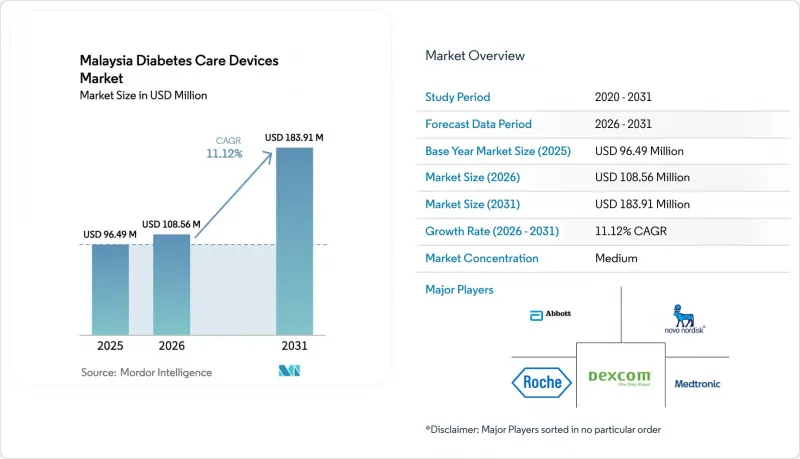
This report is Segmented by Product Type (Monitoring Devices Including Self-Monitoring Blood Glucose Devices and Continuous Glucose Monitoring; Management Devices Including Insulin Pumps, Insulin Syringes, Insulin Cartridges, Disposable Pens, and Other Management Devices) and End User (Hospitals & Specialty Clinics, and More). Market Forecasts are Provided in Terms of Value (USD).
Malaysia Diabetes Care Devices Market Trends and Insights
Rising Diabetes Prevalence & SMBG Penetration
Malaysia's adult diabetes prevalence rose to 15.6% in 2023, yet 44% of diagnosed patients still lack a glucometer at home, underscoring the growth headroom for entry-level SMBG kits. Retail meters sell for RM66-99, while test strips cost RM28-91, a range that aligns with median monthly household incomes and supports recurring consumable demand. National Diabetes Registry data indicate 902,991 active cases in Ministry of Health (MOH) clinics, a figure that excludes the private sector and undiagnosed individuals, thereby widening the total addressable volume. The 2026 budget allocations of RM64 billion (USD 14.2 billion) for metabolic disease management guarantee stable tender volumes for SMBG supplies. Pharmacy majors respond by stocking low-price glucometers such as EASYSURE, offering affordable entry points while securing strip replenishment revenue.
Localised CGM/Insulin-Pump Manufacturing Incentives
Dexcom's Penang plant, commissioned in 2024 with an investment of RM2.83 billion (approximately USD 662 million), and Insulet's Johor facility, which was scaled to five production lines in 2024, anchor Malaysia as ASEAN's principal manufacturing hub for CGM sensors and tubeless pumps. Tax holidays, streamlined device registration under the ASEAN Medical Device Directive, and ready access to a seasoned electronics workforce lower production costs and shorten time-to-market. Biocon and Novo Nordisk have committed RM2.7 billion and RM1.5 billion, respectively, to insulin facilities, reinforcing a vertically integrated local supply chain for the Malaysian diabetes care devices market. Most output feeds export demand, yet local availability improves logistical resilience and supports rapid product rollouts. Over the long term, cumulative capacity may enable price renegotiations with MOH clinics, narrowing affordability gaps for advanced devices.
High CGM & Pump Cost Burden
A single 14-day sensor costs RM279 (approximately USD 62), translating to RM7,200 (approximately USD 1,593) annually. In contrast, hybrid pumps exceed RM20,000 (approximately USD 4,425), which is significantly higher than the RM5,873 (approximately USD 1,299) median monthly household income. The 2024 HTA deemed CGM not cost-effective, which delayed public reimbursement and limited penetration to the top-income quintiles and foreign medical tourists. Private hospitals provide pump packages, yet financing hurdles deter middle-class uptake. Lower-priced alternatives, such as Ottai CGM, reduce hardware expenses by approximately 30%, although the lack of large-scale clinical validation hinders endocrinologist adoption. Unless bulk procurement discounts emerge, high out-of-pocket costs will hinder the diffusion of advanced devices and temper the expansion of the Malaysian diabetes care devices market.
Other drivers and restraints analyzed in the detailed report include:
- HTA-Driven Push for CGM Reimbursement
- Home-Healthcare & POC Testing Boom
- Tropical-Climate Sensor Adhesion Failures
For complete list of drivers and restraints, kindly check the Table Of Contents.
Segment Analysis
Management Devices are forecast to grow at a 13.72% CAGR through 2031, a rate that will tilt revenue leadership away from monitoring devices despite the latter holding a 53.69% share in 2025. Demand for closed-loop insulin delivery hinges on clinical successes, such as a 22% reduction in hypoglycemia with Medtronic's MiniMed 780G at Subang Jaya Medical Centre. Insulet's local Omnipod output enhances supply certainty and shortens replenishment cycles, while pharmacy chains continue to stock high-volume insulin pens priced at RM55-65 per pack. Subscriptions that pair pens with virtual coaching blur the line between durable and consumable sales, broadening the Malaysia diabetes care devices market.
Continuous glucose monitoring (CGM) penetration remains below 5% but is poised to rise as Abbott-Medtronic interoperability integrates Libre data into pump algorithms, thereby increasing sensor value beyond stand-alone readings. Roche's AI-enabled Accu-Chek SmartGuide, approved in 2024, enters a technology race that can compress upgrade cycles despite saturated meter ownership. Still, price competition is fierce; test-strip commoditization pushes manufacturers toward data-driven services to preserve margins in the Malaysia diabetes care devices market.
Complete Report Scope:
- By Product Type
- Monitoring Devices
- Self-Monitoring Blood Glucose Devices
- Continuous Glucose Monitoring
- Management Devices
- Insulin Pumps
- Insulin Syringes
- Insulin Cartridges
- Disposable Pens
- Other Management Devices
- Monitoring Devices
- By End User
- Hospitals & Specialty Clinics
- Primary Care & Diabetes Centres
- Home-Care Settings
List of Companies Covered in this Report:
- Abbott Laboratories
- Arkray
- Ascensia
- Beckton Dickinson
- Biocon Sdn Bhd
- Dexcom
- DKSH Holdings Malaysia
- Eli Lilly and Company
- Insulet
- Medtronic
- Menarini Diagnostics
- MicroTech Medical
- Novo Nordisk
- Roche
- Sanofi
- Senseonics
- SOOIL
- Tandem Diabetes Care
- Terumo
- Ypsomed
Additional Benefits:
- The market estimate (ME) sheet in Excel format
- 3 months of analyst support
TABLE OF CONTENTS
1 Introduction
- 1.1 Study Assumptions & Market Definition
- 1.2 Scope of the Study
2 Research Methodology
3 Executive Summary
4 Market Landscape
- 4.1 Market Overview
- 4.2 Market Drivers
- 4.2.1 Rising Diabetes Prevalence & SMBG Penetration
- 4.2.2 Expanding Public-Health Budget & Device Procurement
- 4.2.3 Home-Healthcare & POC Testing Boom
- 4.2.4 Localised CGM/Insulin-Pump Manufacturing Incentives
- 4.2.5 HTA-Driven Push for CGM Reimbursement
- 4.2.6 Medical-Tourism Demand for Advanced Devices
- 4.3 Market Restraints
- 4.3.1 High CGM & Pump Cost Burden
- 4.3.2 Import-Dependency & Supply-Chain Risk
- 4.3.3 Tropical-Climate Sensor Adhesion Failures
- 4.3.4 Clinician Data-Integration Knowledge Gaps
- 4.4 Regulatory Landscape
- 4.5 Technological Outlook
- 4.6 Porter's Five Forces Analysis
- 4.6.1 Threat of New Entrants
- 4.6.2 Bargaining Power of Buyers
- 4.6.3 Bargaining Power of Suppliers
- 4.6.4 Threat of Substitutes
- 4.6.5 Competitive Rivalry
5 Market Size & Growth Forecasts
- 5.1 By Product Type
- 5.1.1 Monitoring Devices
- 5.1.1.1 Self-Monitoring Blood Glucose Devices
- 5.1.1.2 Continuous Glucose Monitoring
- 5.1.2 Management Devices
- 5.1.2.1 Insulin Pumps
- 5.1.2.2 Insulin Syringes
- 5.1.2.3 Insulin Cartridges
- 5.1.2.4 Disposable Pens
- 5.1.2.5 Other Management Devices
- 5.1.1 Monitoring Devices
- 5.2 By End User
- 5.2.1 Hospitals & Specialty Clinics
- 5.2.2 Primary Care & Diabetes Centres
- 5.2.3 Home-Care Settings
6 Competitive Landscape
- 6.1 Market Concentration
- 6.2 Market Share Analysis
- 6.3 Company Profiles (includes Global level Overview, Market-level Overview, Core Segments, Financials, Strategic Information, Market Rank/Share, Products & Services, Recent Developments)
- 6.3.1 Abbott Laboratories
- 6.3.2 Arkray
- 6.3.3 Ascensia Diabetes Care
- 6.3.4 Becton Dickinson
- 6.3.5 Biocon Sdn Bhd
- 6.3.6 Dexcom
- 6.3.7 DKSH Holdings Malaysia
- 6.3.8 Eli Lilly
- 6.3.9 Insulet
- 6.3.10 Medtronic
- 6.3.11 Menarini Diagnostics
- 6.3.12 MicroTech Medical
- 6.3.13 Novo Nordisk
- 6.3.14 Roche
- 6.3.15 Sanofi
- 6.3.16 Senseonics
- 6.3.17 SOOIL
- 6.3.18 Tandem Diabetes Care
- 6.3.19 Terumo
- 6.3.20 Ypsomed
7 Market Opportunities & Future Outlook
- 7.1 White-space & Unmet-need Assessment

