PUBLISHER: Mordor Intelligence | PRODUCT CODE: 2116693

PUBLISHER: Mordor Intelligence | PRODUCT CODE: 2116693
Thailand Diabetes Care Devices - Market Share Analysis, Industry Trends & Statistics, Growth Forecasts (2026 - 2031)
According to Mordor Intelligence, the Thailand diabetes care devices market size is expected to grow from USD 290 million in 2025 to USD 304.36 million in 2026 and is forecast to reach USD 387.53 million by 2031 at 4.95% CAGR over 2026-2031.
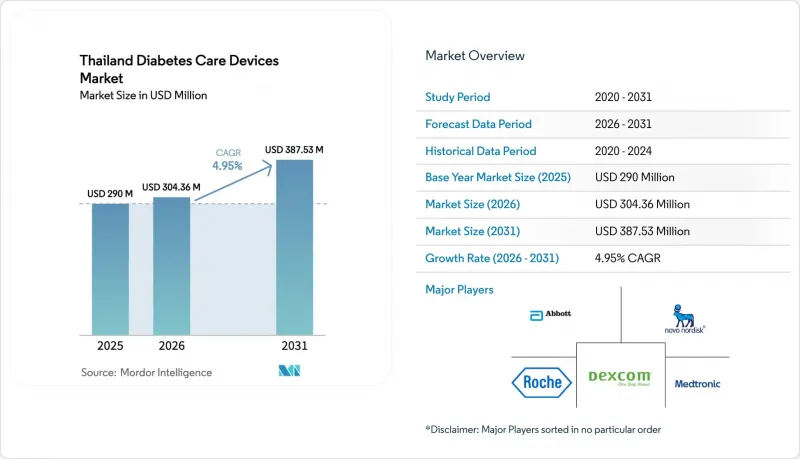
This report is Segmented by Device Type (Monitoring Devices - Self-Monitoring Blood Glucose, Continuous Glucose Monitoring; Management Devices - Insulin Pumps, Insulin Syringes, and More), Patient Type (Type-1 Diabetes, and More), End-User (Hospitals & Clinics, and More), Distribution Channel (Institutional Sales, and More). The Market Forecasts are Provided in Terms of Value (USD).
Thailand Diabetes Care Devices Market Trends and Insights
Growing Prevalence of Diabetes and Pre-diabetes in Thailand
Roughly 11.6% of Thai adults-nearly 5 million people-live with Type 2 diabetes, and annual incident cases exceed 300,000, creating a sizable pipeline of patients who require long-term device-based management. Demand spans both monitoring and insulin-delivery categories as complications tied to poor glycemic control place new pressure on Thailand's Universal Coverage Scheme (UCS). Government-backed screening campaigns are gaining traction among seniors, but working-age adults now account for an increasingly high share of new diagnoses, pushing employers to include CGM as an employee-benefit add-on. Urbanization, ultra-processed diets, and sedentary lifestyles remain primary disease drivers. As prevalence rises, device makers are tailoring educational programs to improve self-management and extend sensor usage life, thereby strengthening patient retention. These trends collectively support steady expansion of the Thailand diabetes care devices market across all price tiers.
Universal Coverage Scheme Expansion Increasing Device Reimbursement
The UCS now insures 47.2 million residents, including 4.27 million individuals with diabetes, and its benefits package has recently been expanded to cover CGM sensors, smart glucometers, and select insulin pens. Reimbursement lowers out-of-pocket costs for middle-income Thais, driving unit sales volume even in price-sensitive provinces. Funding flexibility-stemming from Thailand's tax-based healthcare financing-allows timely inclusion of new diabetes technologies judged cost-effective in preventing expensive complications. Device suppliers are aligning product-registration schedules with the National List of Essential Medicines review cycle to secure faster market access. As more patients transition to reimbursed home-monitoring regimens, refill purchases of test strips, sensors, and lancets rise, reinforcing recurring-revenue streams. This policy evolution is therefore a structural demand catalyst for the Thailand diabetes care devices market.
Limited Trained Diabetes Educators Outside Bangkok
Only 26.7% of Thai Type 2 diabetes patients achieve adequate glycemic control, well below the Ministry of Public Health's 40% target, with inadequate self-management education identified as a major gap. Provincial and rural hospitals contend with a shortage of certified diabetes educators, leading to inconsistent training on device usage and suboptimal treatment adherence. The Northeast records an unmet-need rate of 78% versus 58.4% in the South, reflecting stark regional disparities. Patients who do obtain advanced devices often lack follow-up counseling, reducing long-run sensor and pump retention rates. Manufacturers are piloting hybrid tele-education programs, yet bandwidth limitations outside major cities slow roll-out. Unless educator capacity broadens, the Thailand diabetes care devices market will struggle to unlock its full growth potential beyond Bangkok.
Other drivers and restraints analyzed in the detailed report include:
- Rapid Uptake of CGM Sensors Among Urban Consumers
- Government-Led "Digital Health Sandbox" Encouraging Remote Glucose Monitoring
- Import Dependency Causing Supply Vulnerability During Baht Volatility
For complete list of drivers and restraints, kindly check the Table Of Contents.
Segment Analysis
Monitoring devices generated USD 0.17 billion in 2025, equal to 58.52% of the Thailand diabetes care devices market size, as finger-stick glucometers and CGM sensors form the backbone of daily diabetes care . Hospitals standardize procurement around trusted monitoring brands, and home users appreciate the familiarity of portable readers. However, a noticeable shift toward sensor-based systems is compressing test-strip margins, encouraging incumbents to bundle analytics subscriptions with hardware to stabilize revenue.
Management devices, chiefly insulin pumps and smart pens, accounted for USD 0.12 billion in 2025 and are projected to grow at 7.01% CAGR. The double-digit adoption of hybrid closed-loop systems in Bangkok's tertiary centers demonstrates strong latent demand for automation. Price declines, fueled by Thailand 4.0 import-duty waivers on components, are narrowing the affordability gap. Leading global players have begun local algorithm customization to reflect Thai dietary glycemic loads, positioning management devices as the fastest-growing segment in the Thailand diabetes care devices market.
Complete Report Scope:
- By Device Type
- Monitoring Devices
- Self-Monitoring Blood Glucose
- Glucometer Devices
- Test Strips
- Lancets
- Continuous Glucose Monitoring
- Sensors
- Durables
- Self-Monitoring Blood Glucose
- Management Devices
- Insulin Pumps
- Insulin Pump Device
- Insulin Pump Reservoir
- Infusion Set
- Insulin Syringes
- Insulin Pens
- Jet Injectors
- Insulin Pumps
- Monitoring Devices
- By Patient Type
- Type-1 Diabetes
- Type-2 Diabetes
- Gestational & Others
- By End-user
- Hospitals & Clinics
- Home-care Settings
- Ambulatory Surgical Centres
- Pharmacies & Retail Chains
List of Companies Covered in this Report:
- Abbott Laboratories
- Medtronic
- Roche
- Ascensia Diabetes Care Holdings AG
- MicroTech Medical Co., Ltd.
- DKSH Holding Ltd.
- Novo Nordisk
- Sanofi
- Eli Lilly and Company
- Terumo
- Beckton Dickinson
- Johnson & Johnson
- Arkray
- Nipro
Additional Benefits:
- The market estimate (ME) sheet in Excel format
- 3 months of analyst support
TABLE OF CONTENTS
1 Introduction
- 1.1 Study Assumptions & Market Definition
- 1.2 Scope of the Study
2 Research Methodology
3 Executive Summary
4 Market Landscape
- 4.1 Market Overview
- 4.2 Market Drivers
- 4.2.1 Growing Prevalence of Diabetes and Pre-diabetes in Thailand's Working-age Population
- 4.2.2 Universal Coverage Scheme Expansion Increasing Device Reimbursement
- 4.2.3 Rapid Uptake of CGM Sensors Among Tech-savvy Urban Consumers
- 4.2.4 Government-led "Digital Health Sandbox" Encouraging Remote Glucose Monitoring
- 4.2.5 Local Manufacturing Incentives Under Thailand 4.0 Lowering Device Costs
- 4.2.6 Private Hospital Chains' Chronic-care Programs Boosting Insulin Pump Demand
- 4.3 Market Restraints
- 4.3.1 High Out-of-Pocket Costs for Advanced Insulin Pumps
- 4.3.2 Limited Trained Diabetes Educators Outside Bangkok
- 4.3.3 Import Dependency Causing Supply Vulnerability During Baht Volatility
- 4.3.4 Cultural Resistance to Needle-based Self-Injection in Elderly Patients
- 4.4 Supply-Chain Analysis
- 4.5 Regulatory Outlook
- 4.6 Technological Outlook
- 4.7 Porter's Five Forces
- 4.7.1 Threat of New Entrants
- 4.7.2 Bargaining Power of Suppliers
- 4.7.3 Bargaining Power of Buyers
- 4.7.4 Threat of Substitutes
- 4.7.5 Competitive Rivalry
- 4.8 Pricing Analysis
5 Market Size & Growth Forecasts
- 5.1 By Device Type
- 5.1.1 Monitoring Devices
- 5.1.1.1 Self-Monitoring Blood Glucose
- 5.1.1.1.1 Glucometer Devices
- 5.1.1.1.2 Test Strips
- 5.1.1.1.3 Lancets
- 5.1.1.2 Continuous Glucose Monitoring
- 5.1.1.2.1 Sensors
- 5.1.1.2.2 Durables
- 5.1.1.1 Self-Monitoring Blood Glucose
- 5.1.2 Management Devices
- 5.1.2.1 Insulin Pumps
- 5.1.2.1.1 Insulin Pump Device
- 5.1.2.1.2 Insulin Pump Reservoir
- 5.1.2.1.3 Infusion Set
- 5.1.2.2 Insulin Syringes
- 5.1.2.3 Insulin Pens
- 5.1.2.4 Jet Injectors
- 5.1.2.1 Insulin Pumps
- 5.1.1 Monitoring Devices
- 5.2 By Patient Type
- 5.2.1 Type-1 Diabetes
- 5.2.2 Type-2 Diabetes
- 5.2.3 Gestational & Others
- 5.3 By End-user
- 5.3.1 Hospitals & Clinics
- 5.3.2 Home-care Settings
- 5.3.3 Ambulatory Surgical Centres
- 5.3.4 Pharmacies & Retail Chains
6 Competitive Landscape
- 6.1 Market Concentration
- 6.2 Strategic Moves
- 6.3 Market Share Analysis
- 6.4 Company Profiles (includes Global level Overview, Market level overview, Core Segments, Financials as available, Strategic Information, Market Rank/Share for key companies, Products & Services, and Recent Developments)
- 6.4.1 Abbott Laboratories
- 6.4.2 Medtronic plc
- 6.4.3 F. Hoffmann-La Roche AG
- 6.4.4 Ascensia Diabetes Care Holdings AG
- 6.4.5 MicroTech Medical Co., Ltd.
- 6.4.6 DKSH Holding Ltd.
- 6.4.7 Novo Nordisk A/S
- 6.4.8 Sanofi S.A.
- 6.4.9 Eli Lilly and Company
- 6.4.10 Terumo Corporation
- 6.4.11 Becton, Dickinson and Company
- 6.4.12 Johnson & Johnson (LifeScan)
- 6.4.13 Arkray Inc.
- 6.4.14 Nipro Corporation
7 Market Opportunities & Future Outlook
- 7.1 White-space & Unmet-need Assessment

