PUBLISHER: Mordor Intelligence | PRODUCT CODE: 2121759

PUBLISHER: Mordor Intelligence | PRODUCT CODE: 2121759
France Diabetes Devices - Market Share Analysis, Industry Trends & Statistics, Growth Forecasts (2026 - 2031)
According to Mordor Intelligence, the France diabetes devices market size is projected to expand from USD 1.39 billion in 2025 and USD 1.47 billion in 2026 to USD 2.02 billion by 2031, registering a CAGR of 6.56% between 2026 to 2031.
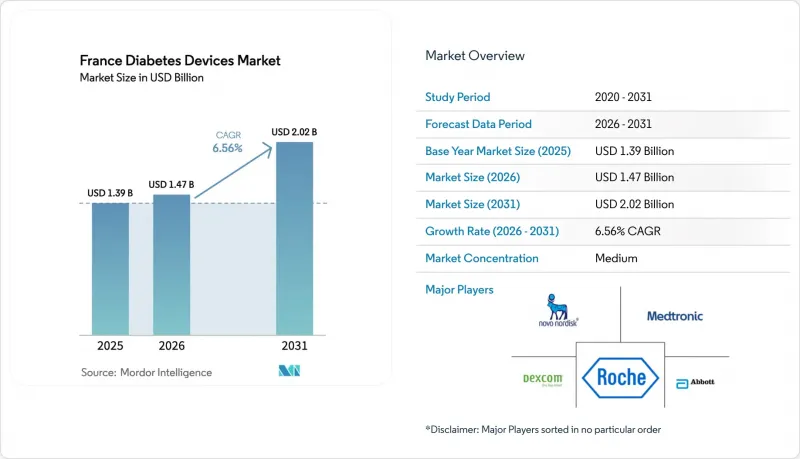
This report is Segmented by Device Type (Glucose Monitoring Devices, Insulin Delivery Devices, and Other Diabetes-Care Devices), Diabetes Type (Type 1 Diabetes, Type 2 Diabetes, and Gestational & Others), End User (Hospitals & Clinics, Specialty Clinics, Home-Care Settings, and More). The Market Provides the Value (in USD) for the Above-Mentioned Segments.
France Diabetes Devices Market Trends and Insights
Mainstream Reimbursement Expansion for CGM Sensors
France approved full reimbursement of Dexcom ONE for 100,000 Type 2 patients on basal insulin in June 2024, opening the first European CGM pathway for non-intensive users. Health-economic studies place the incremental cost-effectiveness ratio within national thresholds, reinforcing payer support. As volumes rise, price-volume clauses lower per-sensor reimbursement, limiting manufacturer margins. Integrated sensor-transmitter ecosystems help offset this pressure by locking users into subscription refill models. The 2025 revision of the EU Medical Device Regulation (MDR) embeds post-market surveillance requirements, so real-world CGM outcomes feed directly into reimbursement renewal.
Rapid Uptake of Tubeless and Patch Insulin Pumps
Insulet introduced Omnipod 5 in June 2024, meeting the demand for a discreet, adhesive-based therapy among lifestyle-conscious Type 1 patients. Real-world surveys of 14,765 users show satisfaction driven by convenience rather than superior glycemic metrics. Grenoble-based Diabeloop secured EUR 15 million in 2024 to speed DBLG1 adoption and prepare the smartphone-native DBLG2, which gained FDA clearance by January 2026. The MiniMed 780G spin-off announced by Medtronic in June 2025 underscores escalating competition as agile software innovators shorten upgrade cycles. Future pump growth depends on algorithmic personalization, patch-format miniaturization, and bundle offers that pair hardware, sensor, and support.
Price-Volume Clauses Squeezing Margins
French price tariffs fall once sales thresholds are crossed, curbing profit despite rising CGM penetration. Dexcom ONE reimbursement illustrates this pinch: higher volumes trigger steeper rebates. Manufacturers introduce premium variants with longer wear or predictive alerts to escape existing caps. The 2025 FreeStyle Libre 3 recall shows how speed-to-market gambits carry quality risk that can magnify financial strain.
Other drivers and restraints analyzed in the detailed report include:
- Smartphone-Integrated SMBG Ecosystems
- Rapid GLP-1 Adoption Shifting Device Mix
- Sensor Cybersecurity and GDPR Compliance Burden
For complete list of drivers and restraints, kindly check the Table Of Contents.
Segment Analysis
The French diabetes devices market size remained at 57.23% of the French diabetes devices market share that year. Sensors remain volume leaders, yet their growth trails pumps, as margin pressure from price-volume clauses tempers revenue gains. AID-capable patch pumps underpin the 7.87% CAGR in insulin delivery, helped by Omnipod 5 and DBLG1 rollouts. Self-monitoring glucometers continue to lose ground as CGM reimbursement widens and fingerstick avoidance intensifies.
Second-generation pumps are split between tethered (MiniMed 780G, Tandem Control-IQ) and tubeless (Omnipod 5, Kaleido) designs. Recall-driven sensor shortages can temporarily re-inflate SMBG demand, but a structural shift favors sensors and smart pumps.
Complete Report Scope:
- By Device Category
- Glucose Monitoring Devices
- Self-Monitoring Blood Glucose (SMBG) Devices
- Glucometers
- Test Strips
- Lancets
- Continuous Glucose Monitoring (CGM) Devices
- Sensors
- Durables (Receivers & Transmitters)
- Self-Monitoring Blood Glucose (SMBG) Devices
- Insulin Delivery Devices
- Insulin Pens
- Insulin Pumps
- Insulin Syringes
- Jet Injectors
- Other Diabetes-Care Devices
- Glucose Monitoring Devices
- By Diabetes Type
- Type 1 Diabetes
- Type 2 Diabetes
- Gestational & Others
- By End User
- Hospitals
- Specialty Clinics
- Home Care Settings
- Other End Users
List of Companies Covered in this Report:
- Abbott Laboratories
- Ascensia
- B. Braun
- Beckton Dickinson
- Dexcom
- Eli Lilly and Company
- Gan & Lee Pharm
- Insulet
- Lepu Medical
- Lifescan
- Medtronic
- MicroPort
- MicroTech Medical Co.
- Novo Nordisk
- Roche
- Sanofi
- Senseonics Holdings
- Sinocare
- Tandem Diabetes Care
- Ypsomed
Additional Benefits:
- The market estimate (ME) sheet in Excel format
- 3 months of analyst support
TABLE OF CONTENTS
1 Introduction
- 1.1 Study Assumptions & Market Definition
- 1.2 Scope of the Study
2 Research Methodology
3 Executive Summary
4 Market Landscape
- 4.1 Market Overview
- 4.2 Market Drivers
- 4.2.1 Mainstream Reimbursement Expansion for CGM Sensors
- 4.2.2 Rapid Uptake of Tubeless & Patch Insulin Pumps
- 4.2.3 Smartphone-Integrated SMBG Ecosystems
- 4.2.4 Rapid GLP-1 Adoption Shifting Device Mix
- 4.2.5 Primary-Care Telemonitoring Quotas (LATM)
- 4.2.6 Diabetic-Elderly Fall-Prevention Mandates
- 4.3 Market Restraints
- 4.3.1 Price-Volume Clauses Squeezing Margins
- 4.3.2 Sensor Cybersecurity / GDPR Compliance Burden
- 4.3.3 GLP-1-Driven Reduction in Basal-Insulin Users
- 4.3.4 CEPS Claw-Backs Tied to Carbon-Footprint KPIs
- 4.4 Regulatory Landscape
- 4.5 Technological Outlook
- 4.6 Porter's Five Forces Analysis
- 4.6.1 Threat of New Entrants
- 4.6.2 Bargaining Power of Buyers
- 4.6.3 Bargaining Power of Suppliers
- 4.6.4 Threat of Substitute Products
- 4.6.5 Intensity of Competitive Rivalry
5 Market Size & Growth Forecasts (Value & Volume)
- 5.1 By Device Category
- 5.1.1 Glucose Monitoring Devices
- 5.1.1.1 Self-Monitoring Blood Glucose (SMBG) Devices
- 5.1.1.1.1 Glucometers
- 5.1.1.1.2 Test Strips
- 5.1.1.1.3 Lancets
- 5.1.1.2 Continuous Glucose Monitoring (CGM) Devices
- 5.1.1.2.1 Sensors
- 5.1.1.2.2 Durables (Receivers & Transmitters)
- 5.1.1.1 Self-Monitoring Blood Glucose (SMBG) Devices
- 5.1.2 Insulin Delivery Devices
- 5.1.2.1 Insulin Pens
- 5.1.2.2 Insulin Pumps
- 5.1.2.3 Insulin Syringes
- 5.1.2.4 Jet Injectors
- 5.1.3 Other Diabetes-Care Devices
- 5.1.1 Glucose Monitoring Devices
- 5.2 By Diabetes Type
- 5.2.1 Type 1 Diabetes
- 5.2.2 Type 2 Diabetes
- 5.2.3 Gestational & Others
- 5.3 By End User
- 5.3.1 Hospitals
- 5.3.2 Specialty Clinics
- 5.3.3 Home Care Settings
- 5.3.4 Other End Users
6 Competitive Landscape
- 6.1 Market Concentration
- 6.2 Market Share Analysis
- 6.3 Company Profiles (includes Global Level Overview, Market Level Overview, Core Segments, Financials as Available, Strategic Information, Market Rank/Share for Key Companies, Products & Services, and Recent Developments)
- 6.3.1 Abbott Diabetes Care
- 6.3.2 Ascensia Diabetes Care
- 6.3.3 B. Braun Melsungen AG
- 6.3.4 Becton Dickinson and Company
- 6.3.5 Dexcom Inc.
- 6.3.6 Eli Lilly and Company
- 6.3.7 Gan & Lee Pharm
- 6.3.8 Insulet Corporation
- 6.3.9 Lepu Medical Technology
- 6.3.10 LifeScan
- 6.3.11 Medtronic
- 6.3.12 MicroPort Scientific
- 6.3.13 MicroTech Medical Co.
- 6.3.14 Novo Nordisk A/S
- 6.3.15 Roche Diabetes Care
- 6.3.16 Sanofi S.A.
- 6.3.17 Senseonics Holdings
- 6.3.18 Sinocare Inc.
- 6.3.19 Tandem Diabetes Care
- 6.3.20 Ypsomed AG
7 Market Opportunities & Future Outlook
- 7.1 White-space & Unmet-Need Assessment

