PUBLISHER: Mordor Intelligence | PRODUCT CODE: 2116694

PUBLISHER: Mordor Intelligence | PRODUCT CODE: 2116694
Indonesia Diabetes Care Devices - Market Share Analysis, Industry Trends & Statistics, Growth Forecasts (2026 - 2031)
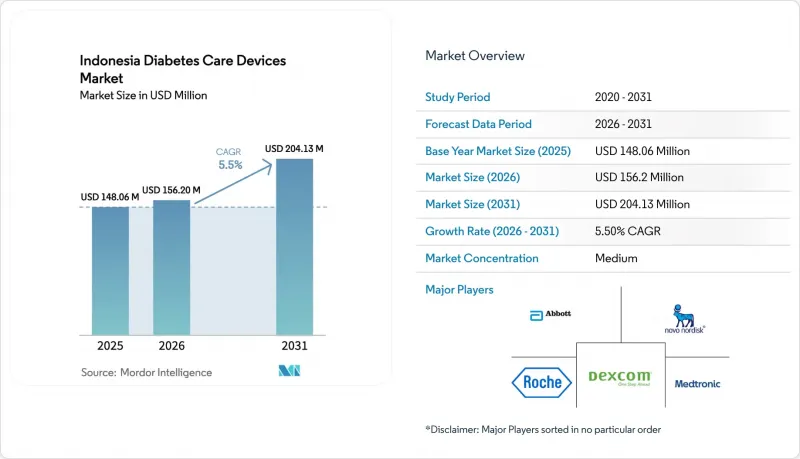
According to Mordor Intelligence, the Indonesia diabetes care devices market size was valued at USD 148.06 million in 2025 and estimated to grow from USD 156.2 million in 2026 to reach USD 204.13 million by 2031, at a CAGR of 5.50% during the forecast period (2026-2031).
This report is Segmented Into Management Devices (Insulin Pumps, Insulin Syringes, and More), Monitoring Devices (Self-Monitoring Blood Glucose and Continuous Glucose Monitoring), by Patient Type (Type-1 Diabetes, Type-2 Diabetes and More), by End User (Hospitals & Clinics, Home-Care Settings and More). The Market Forecasts are Provided in Terms of Value (USD).
Indonesia Diabetes Care Devices Market Trends and Insights
Rising Diabetes Prevalence & Earlier Diagnosis
Indonesia ranks fifth globally for diabetes cases. IDF data show 19.5 million Indonesians living with diabetes in 2024, yet over 70% of cases were undiagnosed until recent screening initiatives. Earlier detection programs in Java's densely populated provinces are elevating demand for entry-level glucometers as well as next-generation continuous glucose monitors. As demographic ageing accelerates and lifestyles shift toward urban sedentary patterns, the Indonesia diabetes care devices market is likely to see sustained baseline growth in device volumes.
Expansion of BPJS National Health Insurance Coverage
BPJS Kesehatan now enrolls 98% of citizens and lists both Type-1 and Type-2 diabetes among its 144 reimbursable conditions. The abolition of inpatient class distinctions in 2025 further lowers out-of-pocket costs for glucose testing supplies. Reliable reimbursement is fostering broader distribution of test strips into rural clinics where private purchasing power remains limited.
High Cost of Imported CGM & Insulin Pumps
Average per-capita diabetes spending is forecast to rise 33% from USD 323.8 in 2021 to USD 431.7 by 2045. Imported closed-loop pump systems retail well above annual median household healthcare budgets, constraining uptake to affluent urban cohorts. Although BPJS covers essential devices, reimbursement ceilings lag behind international list prices, limiting scale.
Other drivers and restraints analyzed in the detailed report include:
- Growing Adoption of SMBG Devices via Awareness Campaigns
- Shift to Insulin-Analog Pens Improving Adherence
- Fragmented Distribution & Counterfeit Strips
For complete list of drivers and restraints, kindly check the Table Of Contents.
Segment Analysis
The Indonesia diabetes care devices market continues to be anchored by self-monitoring blood glucose systems, yet software-enabled insulin delivery platforms are now the fastest-growing line. Test strips, lancets, and basic meters dominate unit volumes, serving millions of BPJS-covered patients who rely on routine finger-stick testing for glycemic control. Continuous glucose monitoring (CGM) adoption is advancing as domestic assemblers push prices down and health-app integration attracts younger users.
Management devices-including insulin pens, pumps, and jet injectors-are set for robust expansion throughout the forecast window. Local fill-finish capacity is lowering landed costs for analog insulin cartridges, while partnerships like Abbott-Medtronic bring automated basal-bolus algorithms to market. As reimbursement schedules are periodically revised, more sophisticated devices are expected to migrate from private specialty clinics into public tertiary hospitals, reinforcing the overall revenue mix of the Indonesia diabetes care devices market.
Complete Report Scope:
- Monitoring Devices
- Self-monitoring Blood Glucose Devices
- Glucometer Devices
- Test Strips
- Lancets
- Continuous Blood Glucose Monitoring
- Sensors
- Durables
- Self-monitoring Blood Glucose Devices
- Management Devices
- Insulin Pump
- Insulin Pump Device
- Insulin Pump Reservoir
- Infusion Set
- Insulin Syringes
- Insulin Cartridges
- Disposable Pens
- Insulin Pump
List of Companies Covered in this Report:
- Beckton Dickinson
- Medtronic
- Insulet
- Tandem Diabetes Care
- Ypsomed
- Novo Nordisk
- Sanofi
- Eli Lilly and Company
- Abbott Laboratories
- Roche
- Johnson & Johnson
- Dexcom
Additional Benefits:
- The market estimate (ME) sheet in Excel format
- 3 months of analyst support
TABLE OF CONTENTS
1 INTRODUCTION
- 1.1 Study Assumptions and Market Definition
- 1.2 Scope of the Study
2 RESEARCH METHODOLOGY
3 EXECUTIVE SUMMARY
4 MARKET DYNAMICS
- 4.1 Market Overview
- 4.2 Market Drivers
- 4.3 Market Restraints
- 4.4 Industry Attractiveness - Porter's Five Forces Analysis
- 4.4.1 Threat of New Entrants
- 4.4.2 Bargaining Power of Buyers/Consumers
- 4.4.3 Bargaining Power of Suppliers
- 4.4.4 Threat of Substitute Products
- 4.4.5 Intensity of Competitive Rivalry
5 MARKET SEGMENTATION
- 5.1 Monitoring Devices
- 5.1.1 Self-monitoring Blood Glucose Devices
- 5.1.1.1 Glucometer Devices
- 5.1.1.2 Test Strips
- 5.1.1.3 Lancets
- 5.1.2 Continuous Blood Glucose Monitoring
- 5.1.2.1 Sensors
- 5.1.2.2 Durables
- 5.1.1 Self-monitoring Blood Glucose Devices
- 5.2 Management Devices
- 5.2.1 Insulin Pump
- 5.2.1.1 Insulin Pump Device
- 5.2.1.2 Insulin Pump Reservoir
- 5.2.1.3 Infusion Set
- 5.2.2 Insulin Syringes
- 5.2.3 Insulin Cartridges
- 5.2.4 Disposable Pens
- 5.2.1 Insulin Pump
6 MARKET INDICATORS
- 6.1 Type-1 Diabetes population
- 6.2 Type-2 Diabetes population
7 COMPETITIVE LANDSCAPE
- 7.1 Company Profiles
- 7.1.1 Becton and Dickenson
- 7.1.2 Medtronic
- 7.1.3 Insulet
- 7.1.4 Tandem
- 7.1.5 Ypsomed
- 7.1.6 Novo Nordisk
- 7.1.7 Sanofi
- 7.1.8 Eli Lilly
- 7.1.9 Abbottt
- 7.1.10 Roche
- 7.1.11 Lifescan (Johnson &Johnson)
- 7.1.12 Dexcom
- 7.2 Company Share Analysis
8 MARKET OPPORTUNITIES AND FUTURE TRENDS

