PUBLISHER: Mordor Intelligence | PRODUCT CODE: 2116696

PUBLISHER: Mordor Intelligence | PRODUCT CODE: 2116696
Vietnam Diabetes Care Devices - Market Share Analysis, Industry Trends & Statistics, Growth Forecasts (2026 - 2031)
According to Mordor Intelligence, the Vietnam diabetes care devices market size is expected to grow from USD 433.01 million in 2025 to USD 443.35 million in 2026 and is forecast to reach USD 504.59 million by 2031 at 2.62% CAGR over 2026-2031.
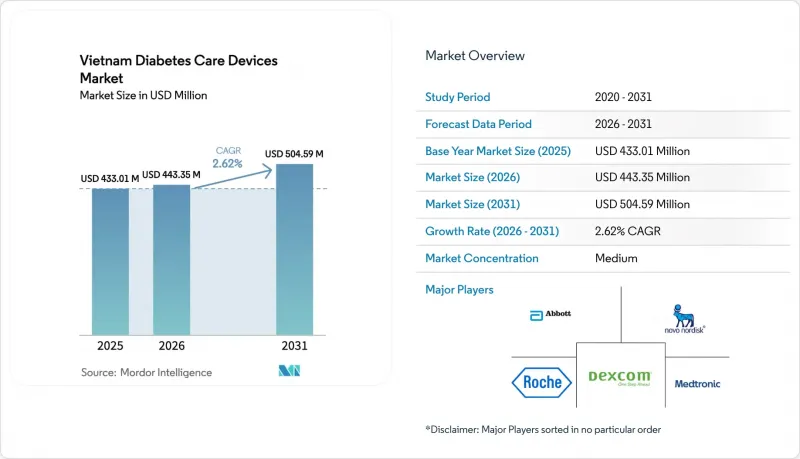
This report is Segmented by Device Type (Glucose Monitoring Devices, Insulin Delivery Devices, Other Diabetes-Care Devices), Patient Type (Type-1 Diabetes, Type-2 Diabetes, Gestational & Others), End-User (Hospitals, Specialty Clinics, Home-Care Settings and Other End Users). The Market Forecasts are Provided in Terms of Value (USD).
Vietnam Diabetes Care Devices Market Trends and Insights
Rising Diabetes Prevalence & Urban Lifestyles
Vietnam's adult diabetes prevalence rose to 3.6% in 2025, translating to 2.5 million diagnosed cases and another 37.8% undiagnosed. Urban residents aged 15-59 face 1.86 times higher odds of diabetes than rural peers, showing how dietary westernization and sedentary work patterns accelerate risk. Northern Vietnam recorded 0.77 Type 1 cases per 100,000 children in 2025, and more than 57% of presentations were in ketoacidosis, proving that monitoring gaps remain wide. For the Vietnam diabetes devices market, this epidemiological burden splits demand between affordable glucometers for mass Type 2 management and premium pumps plus continuous glucose monitors for pediatric Type 1 care. Device makers that align their portfolios with these divergent needs stand to capture the next wave of growth in Vietnam's diabetes device market.
Increasing Healthcare Expenditure & UHC Expansion
National health spending climbed from USD 24.7 billion in 2024 toward a projected USD 57.1 billion by 2029, reflecting an 18.3% CAGR that outpaces GDP growth. Insurance now covers 91-94% of citizens, yet out-of-pocket payments still make up roughly 40% of total outlays, capping uptake of advanced devices. Health Insurance Law 51/2024 and Circular 22/2024 streamlined reimbursement for Class C and D devices, improving the processing of claims for glucometers and insulin pens. Decree 188/2025 mandates electronic claims from 2026 and prioritizes local procurement, signaling political will to widen access while containing costs. Collectively, these reforms enlarge the addressable Vietnam diabetes devices market but favor products priced for mass insurance schedules over top-tier imported tech.
High Device Cost & Limited Reimbursement
Median glucometer prices are USD 35.18, and strips cost USD 0.27-0.56 each, equal to several days' wages for low earners. Pumps cost USD 7,000-9,000, far exceeding covered benefits, so only wealthier families adopt them. Although Circular 22/2024 reimburses selected insulin pens and syringes, CGMs remain mostly uncovered, constraining volume in the Vietnam diabetes devices market.
Other drivers and restraints analyzed in the detailed report include:
- Growing Adoption of Self-Monitoring & Wearables
- Domestic Manufacturing Initiatives Cut Import Costs
- Regulatory Delays for Imported Devices
For complete list of drivers and restraints, kindly check the Table Of Contents.
Segment Analysis
Glucose monitoring devices accounted for 61.01% of the Vietnam diabetes devices market share in 2025, but insulin delivery is forecast to grow at a 3.35% CAGR, outpacing overall growth. Rising pediatric Type 1 diagnoses and streamlined reimbursement for pens under Circular 22/2024 underpin this shift. The Vietnam diabetes devices market for insulin pens is growing as analog formulations gain favor over human insulin, while pumps remain a niche due to high out-of-pocket costs. Continuous glucose monitors add value to pen-based regimens; however, strip-dependent glucometers remain dominant among Type 2 patients who test less frequently to manage costs, underscoring that unit volumes hinge on consumable affordability within the Vietnam diabetes devices market size calculus.
Insulin pens provide easier dosing and fewer training barriers than vials, aligning with clinician guidelines issued after the 2024 Novo Nordisk-MOH memorandum. Domestic distributors are exploring contract assembly to tap into Decree 188/2025 procurement incentives, suggesting that pen prices could soften in the near term. CGM manufacturers court the same premium cohort, and the Abbott-Medtronic interoperability initiative foreshadows hybrid closed-loop systems entering Vietnam, albeit for the top decile of earners. For mass segments, cost-effective meters bundled with discounted strips will continue anchoring the Vietnam diabetes devices market share landscape.
Complete Report Scope:
- By Device Category
- Glucose Monitoring Devices
- Self-Monitoring Blood Glucose (SMBG) Devices
- Glucometers
- Test Strips
- Lancets
- Continuous Glucose Monitoring (CGM) Devices
- Sensors
- Durables (Receivers & Transmitters)
- Self-Monitoring Blood Glucose (SMBG) Devices
- Insulin Delivery Devices
- Insulin Pens
- Insulin Pumps
- Insulin Syringes
- Jet Injectors
- Other Diabetes-Care Devices
- Glucose Monitoring Devices
- By Diabetes Type
- Type 1 Diabetes
- Type 2 Diabetes
- Gestational & Others
- By End User
- Hospital
- Specialty Clinics
- Home Care Settings
- Other End Users
List of Companies Covered in this Report:
- Abbott Laboratories
- B. Braun
- Beckton Dickinson
- Dexcom
- Eli Lilly and Company
- Insulet
- Medtronic
- MicroPort
- Novo Nordisk
- Roche
- Sanofi
- Senseonics Holdings
- Sinocare
- Tandem Diabetes Care
- Ypsomed
Additional Benefits:
- The market estimate (ME) sheet in Excel format
- 3 months of analyst support
TABLE OF CONTENTS
1 Introduction
- 1.1 Study Assumptions & Market Definition
- 1.2 Scope of the Study
2 Research Methodology
3 Executive Summary
4 Market Landscape
- 4.1 Market Overview
- 4.2 Market Drivers
- 4.2.1 Rising Diabetes Prevalence & Urban Lifestyles
- 4.2.2 Increasing Healthcare Expenditure & UHC Expansion
- 4.2.3 Growing Adoption of Self-Monitoring & Wearables
- 4.2.4 Domestic Manufacturing Initiatives Cut Import Costs
- 4.2.5 Tele-Medicine & E-Pharmacy Policies Widen Rural Access
- 4.2.6 Medical Tourism Boosts Demand for Advanced Tech
- 4.3 Market Restraints
- 4.3.1 High Device Cost & Limited Reimbursement
- 4.3.2 Regulatory Delays for Imported Devices
- 4.3.3 Shortage of Trained Educators Outside Cities
- 4.3.4 Data-Security Concerns for CGM Adoption
- 4.4 Regulatory Landscape
- 4.5 Technological Outlook
- 4.6 Porter's Five Forces Analysis
- 4.6.1 Threat of New Entrants
- 4.6.2 Bargaining Power of Buyers
- 4.6.3 Bargaining Power of Suppliers
- 4.6.4 Threat of Substitute Products
- 4.6.5 Intensity of Competitive Rivalry
5 Market Size & Growth Forecasts (Value & Volume)
- 5.1 By Device Category
- 5.1.1 Glucose Monitoring Devices
- 5.1.1.1 Self-Monitoring Blood Glucose (SMBG) Devices
- 5.1.1.1.1 Glucometers
- 5.1.1.1.2 Test Strips
- 5.1.1.1.3 Lancets
- 5.1.1.2 Continuous Glucose Monitoring (CGM) Devices
- 5.1.1.2.1 Sensors
- 5.1.1.2.2 Durables (Receivers & Transmitters)
- 5.1.1.1 Self-Monitoring Blood Glucose (SMBG) Devices
- 5.1.2 Insulin Delivery Devices
- 5.1.2.1 Insulin Pens
- 5.1.2.2 Insulin Pumps
- 5.1.2.3 Insulin Syringes
- 5.1.2.4 Jet Injectors
- 5.1.3 Other Diabetes-Care Devices
- 5.1.1 Glucose Monitoring Devices
- 5.2 By Diabetes Type
- 5.2.1 Type 1 Diabetes
- 5.2.2 Type 2 Diabetes
- 5.2.3 Gestational & Others
- 5.3 By End User
- 5.3.1 Hospital
- 5.3.2 Specialty Clinics
- 5.3.3 Home Care Settings
- 5.3.4 Other End Users
6 Competitive Landscape
- 6.1 Market Concentration
- 6.2 Market Share Analysis
- 6.3 Company Profiles (includes Global Level Overview, Market Level Overview, Core Segments, Financials as Available, Strategic Information, Market Rank/Share for Key Companies, Products & Services, and Recent Developments)
- 6.3.1 Abbott Diabetes Care
- 6.3.2 B. Braun Melsungen AG
- 6.3.3 Becton Dickinson and Company
- 6.3.4 Dexcom Inc.
- 6.3.5 Eli Lilly and Company
- 6.3.6 Insulet Corporation
- 6.3.7 Medtronic
- 6.3.8 MicroPort Scientific
- 6.3.9 Novo Nordisk A/S
- 6.3.10 Roche Diabetes Care
- 6.3.11 Sanofi S.A.
- 6.3.12 Senseonics Holdings
- 6.3.13 Sinocare Inc.
- 6.3.14 Tandem Diabetes Care
- 6.3.15 Ypsomed AG
7 Market Opportunities & Future Outlook
- 7.1 White-space & Unmet-Need Assessment

