PUBLISHER: Mordor Intelligence | PRODUCT CODE: 2113342

PUBLISHER: Mordor Intelligence | PRODUCT CODE: 2113342
Europe Compound Feed - Market Share Analysis, Industry Trends & Statistics, Growth Forecasts (2026 - 2031)
According to Mordor Intelligence, the Europe compound feed market size is expected to grow from USD 116.92 billion in 2025 to USD 120.5 billion in 2026 and is forecast to reach USD 140.03 billion by 2031 at 3.06% CAGR over 2026-2031.
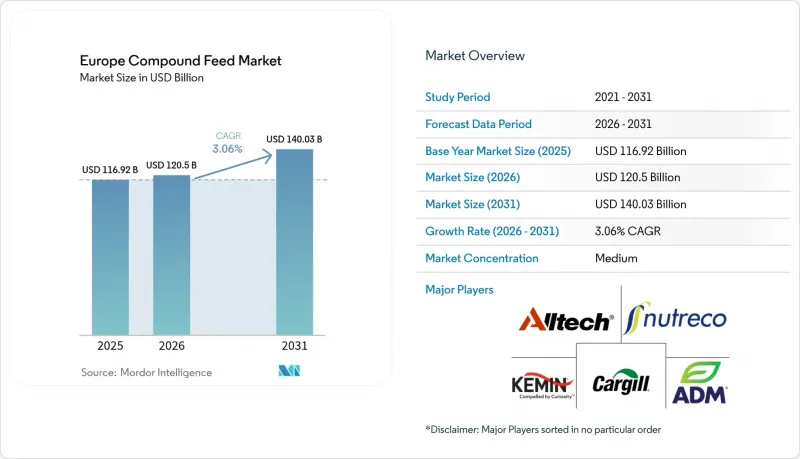
This report is Segmented by Animal Type (Ruminants, Poultry, Swine, and More), by Ingredient Type (Cereals, By-Products, and More), by Form (Mash, Pellets, Crumbles, and More), and by Geography (France, Germany, Italy, United Kingdom, and More). The Market Forecasts are Provided in Terms of Value (USD) and Volume (Metric Tons).
Europe Compound Feed Market Trends and Insights
Rising Meat Consumption and Animal Protein Demand
Poultry intake climbed to 24.8 kilograms per capita in 2024 while pork remained steady at 32.4 kilograms, together safeguarding basal demand for Europe compound feed market supplies despite urban shifts toward plant alternatives. Rising incomes in Poland and Romania are shifting consumption from processed meats toward fresh poultry and value-added pork, both of which rely on higher amino acid densities and enzyme enrichment to meet tight feed conversion targets. Spain lifted broiler output 4.2% in 2024 on export gains to North Africa and the Middle East, offsetting a 2.1% decline in German pork linked to African swine fever containment. Aquaculture is acting as a third anchor, with salmon and trout volumes reaching 2.8 million metric tons in 2024 and demanding premium marine-ingredient rations that cost 20 to 30% more than terrestrial formulas. The pivot toward higher value proteins is forcing mills in the Europe compound feed market to invest in micro-ingredient dosing and liquid application equipment so that enzymes, organic acids, and essential oils are dispersed at below 0.5% inclusion with uniformity that commodity producers struggle to match. Those upgrades increase capital intensity, yet enable suppliers to defend their margins through demonstrated performance improvements, reinforcing the market's transition toward quality-led competition.
Strategic Production Capacity Investments by Integrators
During 2024, integrators commissioned eighteen new feed mills across Spain, Poland, and Germany, adding 3.2 million metric tons of annual throughput aimed at securing margins and enhancing biosecurity. Cargill's upgrade in Krefeld introduced precision grinding and encapsulated butyric acid, targeting a 1.85 feed conversion ratio and lowering grow-out costs by USD 0.09 (EUR 0.08) per kilogram of liveweight. ForFarmers followed with a 240,000 metric tons Polish plant equipped with near-infrared analyzers that trim nutrient variance by 40%. Independent mills are attempting to remain relevant by forming purchasing pools and installing modular extrusion lines that are capable of switching quickly between poultry, swine, and aquaculture diets. Most new brick-and-mortar investments are clustered in wheat and barley belts, such as the Beauce plain in France and Lower Saxony in Germany, which cuts inbound grain logistics costs. These strategic moves underscore how Europe compound feed market participants are racing to secure quality grain pipelines and build flexible capacity that can reformulate quickly.
Volatility in Cereal and Oilseed Prices
European wheat averaged USD 262.1 per metric ton (EUR 245 per metric ton) in 2024 after drought cut French and German harvests by 8.2 million metric tons, while soybean meal peaked at USD 518.9 per metric ton (EUR 485 per metric ton) before easing to USD 449.4 per metric ton (EUR 420 per metric ton) as South American supply stabilized. Smaller plants, lacking hedging tools, were hit hardest, amplifying the structural shift toward large cooperatives that operate grain desks and storage silos. Formulators responded by increasing the shares of rapeseed and sunflower meal, yet the lower amino-acid density required additional synthetic lysine and methionine, thereby increasing supplement expenditure. The need to carry higher safety stocks tied up working capital at a time when interest rates were already elevated. Feed buyers in the European compound feed market, therefore, are confronted with a trade-off between price volatility and nutrient risk, prompting greater interest in locally grown cereals, despite the need for more enzymes to unlock wheat energy. Until Black Sea logistics normalize and climate volatility subsides, raw material swings will continue to weigh on near-term growth.
Other drivers and restraints analyzed in the detailed report include:
- Increasing Focus on Feed Efficiency and Gut-Health Additives
- European Union Green Deal Pushes for Low-Carbon Livestock Production
- Stricter Antibiotic-Free Regulations
For complete list of drivers and restraints, kindly check the Table Of Contents.
Segment Analysis
Poultry preserved a 40.55% share of the Europe compound feed market size in 2025. Poultry blends benefit from finer grinding, as well as the addition of xylanase and amylase, which enhance starch digestibility and offset the higher inclusion of wheat. Swine recovers modestly while ruminant tonnage contracts 1.2% amid herd reductions driven by methane and ammonia targets. Aquaculture feeds are projected to grow at the fastest 5.82% CAGR through 2031, driven by the demand for fishmeal-rich formulas, which are required for Norwegian and Scottish salmon, as well as Mediterranean seabass and seabream, which typically contain 25 to 35% marine protein. Shrimp diets add even more momentum, as the Netherlands and Spain expand recirculating systems that need high digestibility and astaxanthin pigmentation.
Rising demand for micro-pellets measuring less than one millimeter, with two-hour water stability, is reshaping equipment orders across mills that serve salmon smolt and shrimp hatcheries. Swine producers in Germany and Denmark are transitioning to liquid feeding systems that combine dry feed with whey and bakery co-products, reducing costs. In ruminant feed, methane blockers such as 3-nitrooxypropanol are being incorporated at an additional cost, while also providing access to carbon credit payments. As a result, species diversification is influencing capital investments, with feed mills installing flexible production lines that can alternate between high-density fish feed and traditional pellets to maintain utilization rates.
Complete Report Scope:
- By Animal Type
- Ruminants
- Beef Cattle
- Dairy Cattle
- Other Ruminants
- Poultry
- Broiler
- Layer
- Other Poultry
- Swine
- Aquaculture
- Fish
- Shrimp
- Other Aquaculture Species
- Other Animal Types
- Ruminants
- By Ingredient Type
- Cereals
- Cakes and Meals
- By-products
- Supplements
- Vitamins
- Amino Acids
- Enzymes
- Prebiotics and Probiotics
- Acidifiers
- Other Supplements
- By Form
- Mash
- Pellets
- Crumbles
- Micro-Pellets
- By Geography
- Spain
- United Kingdom
- France
- Germany
- Russia
- Italy
- Rest of Europe
List of Companies Covered in this Report:
- Cargill, Incorporated
- Alltech
- Archer Daniels Midland Company
- Nutreco N.V.
- ForFarmers N.V.
- Royal De Heus B.V.
- AB Agri Ltd. (Associated British Foods plc)
- Danish Agro a.m.b.a.
- Agrifirm Group
- DLG Group
- Sodrugestvo Group S.A.
- Miavit GmbH
- Veronesi Mangimi (Gruppo Veronesi)
- Sanders Nutrition Animale (Avril SCA)
- Le Gouessant Cooperative
Additional Benefits:
- The market estimate (ME) sheet in Excel format
- 3 months of analyst support
TABLE OF CONTENTS
1 Introduction
- 1.1 Study Assumptions and Market Definition
- 1.2 Scope of the Study
2 Research Methodology
3 Executive Summary
4 Market Landscape
- 4.1 Market Overview
- 4.2 Market Drivers
- 4.2.1 Rising meat consumption and animal protein demand
- 4.2.2 Strategic production capacity investments by integrators
- 4.2.3 Increasing focus on feed efficiency and gut-health additives
- 4.2.4 European Union Green Deal pushes for low-carbon livestock production
- 4.2.5 Digital twin adoption in feed formulation
- 4.2.6 Expansion of insect-meal inclusion in compound feed
- 4.3 Market Restraints
- 4.3.1 Volatility in cereal and oilseed prices
- 4.3.2 Stricter antibiotic-free regulations
- 4.3.3 Accelerating shift toward plant-based diets
- 4.3.4 Slow harmonization of European Union novel-feed approvals
- 4.4 Regulatory Landscape
- 4.5 Technological Outlook
- 4.6 Porter's Five Forces Analysis
- 4.6.1 Bargaining Power of Buyers
- 4.6.2 Bargaining Power of Suppliers
- 4.6.3 Threat of New Entrants
- 4.6.4 Threat of Substitute Products
- 4.6.5 Intensity of Competitive Rivalry
5 Market Size and Growth Forecasts (Value and Volume)
- 5.1 By Animal Type
- 5.1.1 Ruminants
- 5.1.1.1 Beef Cattle
- 5.1.1.2 Dairy Cattle
- 5.1.1.3 Other Ruminants
- 5.1.2 Poultry
- 5.1.2.1 Broiler
- 5.1.2.2 Layer
- 5.1.2.3 Other Poultry
- 5.1.3 Swine
- 5.1.4 Aquaculture
- 5.1.4.1 Fish
- 5.1.4.2 Shrimp
- 5.1.4.3 Other Aquaculture Species
- 5.1.5 Other Animal Types
- 5.1.1 Ruminants
- 5.2 By Ingredient Type
- 5.2.1 Cereals
- 5.2.2 Cakes and Meals
- 5.2.3 By-products
- 5.2.4 Supplements
- 5.2.4.1 Vitamins
- 5.2.4.2 Amino Acids
- 5.2.4.3 Enzymes
- 5.2.4.4 Prebiotics and Probiotics
- 5.2.4.5 Acidifiers
- 5.2.4.6 Other Supplements
- 5.3 By Form
- 5.3.1 Mash
- 5.3.2 Pellets
- 5.3.3 Crumbles
- 5.3.4 Micro-Pellets
- 5.4 By Geography
- 5.4.1 Spain
- 5.4.2 United Kingdom
- 5.4.3 France
- 5.4.4 Germany
- 5.4.5 Russia
- 5.4.6 Italy
- 5.4.7 Rest of Europe
6 Competitive Landscape
- 6.1 Market Concentration
- 6.2 Strategic Moves
- 6.3 Market Share Analysis
- 6.4 Company Profiles (Includes Global-Level Overview, Market-Level Overview, Core Segments, Financials as Available, Strategic Information, Market Rank/Share for Key Companies, Products and Services, and Recent Developments)
- 6.4.1 Cargill, Incorporated
- 6.4.2 Alltech
- 6.4.3 Archer Daniels Midland Company
- 6.4.4 Nutreco N.V.
- 6.4.5 ForFarmers N.V.
- 6.4.6 Royal De Heus B.V.
- 6.4.7 AB Agri Ltd. (Associated British Foods plc)
- 6.4.8 Danish Agro a.m.b.a.
- 6.4.9 Agrifirm Group
- 6.4.10 DLG Group
- 6.4.11 Sodrugestvo Group S.A.
- 6.4.12 Miavit GmbH
- 6.4.13 Veronesi Mangimi (Gruppo Veronesi)
- 6.4.14 Sanders Nutrition Animale (Avril SCA)
- 6.4.15 Le Gouessant Cooperative
7 Market Opportunities and Future Outlook

