PUBLISHER: Mordor Intelligence | PRODUCT CODE: 2120453

PUBLISHER: Mordor Intelligence | PRODUCT CODE: 2120453
Asia-Pacific Compound Feed - Market Share Analysis, Industry Trends & Statistics, Growth Forecasts (2026 - 2031)
According to Mordor Intelligence, the Asia-Pacific compound feed market size was valued at USD 215.62 billion in 2025 and is estimated to grow from USD 216.21 billion in 2026 to reach USD 272.43 billion by 2031, growing at a 4.73% CAGR over 2026-2031.
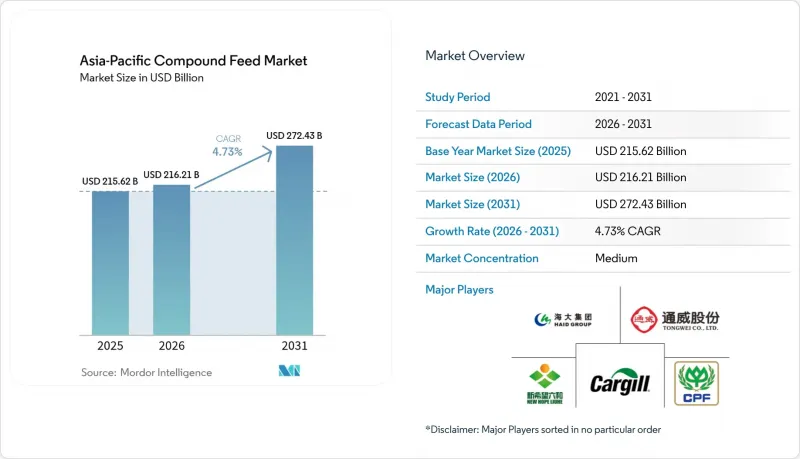
This report is Segmented by Ingredients (Cereals, Oilseeds, Oils, Molasses, and More), by Supplements (Vitamins, Amino Acids, Antibiotics, and More), by Animal Type (Ruminant, Swine, Poultry, Aquaculture, and Other Animal Types), by Form (Pellets, Mash, and More), and by Geography (China, India, Japan, Thailand, and More). The Market Forecasts are Provided in Terms of Value (USD).
Asia-Pacific Compound Feed Market Trends and Insights
Rising Demand for Animal Protein
Income growth across South and Southeast Asia lifted per-capita meat intake. According to the Basic Animal Husbandry Statistics (BAHS) 2025 report, the per capita meat availability in India for the 2024-25 fiscal year was 7.51 kg per person. This reflects a consistent rise in meat production and protein accessibility, with total production for 2024-25 amounting to 10.50 million metric tons . In China, chicken meat production in 2025 increased to 16,200 thousand metric tons, up from 15,350 thousand metric tons in 2024, as large vertically integrated white broiler producers continued to expand capacity despite persistent low margins . Urban consumers in tier-2 cities are willing to pay more for antibiotic-free chicken, encouraging mills to blend organic acids, enzymes, and probiotics. As substitution accelerates, soybean meal alternatives are likely to secure a larger slice of the Asia-Pacific compound feed market.
Government Subsidies for Feed Mills
Government grants, subsidies, and strategic infrastructure funds for feed mills are driving the Asia-Pacific compound feed market. For instance, the Indian government launched the Animal Husbandry Infrastructure Development Fund (AHIDF) under the Atma Nirbhar Bharat Abhiyan stimulus package. The AHIDF was approved to incentivize investments by individual entrepreneurs, private companies, and Farmers' Producer Organizations (FPOs) in establishing dairy processing and value-addition infrastructure, meat processing and value-addition infrastructure, and animal feed plants . In April 2023, Japan's Ministry of Agriculture, Forestry, and Fisheries (MAFF) implemented a special measure under the Compound Feed Price Stabilization System to enhance feed compensation payments to livestock, poultry, and swine producers. This measure revised a formula that had been limiting feed support payments when feed costs remained high for over a year. While subsidies intensify competition by compressing margins, they also promote automation, reducing labor costs and improving batch consistency, thereby strengthening competitive efficiency within the Asia-Pacific compound feed market.
Stricter Antibiotic-Free Regulations
China has implemented fines of up to CNY 500,000 (USD 70,000) for violations of its antibiotic growth promoter ban. This has led feed mills to adopt alternatives, such as organic acids and probiotics, which have increased input costs. In Japan, regulations on tetracycline antibiotic residues in animal products, particularly in kidney and muscle tissues, have established maximum residue limits (MRLs) for compounds like oxytetracycline in specific samples. These regulations have prompted exporters from Thailand and Vietnam to modify their livestock practices. In South Korea, the introduction of a traceability portal has added administrative requirements. While variability in probiotic quality presents challenges to adoption, premium retail channels provide incentives for compliant producers, thereby influencing value distribution within the Asia-Pacific compound feed market.
Other drivers and restraints analyzed in the detailed report include:
- Genomic Breeding Driving Precision Nutrition
- Growth of E-Commerce Feed Ingredient Trade
- Mycotoxin Contamination Escalation
For complete list of drivers and restraints, kindly check the Table Of Contents.
Segment Analysis
Cereals are the largest ingredient and contributed 46.2% of the Asia-Pacific compound feed market share in 2025, led by corn, which supplied the majority of cereal tonnage and remained indispensable for energy density. Wheat has traditionally played a secondary role in ruminant feed formulations, primarily valued for its gluten content, which improves pellet binding. Soybean meal has been a key ingredient, and rapeseed and sunflower meals are gaining prominence, particularly in regions where reliance on soybean imports poses risks to profit margins. Oils, such as soybean and palm, are included sparingly due to concerns over rancidity. Molasses is primarily used in ruminant and liquid feeds. Other raw materials, including rice bran and distillers dried grains, are utilized as feed mills capitalize on localized surpluses.
Supplements scaled faster, expanding at a 5.2% CAGR through 2026-2031, as antibiotic-free mandates and precision feeding drive demand for enzymes and probiotics. The shift confirms cereals' centrality while highlighting a progressive remix of the Asia-Pacific compound feed market toward higher-value micro-ingredients. Supplements are poised for leadership with enzymes, probiotics, and organic acids raising feed efficiency and allowing mills to trim costly fish-meal and soybean-meal shares. Crystalline amino acids account for a significant share of supplement revenues and are steadily gaining importance as genomic selection necessitates more precise targets for lysine and methionine. The use of antibiotics has significantly decreased due to regulatory restrictions, creating greater opportunities for the adoption of functional additives. This transition contributes to improved profit margins, as supplements typically command a higher price per kilogram than bulk cereals, thereby supporting the diversification of earnings within the Asia-Pacific compound feed market.
Amino acids are the largest segment, accounting for 34% of the Asia-Pacific compound feed market size in 2025. Lysine and methionine top the list because they correct protein imbalances in corn-soybean diets and cut nitrogen excretion, a compliance win in Japan and South Korea where nutrient runoff caps apply. Indian integrators utilized enzyme packages to substitute soybean meal with sunflower meal, achieving cost savings while maintaining daily weight gain. Rising e-commerce volumes on Alibaba and JD platforms have trimmed lysine delivery times to under ten days and narrowed distributor margins. These efficiencies reinforce amino acids as the pricing and volume cornerstone of the Asia-Pacific compound feed market size for supplements.
Probiotics are the fastest-growing supplement line, projected to expand at a 4.5% CAGR through 2031 as regulators curb the use of antibiotic growth promoters. China approved 42 probiotic strains in 2025, yet uneven provincial enforcement keeps smaller mills cautious and sustains demand for certified products from multinational suppliers. Retailers in Australia and Japan pay premiums for poultry raised on probiotic-fortified rations. As enforcement tightens and field data accumulate, probiotics are positioned to deliver the greatest incremental value within the broader Asia-Pacific compound feed market.
Complete Report Scope:
- By Ingredients
- Cereals
- Oilseeds
- Oils
- Molasses
- Supplements
- Other Ingredients
- By Supplements
- Vitamins
- Amino Acids
- Antibiotics
- Enzymes
- Antioxidants
- Acidifiers
- Prebiotics
- Probiotics
- Other Supplements
- By Animal Type
- Ruminant
- Swine
- Poultry
- Aquaculture
- Other Animal Types
- By Form
- Pellets
- Mash
- Crumbles
- Liquid Feed
- By Geography
- China
- India
- Japan
- Thailand
- Vietnam
- Australia
- Rest of Asia-Pacific
List of Companies Covered in this Report:
- Charoen Pokphand Foods Public Company Limited
- New Hope Liuhe Co., Ltd.
- Cargill, Incorporated
- Archer-Daniels-Midland Company
- Nutreco N.V. (SHV Holdings N.V.)
- Alltech, Inc.
- Tongwei Co., Ltd.
- Guangdong Haid Group Co., Ltd. (Guangzhou Haihao Investment Co., Ltd.)
- Japfa Ltd. (Santosa Family)
- De Heus Animal Nutrition B.V. (Royal De Heus Group)
- Ridley Corporation Limited
- Zheng DA International Group Co., Ltd.
- Feed One Co., Ltd. (Mitsui & Co., Ltd.)
- Land O'Lakes, Inc
- CJ CheilJedang Co., Ltd. (CJ Group)
Additional Benefits:
- The market estimate (ME) sheet in Excel format
- 3 months of analyst support
TABLE OF CONTENTS
1 Introduction
- 1.1 Study Assumptions and Market Definition
- 1.2 Scope of the Study
2 Research Methodology
3 Executive Summary
4 Market Landscape
- 4.1 Market Overview
- 4.2 Market Drivers
- 4.2.1 Rising demand for animal protein
- 4.2.2 Expansion of commercial aquaculture
- 4.2.3 Government subsidies for feed mills
- 4.2.4 Growth of e-commerce feed ingredient trade
- 4.2.5 Genomic breeding driving precision nutrition
- 4.2.6 Enzymatic feed additive cost reductions
- 4.3 Market Restraints
- 4.3.1 Volatile corn and soybean prices
- 4.3.2 Surge in fermented single-cell proteins
- 4.3.3 Stricter antibiotic-free regulations
- 4.3.4 Mycotoxin contamination escalation
- 4.4 Regulatory Landscape
- 4.5 Technological Outlook
- 4.6 Porter's Five Forces Analysis
- 4.6.1 Bargaining Power of Suppliers
- 4.6.2 Bargaining Power of Buyers
- 4.6.3 Threat of New Entrants
- 4.6.4 Threat of Substitutes
- 4.6.5 Intensity of Competitive Rivalry
5 Market Size and Growth Forecasts (Value)
- 5.1 By Ingredients
- 5.1.1 Cereals
- 5.1.2 Oilseeds
- 5.1.3 Oils
- 5.1.4 Molasses
- 5.1.5 Supplements
- 5.1.6 Other Ingredients
- 5.2 By Supplements
- 5.2.1 Vitamins
- 5.2.2 Amino Acids
- 5.2.3 Antibiotics
- 5.2.4 Enzymes
- 5.2.5 Antioxidants
- 5.2.6 Acidifiers
- 5.2.7 Prebiotics
- 5.2.8 Probiotics
- 5.2.9 Other Supplements
- 5.3 By Animal Type
- 5.3.1 Ruminant
- 5.3.2 Swine
- 5.3.3 Poultry
- 5.3.4 Aquaculture
- 5.3.5 Other Animal Types
- 5.4 By Form
- 5.4.1 Pellets
- 5.4.2 Mash
- 5.4.3 Crumbles
- 5.4.4 Liquid Feed
- 5.5 By Geography
- 5.5.1 China
- 5.5.2 India
- 5.5.3 Japan
- 5.5.4 Thailand
- 5.5.5 Vietnam
- 5.5.6 Australia
- 5.5.7 Rest of Asia-Pacific
6 Competitive Landscape
- 6.1 Market Concentration
- 6.2 Strategic Moves
- 6.3 Market Share Analysis
- 6.4 Company Profiles (Includes Global Level Overview, Market Level Overview, Core Segments, Financials as Available, Strategic Information, Market Rank/Share for Key Companies, Products and Services, and Recent Developments)
- 6.4.1 Charoen Pokphand Foods Public Company Limited
- 6.4.2 New Hope Liuhe Co., Ltd.
- 6.4.3 Cargill, Incorporated
- 6.4.4 Archer-Daniels-Midland Company
- 6.4.5 Nutreco N.V. (SHV Holdings N.V.)
- 6.4.6 Alltech, Inc.
- 6.4.7 Tongwei Co., Ltd.
- 6.4.8 Guangdong Haid Group Co., Ltd. (Guangzhou Haihao Investment Co., Ltd.)
- 6.4.9 Japfa Ltd. (Santosa Family)
- 6.4.10 De Heus Animal Nutrition B.V. (Royal De Heus Group)
- 6.4.11 Ridley Corporation Limited
- 6.4.12 Zheng DA International Group Co., Ltd.
- 6.4.13 Feed One Co., Ltd. (Mitsui & Co., Ltd.)
- 6.4.14 Land O'Lakes, Inc
- 6.4.15 CJ CheilJedang Co., Ltd. (CJ Group)
7 Market Opportunities and Future Outlook

