PUBLISHER: Mordor Intelligence | PRODUCT CODE: 2120794

PUBLISHER: Mordor Intelligence | PRODUCT CODE: 2120794
Thailand Compound Feed - Market Share Analysis, Industry Trends & Statistics, Growth Forecasts (2026 - 2031)
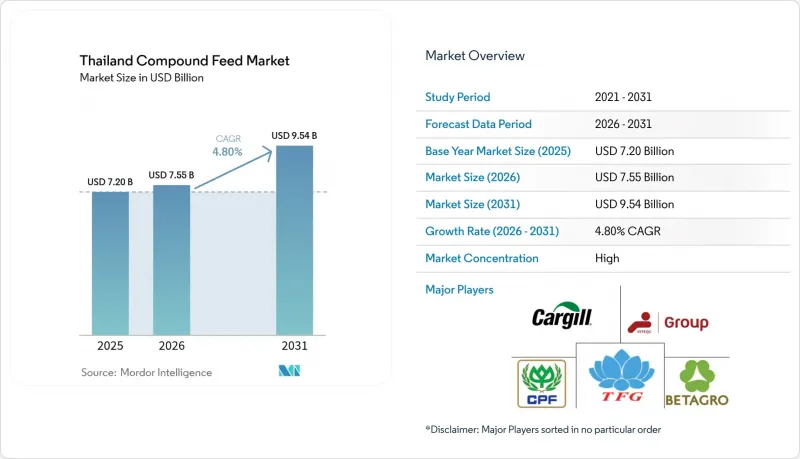
According to Mordor Intelligence, the Thailand compound feed market size was valued at USD 7.20 billion in 2025 and estimated to grow from USD 7.55 billion in 2026 to reach USD 9.54 billion by 2031, at a CAGR of 4.80% during the forecast period (2026-2031).
This report is Segmented by Animal Type (Poultry, Swine, Ruminants, Aquaculture, and Other Animals), by Ingredient (Cereals, Cakes and Meals, By-Products, and Supplements), by Feed Form (Pellets, Mash, and Crumbles), and by Production Stage (Starter, Grower, and Finisher). The Market Forecasts are Provided in Terms of Value (USD).
Thailand Compound Feed Market Trends and Insights
Rising Demand for Animal-Based Protein
Per-capita poultry meat intake rose from 4.7 kg in 2024 to 4.9 kg in 2025, boosting compound-feed use as integrators shorten broiler grow-out cycles by up to 7 days through energy-dense diets. The increasing consumption of poultry, pork, eggs, and aquaculture products in Thailand is driving the demand for compound feed. With rising urban incomes and expanding foodservice exports, livestock producers are scaling operations to meet both domestic and export requirements. For instance, Thailand's poultry exports to Japan and the European Union necessitate consistent, high-quality feed formulations, thereby boosting the demand for nutritionally optimized compound feed. Thailand compound feed market trend directly increases feed production volumes and supports capacity expansion among integrated feed millers.
Government Incentives for Integrated Feed Mills
Thai government policies promoting vertical integration in livestock and aquaculture are strengthening domestic feed production. Incentives such as tax benefits, Board of Investment (BOI) privileges, and soft loans encourage companies to adopt integrated feed-livestock processing models. For instance, large agribusiness groups operating integrated poultry farms benefit from economies of scale, driving demand for in-house compound feed production. These measures enhance investments in feed manufacturing and accelerate the modernization of feed mills. Foreign firms leverage these incentives to establish export hubs that deepen competition inside the thailand compound feed market.
Volatile Imported Feed-Ingredient Prices
In 2025, Thailand imported 50,000 metric tons of corn, exposing domestic feed mills to fluctuations in freight rates and currency exchange, which can significantly impact landed costs within a single quarter. Imported raw material prices, such as corn and soybean meal, are subject to significant fluctuations driven by global supply-demand imbalances, weather conditions, currency fluctuations, geopolitical tensions, and trade restrictions. These price variations directly impact Thailand's cost structure for compound feed production. When import costs rise, feed manufacturers face increased input expenses, which may either reduce profit margins if absorbed or lead to higher feed prices for poultry and livestock producers.
Other drivers and restraints analyzed in the detailed report include:
- Foreign Direct Investment in High-Density Feed Plants
- Expansion of Black Soldier Fly Protein Start-ups
- Limited Arable Land for Domestic Feed Crops
For complete list of drivers and restraints, kindly check the Table Of Contents.
Segment Analysis
Poultry feed was the largest segment, accounting for 46.0% of Thailand compound feed market share in 2025. The market dominance is attributed to vertical integration between feed production and processing facilities, primarily targeting exports. Large-scale broiler operations ensure consistent demand for feed mills, offering stability even amidst raw material price fluctuations. Thailand poultry feed market demonstrates strength due to the country's established role in global chicken exports, particularly to Japan and the European Union, where adherence to strict safety standards is crucial.
Aquaculture feed is the fastest-growing segment, projected to advance at a 6.9% CAGR through 2031. Robust demand for floating shrimp and tilapia feeds positions aquaculture as a market leader within the Thailand compound feed market. Swine feed rebounds as African swine fever declines, while the ruminant and pet segments remain small but grow with urbanization and rising disposable income. The aquaculture feed segment achieves higher profit margins by using specialized formulations with functional additives that enhance feed conversion efficiency and improve the quality of the final product.
Cereals were the largest segment, accounting for 52.0% of the Thailand compound feed market size in 2025. This dominance is attributed to the high demand for cereals as a primary energy source in animal feed, driven by their nutritional value and availability. Cakes and meals rely on imported soybean protein, making ingredient costs sensitive to global price shocks in Thailand's compound feed market. The existing bulk handling infrastructure and supportive tariff policies for domestic crops sustain high cereal inclusion rates in standard feed formulations.
Supplements are the fastest-growing segment, forecast to grow at a 7.8% CAGR to 2031, highlighting the industry's shift toward antibiotic-free production. Feed manufacturers are incorporating probiotics, yeast derivatives, and organic acids, often at premium prices, to meet export requirements for residue-free products. Additionally, the introduction of insect-derived proteins, particularly Black Soldier Fly meal, is broadening supplement options and driving growth in Thailand compound feed market.
Complete Report Scope:
- By Animal Type
- Poultry
- Swine
- Ruminants
- Aquaculture
- Other Animals (Pets, Equine)
- By Ingredient
- Cereals
- Cakes and Meals
- By-Products
- Supplements
- By Feed Form
- Pellets
- Mash
- Crumbles
- By Production Stage
- Starter
- Grower
- Finisher
List of Companies Covered in this Report:
- Charoen Pokphand Foods PCL
- Betagro Public Company Limited
- Cargill, Incorporated
- INTEQC Feed Co. Ltd
- Thai Foods Group Public Company Limited
- SPM Feed Mill Company Limited
- Laemthong Corporation Group
- Sun Feed Co.,Ltd
- Alltech Inc.
- ADM (Archer Daniels Midland)
- De Heus Animal Nutrition
- New Hope Liuhe Co., Ltd
Additional Benefits:
- The market estimate (ME) sheet in Excel format
- 3 months of analyst support
TABLE OF CONTENTS
1 Introduction
- 1.1 Study Assumptions and Market Definition
- 1.2 Scope of the Study
2 Research Methodology
3 Executive Summary
4 Market Landscape
- 4.1 Market Overview
- 4.2 Market Drivers
- 4.2.1 Rising Demand for Animal-Based Protein
- 4.2.2 Government Incentives for Integrated Feed Mills
- 4.2.3 Foreign Direct Investment in High-Density Feed Plants
- 4.2.4 Expansion of Black Soldier Fly Protein Start-ups
- 4.2.5 Blockchain-Enabled Feed-to-Fork Traceability Mandates
- 4.2.6 Blue Economy Plan Accelerating Extruded Aquafeed Demand
- 4.3 Market Restraints
- 4.3.1 Volatile Imported Feed-Ingredient Prices
- 4.3.2 Limited Arable Land for Domestic Feed Crops
- 4.3.3 Chronic Tropical-Warehouse Mycotoxin Contamination
- 4.3.4 Carbon Border Adjustment Mechanisms on Embedded Emissions
- 4.4 Regulatory Landscape
- 4.5 Technological Outlook
- 4.6 Porter's Five Forces Analysis
- 4.6.1 Bargaining Power of Suppliers
- 4.6.2 Bargaining Power of Buyers/Consumers
- 4.6.3 Threat of New Entrants
- 4.6.4 Threat of Substitute Products
- 4.6.5 Intensity of Competitive Rivalry
5 Market Size and Growth Forecasts (Value)
- 5.1 By Animal Type
- 5.1.1 Poultry
- 5.1.2 Swine
- 5.1.3 Ruminants
- 5.1.4 Aquaculture
- 5.1.5 Other Animals (Pets, Equine)
- 5.2 By Ingredient
- 5.2.1 Cereals
- 5.2.2 Cakes and Meals
- 5.2.3 By-Products
- 5.2.4 Supplements
- 5.3 By Feed Form
- 5.3.1 Pellets
- 5.3.2 Mash
- 5.3.3 Crumbles
- 5.4 By Production Stage
- 5.4.1 Starter
- 5.4.2 Grower
- 5.4.3 Finisher
6 Competitive Landscape
- 6.1 Market Concentration
- 6.2 Strategic Moves
- 6.3 Market Share Analysis
- 6.4 Company Profiles (Includes Global Level Overview, Market Level Overview, Core Segments, Financials as Available, Strategic Information, Market Rank/Share for Key Companies, Products and Services, and Recent Developments)
- 6.4.1 Charoen Pokphand Foods PCL
- 6.4.2 Betagro Public Company Limited
- 6.4.3 Cargill, Incorporated
- 6.4.4 INTEQC Feed Co. Ltd
- 6.4.5 Thai Foods Group Public Company Limited
- 6.4.6 SPM Feed Mill Company Limited
- 6.4.7 Laemthong Corporation Group
- 6.4.8 Sun Feed Co.,Ltd
- 6.4.9 Alltech Inc.
- 6.4.10 ADM (Archer Daniels Midland)
- 6.4.11 De Heus Animal Nutrition
- 6.4.12 New Hope Liuhe Co., Ltd
7 Market Opportunities and Future Outlook

