PUBLISHER: Mordor Intelligence | PRODUCT CODE: 2113662

PUBLISHER: Mordor Intelligence | PRODUCT CODE: 2113662
India Compound Feed - Market Share Analysis, Industry Trends & Statistics, Growth Forecasts (2026 - 2031)
According to Mordor Intelligence, India compound feed market size in 2026 is estimated at USD 15.43 billion, growing from 2025 value of USD 14.5 billion with 2031 projections showing USD 21.07 billion, growing at 6.43% CAGR over 2026-2031.
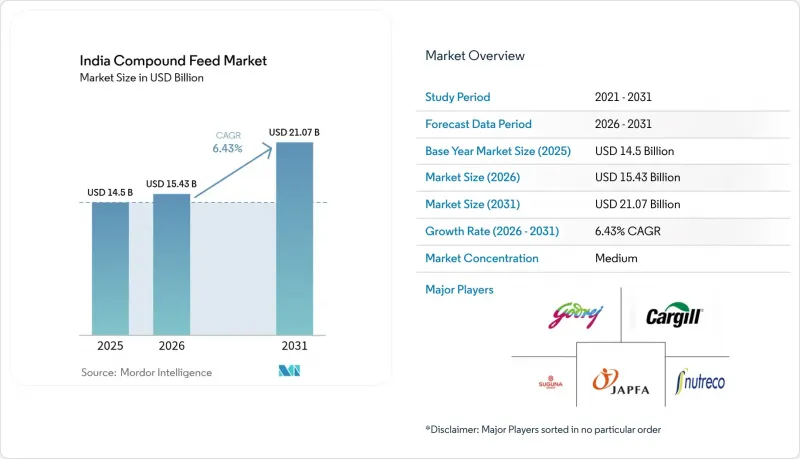
This report is Segmented by Animal Type (Ruminants, Poultry, Swine, Aquaculture, and Other Animal Types) and by Ingredients (Cereal, Cakes and Meals, By-Products, and Supplements). The Market Forecasts are Provided in Terms of Value (USD).
India Compound Feed Market Trends and Insights
Rising Livestock Population
The growth of India's livestock population, particularly in poultry and dairy cattle, drives the demand for compound feeds as traditional grazing and crop residue feeding cannot meet nutritional requirements. The poultry sector anticipates 8-10% annual revenue growth, driven by broiler flock expansion and layer productivity improvements that require scientifically formulated feeds. This transition is prominent in states like Uttar Pradesh and West Bengal, where smallholder farmers are moving from subsistence to commercial livestock operations. The shift intensifies as urbanization reduces grazing land availability, compelling producers to adopt intensive feeding systems. Government livestock census data shows consistent herd growth across multiple species, with dairy cattle and poultry demonstrating the highest expansion rates. The combination of higher stocking densities and improved genetic potential in modern livestock breeds requires precision nutrition that compound feeds provide.
Increasing Demand for Animal-Based Products
The increasing protein consumption in India, particularly in urban and tier-II markets, is driving the demand for compound feeds as livestock producers aim to increase animal productivity. India's per capita egg availability rose to 103 eggs per person per year in 2023-24, an increase from 101 eggs in 2022-23. Total egg production grew to 142.77 billion eggs in 2024, showing a 3.18% increase from the previous year 2023 . South and West India demonstrate strong demand growth, supported by organized retail networks and cold-chain infrastructure that facilitate animal product distribution. Younger consumers show increased preference for animal proteins, indicating a shift from traditional consumption patterns. The export market for processed meat and dairy products contributes to higher domestic production requirements. Rising disposable income in tier-II cities has created consumer segments prioritizing food quality and safety, leading to increased adoption of quality compound feeds among commercial producers.
High Costs of Raw Materials
The volatile pricing of key feed ingredients, particularly maize and soybean meal, creates margin pressure for feed manufacturers and affordability challenges for livestock producers. This volatility potentially limits compound feed adoption among price-sensitive segments. Maize prices have exceeded Rs 26 per kg compared to historical ranges of Rs 20-22 per kg, representing a 20-25% cost increase that directly impacts feed formulation economics and end-user adoption rates. Feed producers must either absorb costs or transfer them to farmers with limited resources. While some mills attempt to reformulate using broken rice and sorghum, the reduced digestibility often negates any cost savings. Dairy cooperatives implement price caps on compound feed to retain members, forcing manufacturers to operate on reduced margins. Additionally, spot shortages lead to speculative hoarding, which causes further price increases and reduces confidence among smallholder farmers.
Other drivers and restraints analyzed in the detailed report include:
- Government Support and Initiatives
- Growth Of Organized Retail Meat and Dairy In Tier-II Cities
- Limited Awareness Among Small-Scale Farmers
For complete list of drivers and restraints, kindly check the Table Of Contents.
Segment Analysis
The poultry segment captured 44.70% of the India compound feed market share in 2025, reflecting its dominance in organized protein supply chains. Feed manufacturers offer breed-specific starter, grower, and finisher rations, each fortified with enzymes and synthetic amino acids to optimize feed conversion. Consumption growth aligns with quick-service restaurant expansion, prompting integrators to secure long-term grain contracts.
The India compound feed market size for aquaculture is projected to surge at a 9.12% CAGR through 2031 on the back of shrimp export momentum and government subsidies for pond aeration equipment. Rising disease pressures in intensive ponds are steering farmers toward floating extruded pellets enriched with immune boosters. Technologically advanced mills nowadays produce micro-pellets tailored for larval stages, improving survival rates in hatcheries. Dairy feed adoption remains mixed, organized cooperatives procure compound concentrates, but many smallholders in milk belts still rely on green fodder and oil-cake mixes. Swine feed demand stays regional, concentrated in northeastern states where pork is culturally accepted. Niche growth pockets include meat goat feed in Rajasthan and sheep fattening pellets in Telangana, each reflecting the adaptive breadth within the India compound feed market.
Complete Report Scope:
- By Animal Type
- Ruminants
- Poultry
- Swine
- Aquaculture
- Other Animal Types
- By Ingredient
- Cereals
- Cakes and Meals
- By-Products
- Supplements
List of Companies Covered in this Report:
- Godrej Agrovet Limited
- Cargill Incorporated
- Suguna Group
- PT Japfa Comfeed Indonesia Tbk
- Nutreco N.V.
- Royal De Heus Group
- Alltech Incorporated
- New Hope Group Co., Ltd
- Archer Daniels Midland Company
- BASF SE
- Avanti Group
Additional Benefits:
- The market estimate (ME) sheet in Excel format
- 3 months of analyst support
TABLE OF CONTENTS
1 Introduction
- 1.1 Study Assumptions and Market Definition
- 1.2 Scope of the Study
2 Research Methodology
3 Executive Summary
4 Market Landscape
- 4.1 Market Overview
- 4.2 Market Drivers
- 4.2.1 Rising livestock population
- 4.2.2 Increasing demand for animal-based products
- 4.2.3 Government support and initiatives
- 4.2.4 Growth of organized retail meat and dairy in tier-ii cities
- 4.2.5 Adoption of precision feeding technologies (IOT-enabled)
- 4.2.6 Expansion of domestic oilseed processing capacity
- 4.3 Market Restraints
- 4.3.1 High costs of raw materials
- 4.3.2 Limited awareness among small-scale farmers
- 4.3.3 Stricter antibiotic-free regulations are elevating formulation cost
- 4.3.4 Climate-linked supply chain volatility
- 4.4 Regulatory Landscape
- 4.5 Technological Outlook
- 4.6 Porter's Five Forces Analysis
- 4.6.1 Bargaining Power of Suppliers
- 4.6.2 Bargaining Power of Buyers/Consumers
- 4.6.3 Threat of New Entrants
- 4.6.4 Threat of Substitute Products
- 4.6.5 Intensity of Competitive Rivalry
5 Market Size and Growth Forecasts (Value)
- 5.1 By Animal Type
- 5.1.1 Ruminants
- 5.1.2 Poultry
- 5.1.3 Swine
- 5.1.4 Aquaculture
- 5.1.5 Other Animal Types
- 5.2 By Ingredient
- 5.2.1 Cereals
- 5.2.2 Cakes and Meals
- 5.2.3 By-Products
- 5.2.4 Supplements
6 Competitive Landscape
- 6.1 Market Concentration
- 6.2 Strategic Moves
- 6.3 Market Share Analysis
- 6.4 Company Profiles (includes Global Level Overview, Market Level Overview, Core Segments, Financials as available, Strategic Information, Market Rank/Share for Key Companies, Products and Services, and Recent Developments)
- 6.4.1 Godrej Agrovet Limited
- 6.4.2 Cargill Incorporated
- 6.4.3 Suguna Group
- 6.4.4 PT Japfa Comfeed Indonesia Tbk
- 6.4.5 Nutreco N.V.
- 6.4.6 Royal De Heus Group
- 6.4.7 Alltech Incorporated
- 6.4.8 New Hope Group Co., Ltd
- 6.4.9 Archer Daniels Midland Company
- 6.4.10 BASF SE
- 6.4.11 Avanti Group
7 Market Opportunities and Future Outlook

