PUBLISHER: Mordor Intelligence | PRODUCT CODE: 2120344

PUBLISHER: Mordor Intelligence | PRODUCT CODE: 2120344
GCC Compound Feed - Market Share Analysis, Industry Trends & Statistics, Growth Forecasts (2026 - 2031)
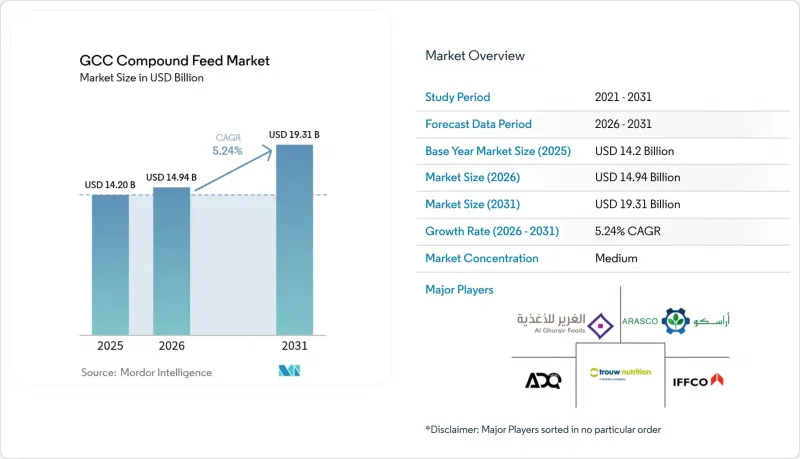
According to Mordor Intelligence, the GCC compound feed market size was valued at USD 14.2 billion in 2025 and estimated to grow from USD 14.94 billion in 2026 to reach USD 19.31 billion by 2031, at a CAGR of 5.24% during the forecast period (2026-2031).
This report is Segmented by Animal Type (Ruminants, Poultry, Swine, Aquaculture, Equine, and More), Ingredient (Cereals, Cakes and Meals, By-Products, and Supplements), Feed Form (Mash, Pellets, Crumbles, Extruded, and More), and Geography (United Arab Emirates, Saudi Arabia, Oman, Bahrain, Kuwait, and Qatar). The Market Forecasts are Provided in Terms of Value (USD).
GCC Compound Feed Market Trends and Insights
Rising Poultry Meat Consumption Per-Capita
Broiler self-sufficiency programs continue to accelerate feed uptake, with Saudi Arabia alone targeting 80% domestic chicken supply through expanded integrated farms. Balady Company's SAR 1.14 billion (USD 304 million) facility confirms investor confidence, while feed represents 60%-70% of poultry production costs. Demographic growth and tourism inflows create additional institutional food-service demand, encouraging mills to optimize corn-heavy formulations that underpin stable cereal purchases. Pellet producers benefit most because automated feeders favor pelletized diets that lift feed-conversion ratios. Regional hatcheries are also upgrading genetics, reinforcing demand for nutrient-dense starter feeds that shorten grow-out cycles.
Government Food-Security Policies Supporting Local Feed Mills
UAE's 25% feed subsidies and Saudi wheat procurement mandates of 1.5 million metric tons per year tilt economics in favor of domestic mills. Subsidies shield margins from grain swings, while preferential purchasing secures captive demand for local output. Larger integrated players deepen government ties to lock in multi-year contracts; smaller firms pivot toward organic or specialty lines to stay competitive within rigorous quality frameworks. Capital grants for silo construction further lower entry barriers for modernization, raising sector-wide efficiency. These programs collectively raise utilization rates and inject confidence for green-field and brown-field expansions across the bloc.
Volatile Global Grain Prices
Corn and soybean meal comprise more than 70% of raw-material cost, exposing mills to commodity swings. Saudi soybean meal use hit 1.54 million metric tons in 2024, and currency moves amplify price shocks. Larger groups deploy hedging and storage strategies, whereas smaller producers absorb margin hits or adjust recipes with alternative proteins. Extended payment terms with livestock integrators stretch working capital during price spikes. Currency hedges and forward contracts mitigate some risk, yet sustained high prices can squeeze feed-mill margins by up to 4 percentage points.
Other drivers and restraints analyzed in the detailed report include:
- Advances in Precision Nutrition and Mill Automation
- Heightened Livestock-Health Focus Spurring Medicated Additives
- Water-Scarcity Crop Bans Raising Import Dependence
For complete list of drivers and restraints, kindly check the Table Of Contents.
Segment Analysis
Aquaculture commanded the fastest 8.72% CAGR outlook, propelled by Oman's USD 1.2 billion development fund and coastal cage investments that generate steady call-off orders for extruded floating feeds. Poultry retained leadership with 45.62% GCC compound feed market share in 2025, underwritten by expanding broiler capacities linked to food-security mandates.
Regional diversification into finfish and shrimp lowers reliance on traditional livestock while enabling export sales to East Asian buyers. Feed manufacturers able to deliver species-specific amino-acid profiles and lipid ratios secure pricing power. In contrast, ruminant diets revolve around TMR blends tied to mega dairies, providing high-volume yet lower-margin outlets. Swine and equine formulations remain niche, serving cultural or high-end recreational segments that still value premium nutrition and traceability.
Complete Report Scope:
- By Animal Type
- Ruminants
- Poultry
- Swine
- Aquaculture
- Equine
- Other Animal Types
- By Ingredient
- Cereals
- Cakes and Meals
- By-products
- Supplements
- By Feed Form
- Mash
- Pellets
- Crumbles
- Extruded
- Other Forms
- By Geography
- United Arab Emirates
- Saudi Arabia
- Oman
- Bahrain
- Kuwait
- Qatar
List of Companies Covered in this Report:
- Al Ghurair Foods LLC
- Arabian Agricultural Services Company (ARASCO)
- Agthia Group PJSC
- IFFCO Group
- Trouw Nutrition Middle East
- Oman Flour Mills Company SAOG
- Fujairah Feed Factory LLC
- National Feed and Flour Production and Marketing Co. LLC
- Al Watania Agriculture Co.
- Bahra Advanced Food Industries Ltd.
Additional Benefits:
- The market estimate (ME) sheet in Excel format
- 3 months of analyst support
TABLE OF CONTENTS
1 Introduction
- 1.1 Study Assumptions and Market Definition
- 1.2 Scope of the Study
2 Research Methodology
3 Executive Summary
4 Market Landscape
- 4.1 Market Overview
- 4.2 Market Drivers
- 4.2.1 Rising poultry meat consumption per-capita
- 4.2.2 Government food-security policies supporting local feed mills
- 4.2.3 Advances in precision nutrition and mill automation
- 4.2.4 Heightened livestock-health focus spurring medicated additives
- 4.2.5 Mega desert dairy projects adopting TMR-based compound feed
- 4.2.6 Port-based aquafeed extrusion plants catalyzing marine fish farming
- 4.3 Market Restraints
- 4.3.1 Volatile global grain prices
- 4.3.2 Consumer shift toward plant-based diets
- 4.3.3 Tighter antibiotic growth-promoter regulations
- 4.3.4 Water-scarcity crop bans raising import dependence
- 4.4 Regulatory Landscape
- 4.5 Technological Outlook
- 4.6 Porter's Five Forces Analysis
- 4.6.1 Threat of New Entrants
- 4.6.2 Bargaining Power of Consumers
- 4.6.3 Bargaining Power of Suppliers
- 4.6.4 Threat of Substitute Products
- 4.6.5 Intensity of Competitive Rivalry
5 Market Size and Growth Forecasts (Value)
- 5.1 By Animal Type
- 5.1.1 Ruminants
- 5.1.2 Poultry
- 5.1.3 Swine
- 5.1.4 Aquaculture
- 5.1.5 Equine
- 5.1.6 Other Animal Types
- 5.2 By Ingredient
- 5.2.1 Cereals
- 5.2.2 Cakes and Meals
- 5.2.3 By-products
- 5.2.4 Supplements
- 5.3 By Feed Form
- 5.3.1 Mash
- 5.3.2 Pellets
- 5.3.3 Crumbles
- 5.3.4 Extruded
- 5.3.5 Other Forms
- 5.4 By Geography
- 5.4.1 United Arab Emirates
- 5.4.2 Saudi Arabia
- 5.4.3 Oman
- 5.4.4 Bahrain
- 5.4.5 Kuwait
- 5.4.6 Qatar
6 Competitive Landscape
- 6.1 Market Concentration
- 6.2 Strategic Moves
- 6.3 Market Share Analysis
- 6.4 Company Profiles (includes Global-level Overview, Market-level Overview, Core Segments, Financials as available, Strategic Information, Market Rank/Share, Products and Services, Recent Developments)
- 6.4.1 Al Ghurair Foods LLC
- 6.4.2 Arabian Agricultural Services Company (ARASCO)
- 6.4.3 Agthia Group PJSC
- 6.4.4 IFFCO Group
- 6.4.5 Trouw Nutrition Middle East
- 6.4.6 Oman Flour Mills Company SAOG
- 6.4.7 Fujairah Feed Factory LLC
- 6.4.8 National Feed and Flour Production and Marketing Co. LLC
- 6.4.9 Al Watania Agriculture Co.
- 6.4.10 Bahra Advanced Food Industries Ltd.
7 Market Opportunities and Future Outlook

