PUBLISHER: Mordor Intelligence | PRODUCT CODE: 2113486

PUBLISHER: Mordor Intelligence | PRODUCT CODE: 2113486
Compound Feed - Market Share Analysis, Industry Trends & Statistics, Growth Forecasts (2026 - 2031)
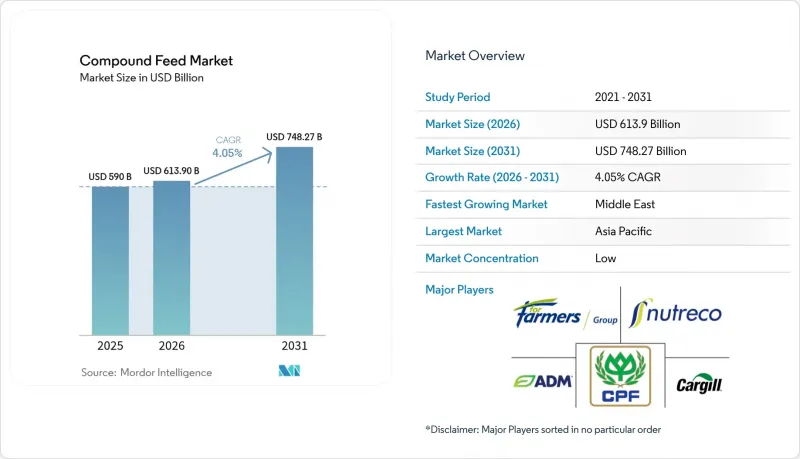
According to Mordor Intelligence, the compound feed market size was valued at USD 590 billion in 2025 and estimated to grow from USD 613.9 billion in 2026 to reach USD 748.27 billion by 2031, at a CAGR of 4.05% during the forecast period (2026-2031).
This report is Segmented by Animal Type (Ruminants, Poultry, Swine, Aquaculture, and Other Animal Types), by Ingredient (Cereals, Cakes and Meals, By-Products, and Supplements), by Form (Pellets, Mash, Crumbles, and Liquid), and by Geography (North America, South America, Europe, Asia-Pacific, Middle East, and Africa). The Market Forecasts are Provided in Terms of Value (USD).
Global Compound Feed Market Trends and Insights
Rising Demand for Animal-Based Protein
Urbanization and income gains in emerging economies are driving larger servings of meat, milk, and seafood, prompting feed manufacturers to expand capacity and refine nutrient density. Shrimp output alone surpassed 5 million metric tons in 2024, stimulating specialized functional diets rich in peptides and nucleotides that enhance growth and immunity. Precision amino-acid balancing technologies such as Skretting's AmiNova line are also reducing nitrogen discharge in aquaculture ponds, helping producers meet environmental benchmarks.
Industrialization of Poultry and Swine Farming
Integrated corporations now deploy sensor networks and automated feeders that adjust rations in real time. Charoen Pokphand Foods' AI FarmLab in Thailand uses computer vision and climate mapping to maintain uniform bird weights and cut feed conversion ratios, while large Chinese operators have partnered with Huawei Cloud to roll out edge-computing modules that track barn conditions continuously. These platforms translate to leaner inventories and lower disease risk, strengthening profitability.
Volatility in Cereal and Soybean Prices
Corn futures softened from USD 187 per metric ton in 2023 to USD 173.20 in 2024, while soybeans slipped from USD 494 to USD 441, reflecting shifting acreage and freight disruption around the Black Sea. Feed formulators hedge through diversified ingredient matrices, yet cost swings still pressure margins, especially in regions that rely on imports. The Ukraine-Russia conflict continues to influence global grain markets, with low stocks-to-use ratios affecting distillers-to-corn price relationships and creating uncertainty in feed ingredient procurement strategies.
Other drivers and restraints analyzed in the detailed report include:
- Adoption of Precision-Nutrition Software in Feed Mills
- Carbon-Footprint Labeling Pressures on Feed Formulators
- Stringent Caps on Antibiotic Usage in Feed
For complete list of drivers and restraints, kindly check the Table Of Contents.
Segment Analysis
Poultry represented 38.12% of the compound feed market share in 2025, confirming its anchor position within the compound feed market. Robust demand for chicken protein and established industrial infrastructures keep volumes high. In contrast, aquaculture posted the strongest 5.55% CAGR outlook to 2031, signaling its rising strategic weight. Functional shrimp diets fortified with beta-glucans, carotenoids, and single-cell proteins now command premiums, elevating the compound feed market size for aquatic species. Precision nutrition platforms paired with water-quality sensors trim feed conversion ratios and reduce nitrogen loading, enhancing farm profitability and reinforcing environmental compliance.
Ruminant operators adopt radio-frequency identification (RFID) tags and facial-recognition cameras that track individual intake, allowing millers to offer custom concentrates that limit refusals and bolster daily gains. Swine integrators follow circular models that incorporate bakery waste, distillers' dried grains with solubles, and insect meal to offset soybean imports. Together, these shifts widen formulation complexity and create new niches for specialized premix blends across the compound feed market.
Complete Report Scope:
- By Animal Type
- Ruminants
- Poultry
- Swine
- Aquaculture
- Other Animal Types (Equine, etc.)
- By Ingredient
- Cereals
- Cakes and Meals
- By-products
- Supplements
- By Form
- Pellets
- Mash
- Crumbles
- Liquid
- By Geography
- North America
- United States
- Canada
- Mexico
- Rest of North America
- South America
- Brazil
- Argentina
- Rest of South America
- Europe
- Spain
- United Kingdom
- France
- Germany
- Russia
- Italy
- Rest of Europe
- Asia-Pacific
- China
- India
- Japan
- Thailand
- Rest of Asia-Pacific
- Middle East
- Saudi Arabia
- Turkey
- Rest of Middle East
- Africa
- South Africa
- Egypt
- Rest of Africa
- North America
Geography Analysis
Asia-Pacific generated 39.22% of compound feed market revenue in 2025, anchored by China's massive poultry and aquaculture complexes. Government grants that promote the use of enzymes and antibiotic reduction, combined with the adoption of smart farming, give regional players a competitive edge. Vietnam, Indonesia, and Thailand are magnets for European joint ventures that introduce functional additives and cloud-based formulation services, extending market sophistication. The Middle East, though smaller in absolute terms, is on track for a 5.62% CAGR through 2031. Subsidized credit for feed plants, expanding dairy and poultry operations, and tighter food-safety mandates catalyze investment. Countries such as Saudi Arabia and the United Arab Emirates now require mycotoxin certificates for imported raw materials, thereby increasing demand for certified premixes.
South America's compound feed market benefits from merger and partnership deals that blend local distribution reach with European or North American technology. Brazil produced more than 81 million metric tons of compound feed in 2024, and new mineral-based toxin binders are entering swine and poultry diets to address mycotoxin hotspots in tropical storage environments. Europe shapes global policy through stringent residue limits and the Good Manufacturing Practice Plus (GMP+) Feed Safety Assurance scheme, pushing mills toward hazard analysis and risk-based auditing. North America leads digital transformation, cloud analytics platforms integrating mill-sensor data with enterprise resource planning systems, cutting downtime and scaling multi-site control. Africa's feed sector remains fragmented yet is pivoting toward climate-smart crops and drought-resistant sorghum and millet. Development agencies sponsor modular mill installations and mobile testing labs to ensure quality in remote regions. These initiatives, combined with fertilizer and seed subsidies, are raising feed reliability and lifting livestock yields, broadening the customer base for the compound feed market.
- Charoen Pokphand Foods PCL (Charoen Pokphand Group)
- Cargill Incorporated
- Land O Lakes Inc.
- Alltech
- ADM
- Nutreco (SHV Holdings)
- Guangdong HAID Group Co., Ltd.
- New Hope Liuhe Co., Ltd.
- Kent Nutrition Group (Kent Corporation)
- ForFarmers Group
- De Heus Animal Nutrition
- Godrej Agrovet Limited
- JAPFA LTD
- FEED ONE CO., LTD.
- Ridley Corporation Limited
Additional Benefits:
- The market estimate (ME) sheet in Excel format
- 3 months of analyst support
TABLE OF CONTENTS
1 Introduction
- 1.1 Study Assumptions and Market Definition
- 1.2 Scope of the Study
2 Research Methodology
3 Executive Summary
4 Market Landscape
- 4.1 Market Overview
- 4.2 Market Drivers
- 4.2.1 Rising demand for animal-based protein
- 4.2.2 Expanding global livestock population
- 4.2.3 Industrialization of poultry and swine farming
- 4.2.4 Adoption of precision-nutrition software in feed mills
- 4.2.5 Upcycling agri-waste into feed
- 4.2.6 Carbon-footprint labeling pressures on feed formulators
- 4.3 Market Restraints
- 4.3.1 Volatility in cereal and soybean prices
- 4.3.2 Grain diversion to bio-ethanol and bio-chemicals
- 4.3.3 Stringent caps on antibiotic usage in feed
- 4.3.4 Climate-driven variability in feed-crop yields
- 4.4 Regulatory Landscape
- 4.5 Technological Outlook
- 4.6 Porter's Five Forces Analysis
- 4.6.1 Bargaining Power of Suppliers
- 4.6.2 Bargaining Power of Buyers
- 4.6.3 Threat of New Entrants
- 4.6.4 Threat of Substitutes
- 4.6.5 Intensity of Competitive Rivalry
5 Market Size and Growth Forecasts (Value)
- 5.1 By Animal Type
- 5.1.1 Ruminants
- 5.1.2 Poultry
- 5.1.3 Swine
- 5.1.4 Aquaculture
- 5.1.5 Other Animal Types (Equine, etc.)
- 5.2 By Ingredient
- 5.2.1 Cereals
- 5.2.2 Cakes and Meals
- 5.2.3 By-products
- 5.2.4 Supplements
- 5.3 By Form
- 5.3.1 Pellets
- 5.3.2 Mash
- 5.3.3 Crumbles
- 5.3.4 Liquid
- 5.4 By Geography
- 5.4.1 North America
- 5.4.1.1 United States
- 5.4.1.2 Canada
- 5.4.1.3 Mexico
- 5.4.1.4 Rest of North America
- 5.4.2 South America
- 5.4.2.1 Brazil
- 5.4.2.2 Argentina
- 5.4.2.3 Rest of South America
- 5.4.3 Europe
- 5.4.3.1 Spain
- 5.4.3.2 United Kingdom
- 5.4.3.3 France
- 5.4.3.4 Germany
- 5.4.3.5 Russia
- 5.4.3.6 Italy
- 5.4.3.7 Rest of Europe
- 5.4.4 Asia-Pacific
- 5.4.4.1 China
- 5.4.4.2 India
- 5.4.4.3 Japan
- 5.4.4.4 Thailand
- 5.4.4.5 Rest of Asia-Pacific
- 5.4.5 Middle East
- 5.4.5.1 Saudi Arabia
- 5.4.5.2 Turkey
- 5.4.5.3 Rest of Middle East
- 5.4.6 Africa
- 5.4.6.1 South Africa
- 5.4.6.2 Egypt
- 5.4.6.3 Rest of Africa
- 5.4.1 North America
6 Competitive Landscape
- 6.1 Market Concentration
- 6.2 Strategic Moves
- 6.3 Market Share Analysis
- 6.4 Company Profiles (Includes Global Level Overview, Market Level Overview, Core Segments, Financials as Available, Strategic Information, Market Rank/Share for Key Companies, Products and Services, and Recent Developments)
- 6.4.1 Charoen Pokphand Foods PCL (Charoen Pokphand Group)
- 6.4.2 Cargill Incorporated
- 6.4.3 Land O Lakes Inc.
- 6.4.4 Alltech
- 6.4.5 ADM
- 6.4.6 Nutreco (SHV Holdings)
- 6.4.7 Guangdong HAID Group Co., Ltd.
- 6.4.8 New Hope Liuhe Co., Ltd.
- 6.4.9 Kent Nutrition Group (Kent Corporation)
- 6.4.10 ForFarmers Group
- 6.4.11 De Heus Animal Nutrition
- 6.4.12 Godrej Agrovet Limited
- 6.4.13 JAPFA LTD
- 6.4.14 FEED ONE CO., LTD.
- 6.4.15 Ridley Corporation Limited
7 Market Opportunities and Future Outlook

