PUBLISHER: Mordor Intelligence | PRODUCT CODE: 2116664

PUBLISHER: Mordor Intelligence | PRODUCT CODE: 2116664
Singapore Car Rental - Market Share Analysis, Industry Trends & Statistics, Growth Forecasts (2026 - 2031)
According to Mordor Intelligence, the Singapore car rental market size was valued at USD 256.99 million in 2025 and estimated to grow from USD 265.41 million in 2026 to reach USD 317.35 million by 2031, at a CAGR of 3.64% during the forecast period (2026-2031).
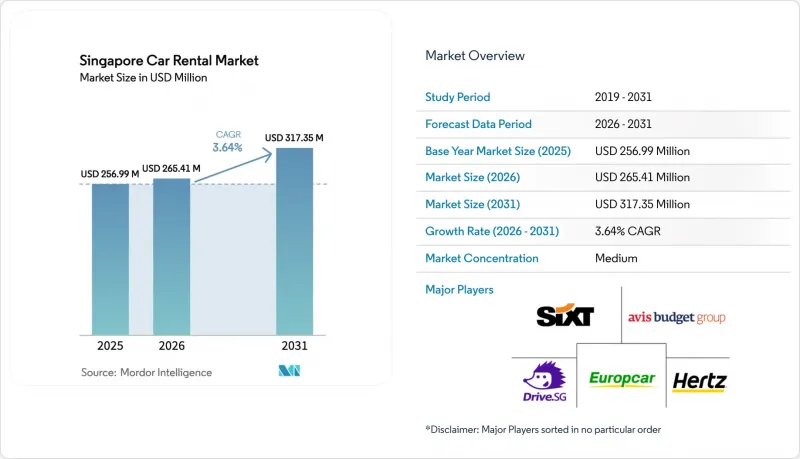
This report is Segmented by Vehicle Type (Economy, Premium, and More), Booking Channel (Online and Offline), Rental Duration (Short-Term and Long-Term), Application (Tourism and General Commuting), Powertrain Type (Internal Combustion Engine (ICE), Hybrid, and Electric Vehicle ), and End-User (Individual and Corporate). The Market Forecasts are Provided in Terms of Value (USD).
Singapore Car Rental Market Trends and Insights
Rising COE Premiums Pricing Out Ownership
Category A Certificate of Entitlement (COE) premiums have risen significantly, pushing the all-in cost of a compact sedan to a high level before financing. Despite the Land Transport Authority (LTA) releasing additional quotas, prices remain well above pre-pandemic levels . Households priced out of ownership are reserving economy cars for weekends several weeks in advance, indicating a structural reset in mobility budgeting. Affluent buyers migrating to Category B vehicles further amplify rental demand for entry-level sedans because fleet operators focus on segments with the widest addressable base. The shift toward variable-cost mobility suggests that a mild COE retreat will not immediately prompt consumers to revert to outright ownership.
Tourism Rebound and Inbound Arrivals
International arrivals reached 16.5 million in 2024, a 21.5% increase year-over-year, while tourism receipts totaled SGD 29.8 billion (USD 22.1 billion) . During holiday peaks, airport-based rental operators experienced a significant increase in utilization rates compared to off-peak months. Economy-class bookings are predominantly led by visitors hailing from Indonesia, Malaysia, and China. However, there is a noticeable trend: renters from India and the Middle East are increasingly gravitating toward premium sport-utility vehicles (SUVs), even willingly paying a cross-border surcharge for drives into Malaysia. Meanwhile, peer-to-peer hosts are capitalizing on their idle cars, listing them while abroad, which in turn amplifies fleet supply without any capital expenditure from operators. The outlook for the Singapore car rental market remains optimistic, buoyed by steady weekend and holiday utilization driven by inbound leisure travel.
Spiking Insurance Premiums for Rental Fleets
Motor gross written premiums have increased, while underwriting losses have significantly risen. Renewal quotes for rental fleets are notably higher than previous levels, and deductibles on standard policies have also increased . To mitigate exposure, Avis imposes daily charges for zero-deductible waivers and partial options, which can substantially raise weekly expenses for customers. FIDReC's expanded remit to handle third-party motor disputes offers a means of redress but also prolongs settlement timelines, tying up operators' cash. Small fleets, with limited bargaining power, are facing compressed margins, which is slowing the entry of new players into the market.
Other drivers and restraints analyzed in the detailed report include:
- Government EV-Rental Incentives Drive Electrification
- AI-Driven Fleet Optimization Lowering Operator Costs
- Scarcity of Overnight Public EV Chargers
For complete list of drivers and restraints, kindly check the Table Of Contents.
Segment Analysis
The economy category accounted for 40.21% of the Singapore car rental market share in 2025 and is on track to post a 6.27% CAGR through 2031, demonstrating that value-oriented demand remains the backbone of fleet utilization. As operators cascade EV rebates into seven-seater models, the Singapore car rental market for SUVs is poised for growth. Eurokars Leasing revamped its digital platform, allowing customers to switch from a Mazda 3 to a Porsche Cayenne mid-booking, contingent on availability. While GetGo continues to use hatchbacks to optimize parking across its sites, its pilot of Tesla Model 3 units tests the market's appetite for premium EVs. Hertz's global deal for Tesla vehicles is now seeding the local fleet, and the LTA's cleaner-energy mandate is poised to reshape the vehicle mix.
Operators note an uptick in cross-booking from economy to premium tiers during holidays, hinting at potential upsell revenue. However, as battery EV residuals stabilize and their servicing costs drop compared to combustion engines, the margin gap tightens. Fleet managers are expected to shift their focus towards mid-priced EV sedans that align with regulatory, cost, and consumer experience benchmarks.
Online channels captured more than 73.29% of 2025 revenue and are on track for an 8.24% CAGR to 2031. The shift reflects consumer comfort with app-based contracts, real-time pricing, and keyless entry. GetGo, which leverages a mobile-only approach that eliminates counter staff and paper forms, has amassed a significant subscriber base. Europcar, capitalizing on high-intent traffic, embedded rental offers into Singapore Airlines' KrisFlyer booking path, earning miles for each leisure transaction. However, offline channels remain vital for those seeking last-minute or personalized services. Sixt's myDriver, in collaboration with Cathay Pacific, offers chauffeur services to the airline's premium clientele, steering high-value clients straight to Sixt.
Operators face mounting pressure from digital price-discovery tools, prompting them to either tighten their cost structures or differentiate themselves with flexible pickup points and bundled services. With API integrations into SAP Concur and Navan, automatic expense reconciliation is now a reality, broadening corporate engagement. As the rollout of distance-based charging progresses, the integration of real-time trip pricing in booking apps is set to bolster the appeal of digital channels.
Complete Report Scope:
- By Vehicle Type
- Economy
- Premium
- Luxury
- Sport Utility Vehicle and Multi-Purpose Vehicle
- By Booking Channel
- Online
- Offline
- By Rental Duration
- Short-term (Less Than 30 days)
- Long-term (More Than 30 days)
- By Application
- Tourism
- General Commuting
- By Powertrain Type
- Internal Combustion Engine (ICE)
- Hybrid
- Electric Vehicle (EV)
- By End User
- Individual
- Corporate
List of Companies Covered in this Report:
- Avis Budget Group
- Hertz Corporation
- Sixt SE
- Europcar Mobility Group
- GetGo Technologies Pte Ltd
- Car Club Pte Ltd (TribeCar)
- Drive.SG Pte Ltd
- AKA Car Rental
- Ride Now
- Motorist Pte Ltd
Additional Benefits:
- The market estimate (ME) sheet in Excel format
- 3 months of analyst support
TABLE OF CONTENTS
1 Introduction
- 1.1 Study Assumptions and Market Definition
- 1.2 Scope of the Study
2 Research Methodology
3 Executive Summary
4 Market Landscape
- 4.1 Market Overview
- 4.2 Market Drivers
- 4.2.1 Rising COE Premiums Pricing Out Ownership
- 4.2.2 Tourism Rebound and Inbound Arrivals
- 4.2.3 Corporate Demand for Flexible Mobility Solutions
- 4.2.4 Government EV-Rental Incentives (CVES, Tax Rebates)
- 4.2.5 Growth of Subscription and Peer-To-Peer Rental Platforms
- 4.2.6 AI-Driven Fleet Optimization Lowering Operator Costs
- 4.3 Market Restraints
- 4.3.1 Security-Deposit Disputes Eroding Trust
- 4.3.2 High ERP Congestion Charges Dampen Rental Utilization
- 4.3.3 Spiking Insurance Premiums for Rental Fleets
- 4.3.4 Scarcity of Overnight Public EV Chargers
- 4.4 Value / Supply-Chain Analysis
- 4.5 Regulatory Landscape
- 4.6 Technological Outlook (connected and autonomous add-ons)
- 4.7 Porter's Five Forces
- 4.7.1 Threat of New Entrants
- 4.7.2 Bargaining Power of Buyers/Consumers
- 4.7.3 Bargaining Power of Suppliers
- 4.7.4 Threat of Substitute Products/Services
- 4.7.5 Intensity of Competitive Rivalry
5 Market Size and Growth Forecasts (Value, USD)
- 5.1 By Vehicle Type
- 5.1.1 Economy
- 5.1.2 Premium
- 5.1.3 Luxury
- 5.1.4 Sport Utility Vehicle and Multi-Purpose Vehicle
- 5.2 By Booking Channel
- 5.2.1 Online
- 5.2.2 Offline
- 5.3 By Rental Duration
- 5.3.1 Short-term (Less Than 30 days)
- 5.3.2 Long-term (More Than 30 days)
- 5.4 By Application
- 5.4.1 Tourism
- 5.4.2 General Commuting
- 5.5 By Powertrain Type
- 5.5.1 Internal Combustion Engine (ICE)
- 5.5.2 Hybrid
- 5.5.3 Electric Vehicle (EV)
- 5.6 By End User
- 5.6.1 Individual
- 5.6.2 Corporate
6 Competitive Landscape
- 6.1 Market Concentration
- 6.2 Strategic Moves (M&A, fleet electrification, tech tie-ups)
- 6.3 Market Share Analysis
- 6.4 Company Profiles {(Includes Global level Overview, Market level overview, Core Segments, Financials as available, Strategic Information, Market Rank/Share for key companies, Products and Services, and Recent Developments)}
- 6.4.1 Avis Budget Group
- 6.4.2 Hertz Corporation
- 6.4.3 Sixt SE
- 6.4.4 Europcar Mobility Group
- 6.4.5 GetGo Technologies Pte Ltd
- 6.4.6 Car Club Pte Ltd (TribeCar)
- 6.4.7 Drive.SG Pte Ltd
- 6.4.8 AKA Car Rental
- 6.4.9 Ride Now
- 6.4.10 Motorist Pte Ltd
7 Market Opportunities and Future Outlook

