PUBLISHER: Mordor Intelligence | PRODUCT CODE: 2119792

PUBLISHER: Mordor Intelligence | PRODUCT CODE: 2119792
Thailand Data Center Construction - Market Share Analysis, Industry Trends & Statistics, Growth Forecasts (2026 - 2031)
According to Mordor Intelligence, the Thailand data center construction market size is expected to increase from USD 0.87 billion in 2025 to USD 0.94 billion in 2026 and reach USD 1.49 billion by 2031, growing at a CAGR of 9.49% over 2026-2031.
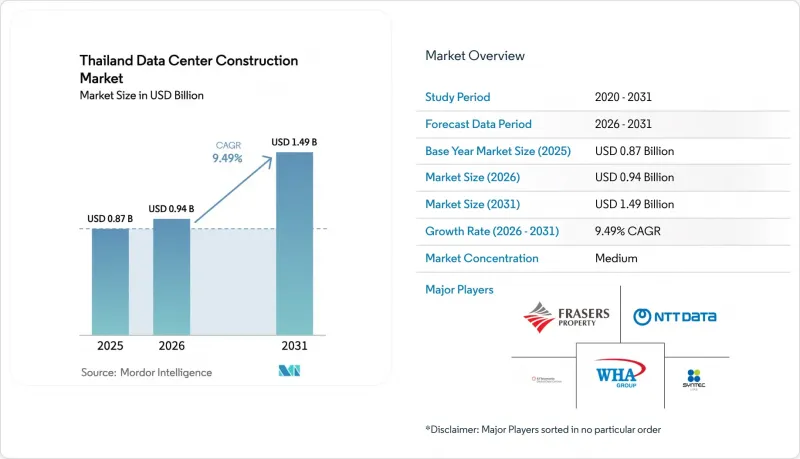
This report is Segmented by Tier Type (Tier 1 and 2, Tier 3, and Tier 4), Data Center Size (Small, Medium, Large, and Hyperscale), Data Center Type (Colocation Data Center, Hyperscalers/Cloud Service Provider, and Enterprise and Edge Data Center), and Infrastructure (Electrical Infrastructure, Mechanical Infrastructure, and More). The Market Forecasts are Provided in Terms of Value (USD).
Thailand Data Center Construction Market Trends and Insights
Intensified Cloud-Service Build-Outs by Hyperscalers
A multibillion-dollar wave of captive infrastructure is reshaping the Thailand data center construction market as Amazon Web Services, Google Cloud, and Microsoft Azure commit to local regions that must meet sovereign-cloud and renewable-energy mandates. The Board of Investment approved USD 2.7 billion in new data center projects in March 2025, including a 300 MW campus in Rayong by Beijing Haoyang, confirming the pull-through effect of hyperscaler anchor tenants. Chonburi and Rayong have emerged as core nodes thanks to land availability, proximity to submarine-cable landing sites, and direct power-purchase pilots that shave 10-15% off grid tariffs. Liquid-cooling adoption is quickening in tandem because hyperscalers favor 100 kW-per-rack densities for AI training. Competition for megawatt-scale sites is now spilling into secondary EEC plots as prime parcels sell out.
Government Incentives for Eastern Economic Corridor Digital Corridors
Fifteen-year tax holidays, duty-free imports of IT equipment, and streamlined land-ownership rights underpin the EEC policy package, removing much of the fiscal drag that historically pushed developers into neighboring Malaysia or Vietnam. Digital Park Thailand supplies dark fiber to submarine cable systems and enables qualifying data centers to procure up to 50 MW of renewable power at rates below commercial tariffs. The FastPass framework compresses permitting from eighteen to six months, a critical advantage for hyperscale builds that stage civil, electrical, and mechanical work concurrently. WHA Corporation disclosed land sales of 180 acres to a single data-center customer in 1Q 2025, underscoring sustained appetite for EEC plots. Collectively, these incentives add more than two percentage points to forecast CAGR.
Premium Electricity Tariffs versus Regional Peers
Commercial tariffs averaged THB 4.20 per kWh in 2025, roughly 15-20% higher than Malaysia or Vietnam, driving up total cost of ownership for GPU clusters that draw continuous high loads. EGAT's direct power-purchase pilot lets qualifying facilities lock in renewable energy at discounts, but the 2 GW program supports fewer than forty large sites, advantaging hyperscalers and leaving mid-tier colocation firms on standard rates. Developers are now exploring on-site solar-plus-battery systems to shave peak demand, though capex adds payback risk. Unless the 2024 Power Development Plan's 10 GW renewable expansion is accelerated, high tariffs may curb small-format builds.
Other drivers and restraints analyzed in the detailed report include:
- Growth in OTT Video Traffic and Edge-Node Demand
- Mandatory Data-Sovereignty Compliance (PDPA)
- Lengthy 115 kV Grid-Connection Approval Cycles
For complete list of drivers and restraints, kindly check the Table Of Contents.
Segment Analysis
Tier 3 installations controlled 56.43% of Thailand data center construction market in 2025, offering enterprises 99.982% service-level agreements without Tier 4's costlier fault tolerance. Hyperscalers, however, are driving a 10.32% CAGR in Tier 4 builds by insisting on N + N power and cooling to host AI training models at densities that breach 30 kW per rack. SUPERNAP Thailand's Tier IV Chonburi campus became one of Southeast Asia's only fault-tolerant sites in 2024, giving operators a blueprint for GPU-ready design. Liquid-cooling retrofits such as the 100 kW-per-rack system deployed by STT GDC in April 2025 further bolster Tier 4 economics by boosting power-usage effectiveness from 1.6 to 1.2.
Tier 1 and Tier 2 footprints, once popular with small enterprises, are declining as workloads consolidate into higher-tier colocation suites. Operators that cannot finance Tier 3 upgrades face acquisition or exit. The investment tilt toward Tier 4 elevates mechanical complexity, encouraging partnership with specialist engineering firms that can certify fault tolerance under Uptime Institute protocols. Over the forecast window, Tier 3 will still anchor the Thailand data center construction market size, but Tier 4 is set to outgrow every other tier as AI adoption accelerates.
Large-format facilities (10-50 MW) represented 54.54% of 2025 spending, yet the hyperscale segment, defined as campuses topping 50 MW, is moving at a 10.64% CAGR. Amazon Web Services and Google Cloud have each earmarked multiyear investments exceeding USD 1 billion for hyperscale regions, while Beijing Haoyang's 300 MW Rayong plan will dwarf existing Thai footprints once completed. The Thailand data center construction market size for hyperscale projects is set to overtake large-format colocation by 2029 if all announced capacity materializes. Modular construction and prefabricated power rooms from Schneider Electric let developers shave deployment cycles by 6 months, a competitive edge when anchor tenants require first-rack delivery within 24 months.
Medium-format (5-10 MW) facilities lag because enterprises either leapfrog directly into public cloud or consolidate workloads into shared 20 MW colocation halls. Small (sub-5 MW) sites now skew toward edge computing and disaster recovery, particularly in Chiang Mai and Phuket, where regional consumer bases justify local caching. Nonetheless, the Thailand data center construction market retains a place for micro-facilities tied to 5G towers and retail hubs, keeping supply chains diverse.
Complete Report Scope:
- By Tier Type
- Tier 1 and 2
- Tier 3
- Tier 4
- By Data Center Size
- Small
- Medium
- Large
- Hyperscale
- By Data Center Type
- Colocation Data Center
- Hyperscalers/Cloud Service Provider (CSPs)
- Enterprise and Edge Data Center
- By Infrastructure
- Electrical Infrastructure
- Power Distribution Solution
- Power Backup Solutions
- Mechanical Infrastructure
- Cooling Systems
- Racks and Cabinets
- Servers and Storage
- Other Mechanical Infrastructure
- General Construction
- Services - Design and Consulting, Integration, Support and Maintenance
- Electrical Infrastructure
List of Companies Covered in this Report:
- Aurecon Group Pty Ltd
- AECOM (Thailand) Ltd
- Princeton Digital Group
- Syntec Construction PCL
- Central Pattana PCL
- Thai Kajima Co., Ltd
- Thai Obayashi Corp. Ltd
- PPS Group PCL
- Frasers Property (Thailand) PCL
- WHA Corporation PCL
- STT GDC Thailand Co., Ltd
- NTT Global Data Centers (Thailand) Ltd
- True Internet Data Center Co., Ltd
- SUPERNAP (Thailand) Co., Ltd
- CAT Telecom PLC (National Telecom)
- GULF INNO Infrastructure Co., Ltd
- Huawei Technologies (Thailand) Co., Ltd
- Schneider Electric (Thailand) Ltd
- Delta Electronics (Thailand) PCL
Additional Benefits:
- The market estimate (ME) sheet in Excel format
- 3 months of analyst support
TABLE OF CONTENTS
1 INTRODUCTION
- 1.1 Study Assumptions and Market Definition
- 1.2 Scope of the Study
2 RESEARCH METHODOLOGY
3 EXECUTIVE SUMMARY
4 MARKET LANDSCAPE
- 4.1 Market Overview
- 4.2 Market Drivers
- 4.2.1 Intensified Cloud-Service Build-Outs by Hyperscalers
- 4.2.2 Government Incentives for Eastern Economic Corridor Digital Corridors
- 4.2.3 Growth in OTT Video Traffic and Edge-Node Demand
- 4.2.4 Accelerating Liquidity in REIT-Backed Data-Center Real-Estate
- 4.2.5 Mandatory Data-Sovereignty Compliance (PDPA)
- 4.2.6 Emerging Quantum-Ready Power and Cooling Standards
- 4.3 Market Restraints
- 4.3.1 Premium Electricity Tariffs versus Regional Peers
- 4.3.2 Lengthy 115 kV Grid-Connection Approval Cycles
- 4.3.3 Rising Land Prices in Metro Bangkok
- 4.3.4 Shortage of Uptime-Tier-Accredited Engineers
- 4.4 Industry Supply-Chain Analysis
- 4.5 Regulatory Landscape
- 4.6 Technological Outlook
- 4.7 Porter's Five Forces Analysis
- 4.7.1 Bargaining Power of Suppliers
- 4.7.2 Bargaining Power of Consumers
- 4.7.3 Threat of New Entrants
- 4.7.4 Threat of Substitutes
- 4.7.5 Intensity of Competitive Rivalry
- 4.8 Key Data Center Statistics
- 4.8.1 Exhaustive Data Center Operators in Thailand (in MW)
- 4.8.2 List of Major Upcoming Data Center Projects in Thailand (2025-2030)
- 4.8.3 CAPEX and OPEX For Thailand Data Center Construction
- 4.8.4 Data Center Power Capacity Absorption In MW, Thailand, 2023 and 2024
- 4.9 Artificial Intelligence (AI) Inclusion in Data Center Construction in Thailand
- 4.10 Regulatory and Compliance Framework
- 4.11 Impact of Macroeconomic Factors on the Market
5 MARKET SIZE AND GROWTH FORECASTS (VALUE)
- 5.1 By Tier Type
- 5.1.1 Tier 1 and 2
- 5.1.2 Tier 3
- 5.1.3 Tier 4
- 5.2 By Data Center Size
- 5.2.1 Small
- 5.2.2 Medium
- 5.2.3 Large
- 5.2.4 Hyperscale
- 5.3 By Data Center Type
- 5.3.1 Colocation Data Center
- 5.3.2 Hyperscalers/Cloud Service Provider (CSPs)
- 5.3.3 Enterprise and Edge Data Center
- 5.4 By Infrastructure
- 5.4.1 Electrical Infrastructure
- 5.4.1.1 Power Distribution Solution
- 5.4.1.2 Power Backup Solutions
- 5.4.2 Mechanical Infrastructure
- 5.4.2.1 Cooling Systems
- 5.4.2.2 Racks and Cabinets
- 5.4.2.3 Servers and Storage
- 5.4.2.4 Other Mechanical Infrastructure
- 5.4.3 General Construction
- 5.4.4 Services - Design and Consulting, Integration, Support and Maintenance
- 5.4.1 Electrical Infrastructure
6 COMPETITIVE LANDSCAPE
- 6.1 Market Concentration
- 6.2 Strategic Moves
- 6.3 Market Share Analysis
- 6.4 Data Center Infrastructure Investment Based on Megawatt (MW) Capacity, 2024 vs 2030
- 6.5 Data Center Construction Landscape (Key Vendors Listings)
- 6.6 Company Profiles (Includes Global Level Overview, Market Level Overview, Core Segments, Financials as Available, Strategic Information, Market Rank/Share, Products and Services, and Recent Developments)
- 6.6.1 Aurecon Group Pty Ltd
- 6.6.2 AECOM (Thailand) Ltd
- 6.6.3 Princeton Digital Group
- 6.6.4 Syntec Construction PCL
- 6.6.5 Central Pattana PCL
- 6.6.6 Thai Kajima Co., Ltd
- 6.6.7 Thai Obayashi Corp. Ltd
- 6.6.8 PPS Group PCL
- 6.6.9 Frasers Property (Thailand) PCL
- 6.6.10 WHA Corporation PCL
- 6.6.11 STT GDC Thailand Co., Ltd
- 6.6.12 NTT Global Data Centers (Thailand) Ltd
- 6.6.13 True Internet Data Center Co., Ltd
- 6.6.14 SUPERNAP (Thailand) Co., Ltd
- 6.6.15 CAT Telecom PLC (National Telecom)
- 6.6.16 GULF INNO Infrastructure Co., Ltd
- 6.6.17 Huawei Technologies (Thailand) Co., Ltd
- 6.6.18 Schneider Electric (Thailand) Ltd
- 6.6.19 Delta Electronics (Thailand) PCL
- 6.7 List of Data Center Construction Companies
7 MARKET OPPORTUNITIES AND FUTURE OUTLOOK
- 7.1 White-Space and Unmet-Need Assessment

