PUBLISHER: Mordor Intelligence | PRODUCT CODE: 2120849

PUBLISHER: Mordor Intelligence | PRODUCT CODE: 2120849
Singapore Real Estate - Market Share Analysis, Industry Trends & Statistics, Growth Forecasts (2026 - 2031)
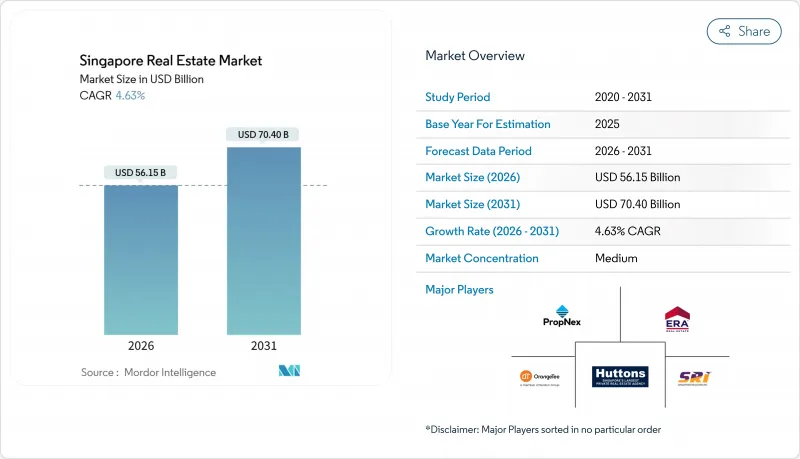
According to Mordor Intelligence, the Singapore real estate market size is USD 56.15 billion in 2026 and is projected to reach USD 70.4 billion by 2031, reflecting a 4.63% CAGR.
This report is Segmented by Property Type (Residential and Commercial), by Business Model (Sales and Rental), by End User (Individuals/Households, Corporates & SMEs and Others), and by Region (Core Central Region (CCR), Rest of Central Region (RCR) and Outside Central Region (OCR)). The Report Offers Market Size and Forecasts in Value (USD) for all the Above Segments.
Singapore Real Estate Market Trends and Insights
Government-Backed Urban Planning Spurring Long-Term Development
The Urban Redevelopment Authority's planning framework, including the transformation of the Greater Southern Waterfront, expands the supply of mixed-use and housing options over a multi-decade horizon in the Singapore Real Estate market. Port relocation and new precinct development create pathways to re-balance density and enhance liveability, with a clear sequence of transport, coastal protection, and community infrastructure investments. The pipeline around city-fringe sites and mature estates aligns new housing with transit nodes and social amenities, which supports price stability through broader access and reduces cross-island commuting. Government Land Sales continue to anchor investor expectations around bid discipline, location advantages, and integrated designs in the Singapore Real Estate market. Over time, these measures build a steady foundation for demand while reducing concentrations of obsolescent stock across the city.
Strategic Positioning as a Regional Business Hub Supporting Office, Co-working, and Mixed-Use Growth
Singapore's role as a regional headquarters location continues to reinforce CBD office fundamentals through steady leasing, low vacancy, and a flight to quality. Vacancy in Core CBD Grade A assets narrowed to 4.7% in the third quarter of 2025, which indicates demand resilience in the Singapore Real Estate market. Limited near-term completions in prime districts, combined with sustained professional services and finance hiring, continue to favor newer green-certified assets. Flexible workspace offerings complement this trend by providing turnkey options to occupiers that prefer short commitments while waiting for clearer macro signals in the Singapore Real Estate market. The Central Business District Incentive Scheme and Strategic Development Incentive Scheme, both overseen by the Urban Redevelopment Authority, encourage adaptive reuse of older buildings to mixed-use formats, which supports long-run grade improvement in the stock. Together, these dynamics reinforce a premium for centrally located, efficient, and sustainable projects in the Singapore Real Estate market.
Stringent Cooling Measures and Stamp Duties Tempering Speculative Residential Investment
Additional Buyer's Stamp Duty remains a key tool in shaping residential demand composition, with a 60% rate applied to foreign buyers since April 2023 in the Singapore Real Estate market. The Seller's Stamp Duty regime, extended to a four-year holding period in July 2025, further disincentivizes short-term flipping and supports more stable resale activity. Macroprudential measures like the Total Debt Servicing Ratio cap help ensure that borrowing remains prudent relative to income levels, which sustains financial stability for households. These frameworks preserve market integrity while reducing volatility in the Singapore Real Estate market. The result is a clearer emphasis on end-user needs and long-run value rather than speculative momentum.
Other drivers and restraints analyzed in the detailed report include:
- Booming E-Commerce and Advanced Manufacturing Driving Logistics and Industrial Real Estate Demand
- Sustained Demand in the Luxury and High-End Residential Segment from Global UHNWIs
- Limited Land Supply and High Land Acquisition Costs Constraining New Development
For complete list of drivers and restraints, kindly check the Table Of Contents.
Segment Analysis
Residential commanded a 54.1% share in 2025, underscoring its role as the largest revenue contributor in the Singapore Real Estate market. HDB resale transactions reached 28,986 in 2025, which indicates steady end-user movement and supports upgrader pathways over time. Commercial assets are the fastest-growing subsegment at a 5.44% CAGR through 2031, supported by low CBD vacancy and a continued flight to quality in the Singapore Real Estate market. Core CBD Grade A vacancy tightened to 4.7% in the third quarter of 2025, which reinforces landlord pricing power at the top end. Industrial and logistics benefit from port automation and pre-commitments in advanced manufacturing, which support sustained absorption and balanced rental growth.
Within Residential, non-landed homes remain the most liquid format for upgraders and new entrants, while landed segments are structurally supply-constrained. In Commercial, office dominates the subsegment revenue, followed by retail and logistics, although logistics has the strongest cyclical tailwind as e-commerce share stabilizes at higher levels. Retail portfolios in suburban catchments benefit from near-full occupancy and healthy rental reversion, reflecting resilient household spending patterns tied to essential services. Data center exposure within industrial portfolios continues to expand, as illustrated by acquisitions of high-spec assets that are fully leased to digital and financial services tenants in the Singapore Real Estate market. Green certification, energy efficiency, and embedded smart systems are increasingly central to asset differentiation across all property types in the Singapore Real Estate industry.
Complete Report Scope:
- Sales
- Rental
List of Companies Covered in this Report:
- PropNex Realty Pte Ltd
- ERA Realty Network Pte Ltd
- Huttons Asia Pte Ltd
- OrangeTee & Tie Pte Ltd
- SRI Pte Ltd
- City Developments Limited (CDL)
- CapitaLand Development (Singapore)
- Frasers Property Singapore
- UOL Group Limited
- GuocoLand Singapore
- Far East Organization
- Keppel Land
- Mapletree Investments
- Allgreen Properties
- MCL Land
- Hongkong Land (Singapore)
- Ho Bee Land
- Bukit Sembawang Estates
- Wing Tai Holdings
- Sim Lian Group
- EL Development
- MCC Land (Singapore)
- Qingjian Realty (South Pacific)
- CapitaLand Integrated Commercial Trust (CICT)
- Ascendas Real Estate Investment Trust (Ascendas REIT)
- Mapletree Logistics Trust (MLT)
- Keppel DC REIT
- Frasers Centrepoint Trust (FCT)
- Lendlease Global Commercial REIT
Additional Benefits:
- The market estimate (ME) sheet in Excel format
- 3 months of analyst support
TABLE OF CONTENTS
1 Introduction
- 1.1 Study Assumptions & Market Definition
- 1.2 Scope of the Study
2 Research Methodology
3 Executive Summary
4 Market Landscape
5 Market Insights and Dynamics
- 5.1 Overview of the Economy and Market
- 5.2 Real Estate Buying Trends - Socioeconomic and Demographic Insights
- 5.3 Rental Yield Analysis
- 5.4 Capital-Market Penetration & REIT
- 5.5 Regulatory Outlook
- 5.6 Technological Outlook
- 5.7 Insights into Real Estate Tech and Startups Active in the Real Estate Segment
- 5.8 Insights into Existing and Upcoming Projects
- 5.9 Market Drivers
- 5.9.1 Robust foreign investor interest driven by political stability and strong legal frameworks
- 5.9.2 Government-backed urban planning (e.g., Master Plan, Greater Southern Waterfront) spurring long-term development
- 5.9.3 Sustained demand in the luxury and high-end residential segment from global UHNWIs
- 5.9.4 Strategic positioning as a regional business hub supporting office, co-working, and mixed-use growth
- 5.9.5 Booming e-commerce and advanced manufacturing driving logistics and industrial real estate demand
- 5.9.6 Rising adoption of smart and sustainable building technologies encouraged by government incentives
- 5.10 Market Restraints
- 5.10.1 Stringent cooling measures and stamp duties tempering speculative residential investment
- 5.10.2 Limited land supply and high land acquisition costs constraining new development
- 5.10.3 Geopolitical and economic headwinds impacting foreign capital flow and tenant demand
- 5.10.4 Supply-demand imbalances in select asset classes (e.g., oversupply in suburban retail or fringe office locations)
- 5.11 Value/Supply-Chain Analysis
- 5.11.1 Overview
- 5.11.2 Real estate developers & Contractors - key quantitative and qualitative insights
- 5.11.3 Real estate brokers and agents - key quantitative and qualitative insights
- 5.11.4 Property management companies - key quantitative and qualitative insights
- 5.11.5 Insights on Valuation Advisory and Other Real Estate Services
- 5.11.6 State of the building materials industry and partnerships with key developers
- 5.11.7 Insights on key strategic real estate investors/buyers in the market
- 5.12 Porter's Five Forces
- 5.12.1 Bargaining Power of Suppliers
- 5.12.2 Bargaining Power of Buyers
- 5.12.3 Threat of New Entrants
- 5.12.4 Threat of Substitutes
- 5.12.5 Intensity of Competitive Rivalry
6 Market Size & Growth Forecasts (Value,USD billion)
- 6.1 Sales
- 6.2 Rental
7 Sales Model Market Size & Growth Forecasts (Value,USD billion)
- 7.1 By Property Type
- 7.1.1 Residential
- 7.1.1.1 Apartments & Condominiums
- 7.1.1.1.1 Villas & Landed Houses
- 7.1.1.2 Commercial
- 7.1.1.2.1 Office
- 7.1.1.2.2 Retail
- 7.1.1.2.3 Logistics
- 7.1.1.2.4 Others (industrial real estate, hospitality real estate, etc.)
- 7.1.1.1 Apartments & Condominiums
- 7.1.2 By End-user
- 7.1.2.1 Individuals / Households
- 7.1.2.2 Corporates & SMEs
- 7.1.2.3 Others
- 7.1.3 By Region
- 7.1.3.1 Core Central Region (CCR)
- 7.1.3.2 Rest of Central Region (RCR)
- 7.1.3.3 Outside Central Region (OCR)
- 7.1.1 Residential
8 Competitive Landscape
- 8.1 Market Concentration
- 8.2 Strategic Moves
- 8.3 Market Share Analysis
- 8.4 Company Profiles {(includes Global level Overview, Market level overview, Core Segments, Financials as available, Strategic Information, Market Rank/Share for key companies, Products & Services, and Recent Developments)}
- 8.4.1 PropNex Realty Pte Ltd
- 8.4.2 ERA Realty Network Pte Ltd
- 8.4.3 Huttons Asia Pte Ltd
- 8.4.4 OrangeTee & Tie Pte Ltd
- 8.4.5 SRI Pte Ltd
- 8.4.6 City Developments Limited (CDL)
- 8.4.7 CapitaLand Development (Singapore)
- 8.4.8 Frasers Property Singapore
- 8.4.9 UOL Group Limited
- 8.4.10 GuocoLand Singapore
- 8.4.11 Far East Organization
- 8.4.12 Keppel Land
- 8.4.13 Mapletree Investments
- 8.4.14 Allgreen Properties
- 8.4.15 MCL Land
- 8.4.16 Hongkong Land (Singapore)
- 8.4.17 Ho Bee Land
- 8.4.18 Bukit Sembawang Estates
- 8.4.19 Wing Tai Holdings
- 8.4.20 Sim Lian Group
- 8.4.21 EL Development
- 8.4.22 MCC Land (Singapore)
- 8.4.23 Qingjian Realty (South Pacific)
- 8.4.24 CapitaLand Integrated Commercial Trust (CICT)
- 8.4.25 Ascendas Real Estate Investment Trust (Ascendas REIT)
- 8.4.26 Mapletree Logistics Trust (MLT)
- 8.4.27 Keppel DC REIT
- 8.4.28 Frasers Centrepoint Trust (FCT)
- 8.4.29 Lendlease Global Commercial REIT
9 Market Opportunities & Future Outlook
- 9.1 White-space & unmet-need assessment

