PUBLISHER: Mordor Intelligence | PRODUCT CODE: 2123043

PUBLISHER: Mordor Intelligence | PRODUCT CODE: 2123043
France Packaging - Market Share Analysis, Industry Trends & Statistics, Growth Forecasts (2026 - 2031)
According to Mordor Intelligence, the France packaging market size is USD 32.88 billion in 2026 and it is projected to reach USD 39.46 billion by 2031, reflecting a 3.72% CAGR during the forecast period.
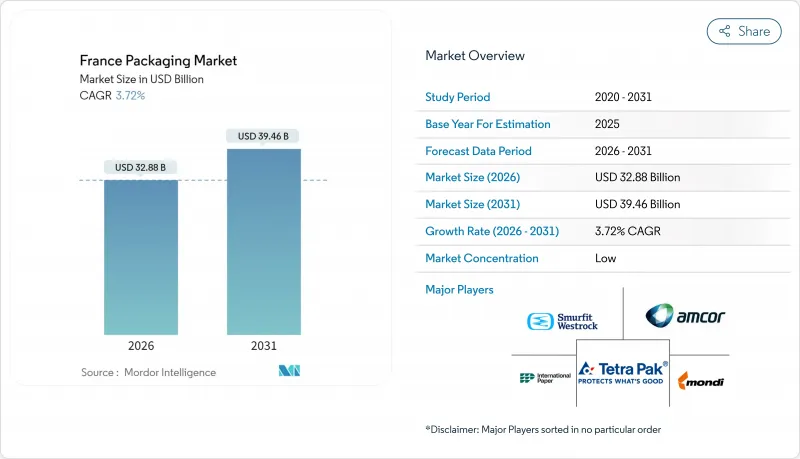
This report is Segmented by Material Type (Paper and Paperboard, Plastic, Metal, and Container Glass), Packaging Format (Flexible, and Rigid), Product Type (Paper and Paperboard Product Type, Plastic Product Type, Metal Product Type, and Container Glass Product Type), End-User (Food, Beverage, Pharmaceuticals and Medical, Automotive, and More). The Market Forecasts are Provided in Terms of Value (USD).
France Packaging Market Trends and Insights
Rising Demand For Sustainable And Recyclable Packaging
Brand owners across dairy, personal care, and beverage categories are prioritizing recycled content and bio-based polymers to avoid surcharges on non-recyclable formats. Carrefour's Loop network, active in 345 stores, targets removal of 15,000 tonnes of virgin plastic by 2030, pushing converters to design containers that tolerate 20-50 refill cycles without barrier loss. Polylactic acid capacity is projected to help lift global bioplastics output from 2.47 million tonnes in 2024 to 5.73 million tonnes in 2029, with 45% earmarked for packaging. Cost premiums and modest heat resistance confine polylactic acid to cold-fill and ambient goods, so hot-fill lines still rely on polyethylene terephthalate and polypropylene. EU recycled-content mandates tighten each review period, forcing even small converters to switch to mono-material structures. Early supply deals for bio-based resin therefore deliver strategic security in the France packaging market.
Growth of E-Commerce And Parcel Logistics
E-commerce accounted for 13% of French retail sales in 2025, generating more than 1 billion parcels that require corrugated outers, void fill, and tamper-evident tape. Each shipment endures extra handling, so packaging intensity per transaction exceeds in-store requirements by up to 60%. Kraft-liner mills still pay EUR 150-180 per megawatt-hour for power, about double the pre-2021 norm, lifting box costs. Integrated producers such as Smurfit WestRock leverage captive recycled-fiber loops to buffer volatility. Parcel carriers now specify lighter boxes, prompting converters to adopt micro-flute and high-performance adhesives that retain stacking strength at lower basis weight.
Stringent Single-Use Plastic Bans And EPR Fees
France's AGEC law prohibits polystyrene trays, single-use cutlery, and colored polyethylene terephthalate bottles, while the EU Packaging and Packaging Waste Regulation enforces minimum recycled-content thresholds and harmonized EPR fees. Eco-modulation penalties add up to 30% on non-recyclable formats, shrinking margins for converters that serve fresh produce and snack brands. Verallia saw Q3 2024 revenue fall 6.8% organically as beverage customers lightweighted bottles or shifted to aluminum cans to avoid glass surcharges. SMEs without R&D budgets struggle to reformulate adhesives and coatings quickly, fueling consolidation. Compliance spending crowds out growth capital, delaying new-line investments across the France packaging market.
Other drivers and restraints analyzed in the detailed report include:
- Robust Food And Beverage Production Base
- Government-Led Funding For Smart Packaging R&D
- Volatile Raw-Material And Energy Prices
For complete list of drivers and restraints, kindly check the Table Of Contents.
Segment Analysis
Plastic maintained a 52.54% share of the France packaging market in 2025, owing to versatile polyethylene, polypropylene, and PET containers across dairy, sauces, and personal-care SKUs. Paper and paperboard, however, are set to outpace all materials with a 4.32% CAGR through 2031 as e-commerce corrugated boxes, folding cartons, and molded-pulp trays unlock eco-modulation discounts. Container glass remains entrenched in the wine and premium beverage markets, but the lightweighting of bottles reduces tonnage demand. Metal cans continue to serve hermetic or retort categories, offering infinite recyclability messaging.
Cost visibility in kraft liner production remains challenging due to fiber scarcity and elevated energy tariffs; however, integrated mill-converter players can offset input swings through captive recyclate loops. PET dominates beverage packaging due to its clarity and ready food-contact approvals, and its mono-material thermoforms now qualify for higher EPR discounts. High-density polyethylene and low-density polyethylene retain a significant share of the detergent market and are used to produce films, while polypropylene excels in closures and microwaveable containers. In contrast, PVC and polystyrene experience demand declines under AGEC restrictions and risks to consumer perception.
Flexible formats captured 56.86% of the France packaging market in 2025 and are projected to grow at a 4.75% CAGR through 2031, driven by stand-up pouches, multi-layer films, and e-commerce mailers that achieve up to 50% material savings compared to their rigid counterparts. Rigid solutions, although heavier, remain indispensable for carbonated beverages, pharmaceuticals, and premium cosmetics that need drop resistance and shelf impact. Lightweighting in flexible substrates now leverages high-barrier polyethylene or polypropylene blends that pass new recyclability tests, enabling converters to avoid EPR penalties.
Digital watermarking trials achieved 88-94% detection accuracy, paving the way for flexible mono-material sortation at scale. Rigid bottles are increasingly paired with refill pouches in Carrefour's Loop, reducing net virgin plastic use by up to 70%. E-commerce brands demand bubble mailers and air pillows that trim dimensional weight, which favors converters with in-line extrusion and pouch-forming capabilities. While rigid glass and metal keep a share in flavor-critical or regulatory niches, the relative cost advantage of flexible laminates secures their expansion.
Complete Report Scope:
- By Material Type
- Paper and Paperboard
- Plastic
- Polyethylene Polypropylene (PP)
- High-density Polyethylene (HDPE) and Low-density Polyethylene (LDPE)
- Polyethylene Terephthalate (PET)
- Polyvinyl Chloride (PVC)
- Polystyrene (PS)
- Other Plastics
- Metal
- Container Glass
- By Product Type
- Paper and Paperboard Product Type
- Folding Carton and Rigid Boxes
- Corrugated Boxes and Containers
- Single-use Paper Products
- Other Paper and Paperboard Product Types
- Plastic Product Type
- Rigid Plastics
- Bottles and Jars
- Caps and Closures
- Bulk-Grade Products
- Other Rigid Plastics Product Types
- Flexible Plastics
- Pouches
- Bags
- Films and Wraps
- Other Flexible Plastics Product Types
- Rigid Plastics
- Metal Product Type
- Cans
- Aerosol Containers
- Caps and Closures
- Other Metal Product Types
- Container Glass Product Type
- Bottles
- Jars
- Paper and Paperboard Product Type
- By Packaging Format
- Rigid Packaging Format
- Flexible Packaging Format
- By End-user
- Food
- Beverage
- Pharmaceuticals and Medical
- Personal Care and Cosmetics
- Industrial and Chemical
- Agriculture
- Automotive
- Other End-users
List of Companies Covered in this Report:
- Amcor plc
- Smurfit WestRock
- Tetra Pak International SA
- Ball Corporation
- Mondi plc
- Crown Holdings Inc.
- Owens-Illinois Inc.
- Ardagh Group S.A.
- Constantia Flexibles GmbH
- Verallia SA
- Groupe Guillin SA
- Albea Services SAS
- Sealed Air Corporation
- Huhtamaki Oyj
- ALPLA Werke Alwin Lehner GmbH
- Plastipak Holdings Inc.
- Sleever International
- AR Packaging (Graphic Packaging Intl.)
- Ahlstrom-Munksjo Oyj
- International Paper Company
Additional Benefits:
- The market estimate (ME) sheet in Excel format
- 3 months of analyst support
TABLE OF CONTENTS
1 INTRODUCTION
- 1.1 Study Assumptions and Market Definition
- 1.2 Scope of the Study
2 RESEARCH METHODOLOGY
3 EXECUTIVE SUMMARY
4 MARKET LANDSCAPE
- 4.1 Market Overview
- 4.2 Market Drivers
- 4.2.1 Rising Demand for Sustainable and Recyclable Packaging
- 4.2.2 Growth of E-commerce and Parcel Logistics
- 4.2.3 Robust Food and Beverage Production Base
- 4.2.4 Government-Led Funding for Smart Packaging R&D
- 4.2.5 Expansion of Refill and Bulk Retail Stations
- 4.2.6 Digital Watermarking Roll-out for Advanced Recycling
- 4.3 Market Restraints
- 4.3.1 Stringent Single-Use Plastic Bans and EPR Fees
- 4.3.2 Volatile Raw-Material and Energy Prices
- 4.3.3 Recycling Feedstock Bottlenecks (rPET, rHDPE)
- 4.3.4 Packaging-Engineering Talent Shortage
- 4.4 Impact of Macroeconomic Factors on the Market
- 4.5 Industry Value Chain Analysis
- 4.6 Regulatory Landscape
- 4.7 Technological Outlook
- 4.8 Porter's Five Forces Analysis
- 4.8.1 Bargaining Power of Suppliers
- 4.8.2 Bargaining Power of Buyers
- 4.8.3 Threat of New Entrants
- 4.8.4 Threat of Substitutes
- 4.8.5 Intensity of Competitive Rivalry
- 4.9 Investment Analysis
5 MARKET SIZE AND GROWTH FORECASTS (VALUE)
- 5.1 By Material Type
- 5.1.1 Paper and Paperboard
- 5.1.2 Plastic
- 5.1.2.1 Polyethylene Polypropylene (PP)
- 5.1.2.2 High-density Polyethylene (HDPE) and Low-density Polyethylene (LDPE)
- 5.1.2.3 Polyethylene Terephthalate (PET)
- 5.1.2.4 Polyvinyl Chloride (PVC)
- 5.1.2.5 Polystyrene (PS)
- 5.1.2.6 Other Plastics
- 5.1.3 Metal
- 5.1.4 Container Glass
- 5.2 By Product Type
- 5.2.1 Paper and Paperboard Product Type
- 5.2.1.1 Folding Carton and Rigid Boxes
- 5.2.1.2 Corrugated Boxes and Containers
- 5.2.1.3 Single-use Paper Products
- 5.2.1.4 Other Paper and Paperboard Product Types
- 5.2.2 Plastic Product Type
- 5.2.2.1 Rigid Plastics
- 5.2.2.1.1 Bottles and Jars
- 5.2.2.1.2 Caps and Closures
- 5.2.2.1.3 Bulk-Grade Products
- 5.2.2.1.4 Other Rigid Plastics Product Types
- 5.2.2.2 Flexible Plastics
- 5.2.2.2.1 Pouches
- 5.2.2.2.2 Bags
- 5.2.2.2.3 Films and Wraps
- 5.2.2.2.4 Other Flexible Plastics Product Types
- 5.2.2.1 Rigid Plastics
- 5.2.3 Metal Product Type
- 5.2.3.1 Cans
- 5.2.3.2 Aerosol Containers
- 5.2.3.3 Caps and Closures
- 5.2.3.4 Other Metal Product Types
- 5.2.4 Container Glass Product Type
- 5.2.4.1 Bottles
- 5.2.4.2 Jars
- 5.2.1 Paper and Paperboard Product Type
- 5.3 By Packaging Format
- 5.3.1 Rigid Packaging Format
- 5.3.2 Flexible Packaging Format
- 5.4 By End-user
- 5.4.1 Food
- 5.4.2 Beverage
- 5.4.3 Pharmaceuticals and Medical
- 5.4.4 Personal Care and Cosmetics
- 5.4.5 Industrial and Chemical
- 5.4.6 Agriculture
- 5.4.7 Automotive
- 5.4.8 Other End-users
6 COMPETITIVE LANDSCAPE
- 6.1 Market Concentration
- 6.2 Strategic Moves
- 6.3 Market Share Analysis
- 6.4 Company Profiles (includes Global Level Overview, Market Level Overview, Core Segments, Financials as available, Strategic Information, Market Rank/Share for key companies, Products and Services, and Recent Developments)
- 6.4.1 Amcor plc
- 6.4.2 Smurfit WestRock
- 6.4.3 Tetra Pak International SA
- 6.4.4 Ball Corporation
- 6.4.5 Mondi plc
- 6.4.6 Crown Holdings Inc.
- 6.4.7 Owens-Illinois Inc.
- 6.4.8 Ardagh Group S.A.
- 6.4.9 Constantia Flexibles GmbH
- 6.4.10 Verallia SA
- 6.4.11 Groupe Guillin SA
- 6.4.12 Albea Services SAS
- 6.4.13 Sealed Air Corporation
- 6.4.14 Huhtamaki Oyj
- 6.4.15 ALPLA Werke Alwin Lehner GmbH
- 6.4.16 Plastipak Holdings Inc.
- 6.4.17 Sleever International
- 6.4.18 AR Packaging (Graphic Packaging Intl.)
- 6.4.19 Ahlstrom-Munksjo Oyj
- 6.4.20 International Paper Company
7 MARKET OPPORTUNITIES AND FUTURE OUTLOOK
- 7.1 White-Space and Unmet-Need Assessment

